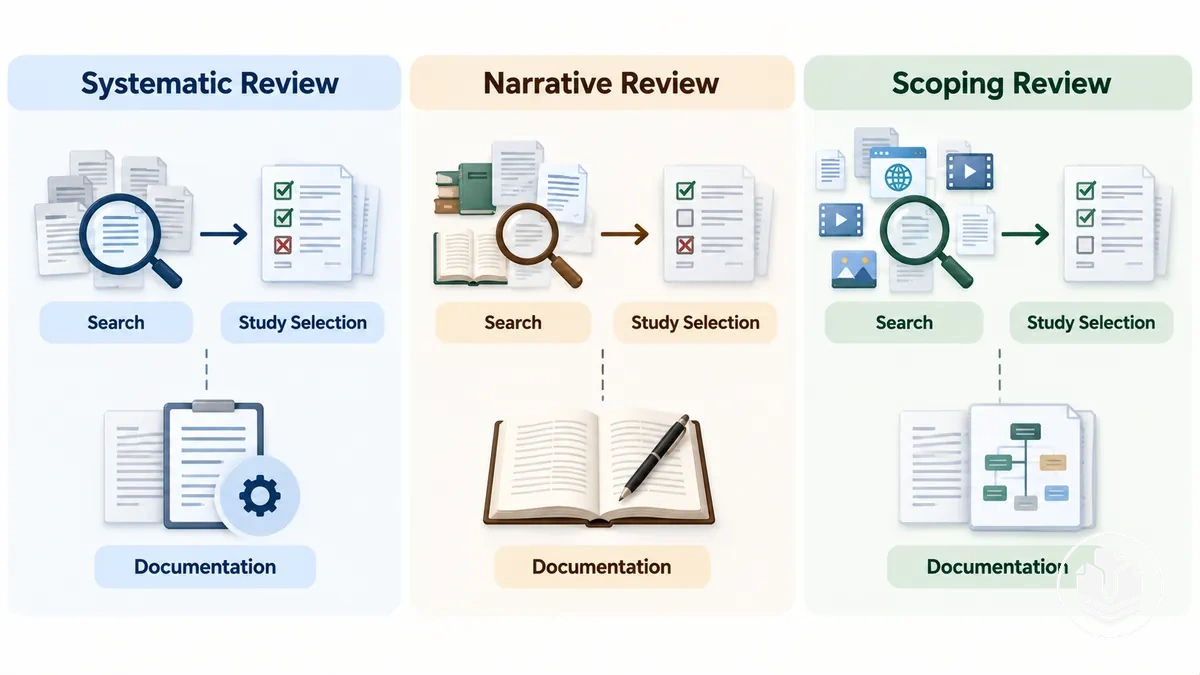
Systematic, Narrative, and Scoping Reviews: Key Methodological Differences
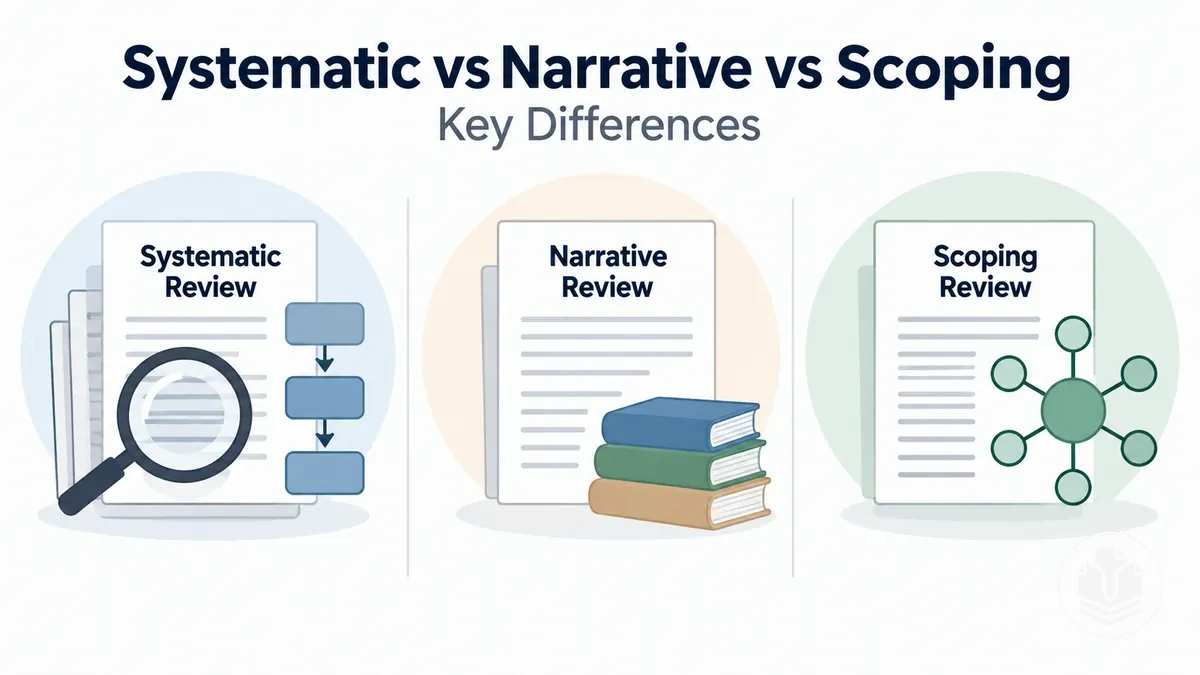
Choose the review type by the output you need: a systematic review answers a focused question with explicit, prespecified evidence-handling methods; a narrative review interprets and integrates a broader body of literature; and a scoping review maps the extent, characteristics, concepts, evidence types, or gaps in a broad evidence field. A systematic review does not automatically mean meta-analysis, and a scoping review is not a simplified systematic review—the question, evidence boundary, and intended inference determine methodological fit.
Compare systematic, narrative, and scoping reviews by purpose and output
Start with the intended review output, then check question breadth, evidence handling, appraisal, and the inference the method can support.
Systematic review
Purpose
Answer a defined, focused question.
Question scope
Bounded by explicit objectives and eligibility criteria.
Search & selection
Comprehensive within scope, explicitly documented, and based on prespecified eligibility.
Appraisal
Formal critical appraisal or risk-of-bias assessment is commonly used when evidence quality affects the conclusion.
Typical output
A structured synthesis tied to the defined question; meta-analysis is used only when appropriate.
Narrative review
Purpose
Interpret and integrate a broader literature.
Question scope
Broad or conceptual, often organised around themes, debates, theory, or development over time.
Search & selection
Can be more flexible; the selection logic and literature considered should be reported transparently.
Appraisal
May assess evidence quality, but procedures vary with the review purpose and approach.
Typical output
An interpretive account explaining concepts, themes, relationships, perspectives, or developments.
Scoping review
Purpose
Map what evidence exists and how it is distributed.
Question scope
Broad, with defined boundaries that can accommodate heterogeneous evidence.
Search & selection
Broad and systematic enough to map the field, with explicit eligibility and traceable selection.
Appraisal
Optional and purpose-dependent; critical appraisal is not the defining function of a scoping review.
Typical output
An evidence map or categorisation of concepts, evidence types, characteristics, and research gaps.
Key distinctions
Systematic review ≠ meta-analysis: meta-analysis is one possible statistical synthesis method.
Narrative review ≠ narrative synthesis: one is a review approach; the other is a synthesis method.
Scoping review ≠ “easier” systematic review: its central function is usually evidence mapping, not a reduced version of the same focused question.
There is no universal quality hierarchy among these three approaches. Methodological rigour depends on whether the methods, transparency, and inference are fit for the review’s stated purpose.
The sections below compare purpose and question scope first, then search and selection, methodological rigour, synthesis outputs, and the conditions that make each review approach suitable.
Table of Contents⌄
How Purpose and Research Question Scope Differ
Review purpose shapes how narrow or broad a research question needs to be.
A systematic review typically narrows the research question to support focused answer-seeking, a narrative review can frame a broader question for interpretive synthesis, and a scoping review commonly uses a broad question for evidence mapping.
The comparison below aligns each review type with its typical purpose, research question scope, and main implication.
These patterns are methodological tendencies rather than fixed rules because the review objective and discipline can further shape question breadth.
Review Type
Typical Purpose
Typical Question Scope
Main Implication
Systematic review
Answer a defined question using explicit methods
Focused question with a bounded objective
The scope identifies a more specifically defined body of potentially relevant evidence
Narrative review
Interpret or conceptually synthesise a topic
Broader question or topic that permits interpretive exploration
The scope can accommodate relationships, perspectives, and concepts across a wider body of literature
Scoping review
Map the extent, characteristics, evidence types, or gaps in a field
Broad question suited to evidence mapping
The scope supports examination of how evidence is distributed across a wider field
For example, the same broad topic could support a systematic review asking whether a defined intervention affects a specified outcome in a specified population, a narrative review interpreting how the topic has been conceptualised across the literature, or a scoping review asking what evidence and research gaps exist across the topic.
This three-way comparison does not catalogue all literature review types; it isolates how purpose changes question breadth for these three approaches.
Research question breadth also establishes practical review scope boundaries by indicating which concepts, populations, contexts, or forms of evidence are relevant to the review objective.
A more focused question therefore creates more bounded search and selection demands, while a broader question generally requires search and selection decisions capable of representing a wider evidence field.
Systematic Reviews: Focused Questions and Specific Objectives
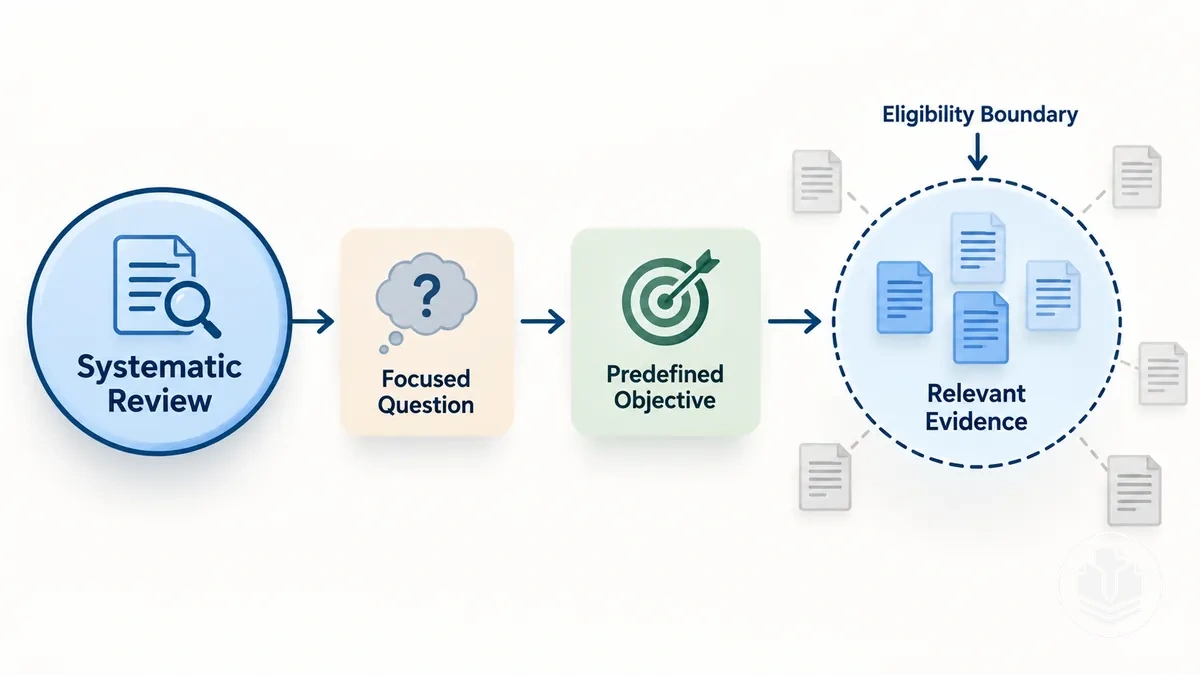
A systematic review usually begins with a clearly specified focused question and predefined objectives that define what evidence the review is intended to address.
University College London Library Services notes that systematic reviews should answer a specific, well-defined research question rather than explore a broad topic, with explicit eligibility criteria determining which studies adequately address that question.
The focused question specifies the concepts or other relevant elements that matter to the review, while the predefined objectives align those elements with the intended evidence.
Eligibility criteria then translate that scope into inclusion and exclusion boundaries, so evidence that addresses the specified question can be distinguished from evidence outside it.
Question frameworks vary by discipline and review objective. For intervention or effectiveness questions, PICO (Population, Intervention, Comparator, Outcome) is a common way to operationalise a systematic-review question; other question types use frameworks suited to their concepts and evidence. A systematic review does not inherently require a clinical question or meta-analysis.
This relationship makes the evidence boundary explicit and connects question specificity with the evidence sought.
For example, a systematic review might define a population or concept, a relevant comparison or context, and an outcome where appropriate, then use those elements to establish which evidence falls within scope.
The focused question and predefined objectives therefore constrain what evidence is relevant for inclusion.
Narrative Reviews: Broad Topics and Interpretive Purpose
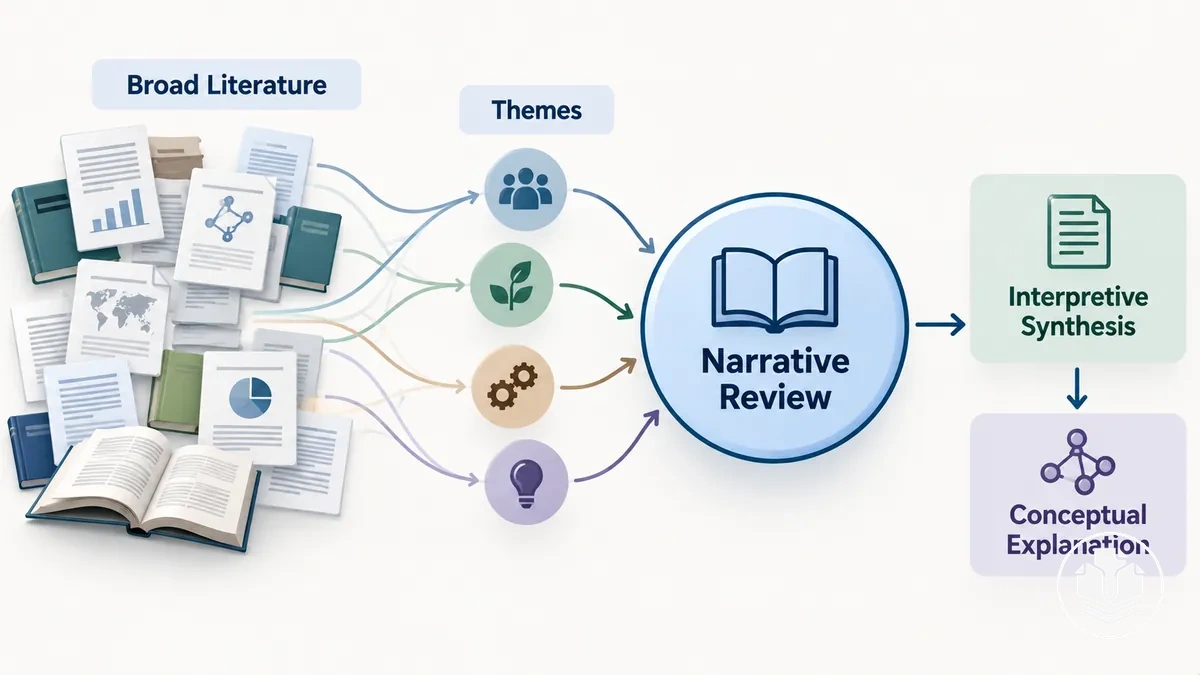
A narrative review commonly addresses a broad topic by integrating and interpreting literature to provide conceptual explanation of themes, debates, developments, or an established body of knowledge.
In the Journal of Graduate Medical Education, Javeed Sukhera describes narrative reviews as a form of knowledge synthesis that can include varied studies and provide an overall account through interpretation and critique.
Broader topical framing allows a narrative review to draw on literature that serves its interpretive objective, while source selection and emphasis may vary with the review question, disciplinary context, and chosen approach.
Author judgement therefore influences how concepts, perspectives, and relationships are connected through interpretive synthesis.
Scoping Reviews: Broad Questions and Evidence Mapping
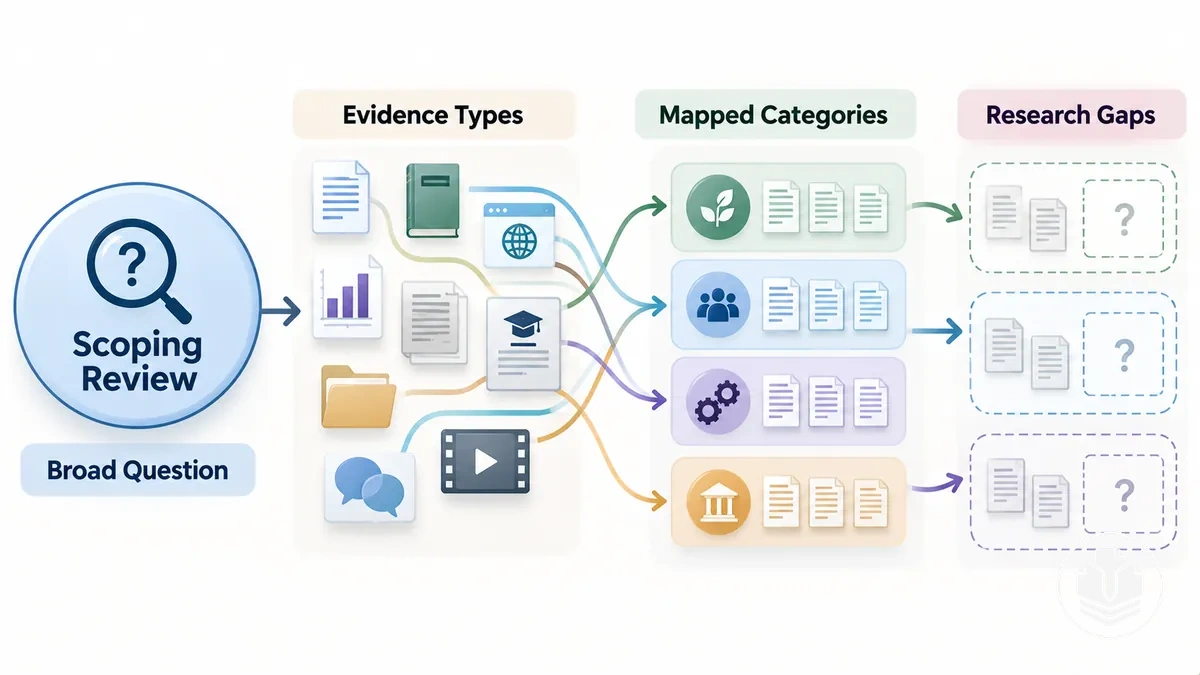
A scoping review typically uses a broad question to map the extent, characteristics, concepts, evidence types, or research gaps within a field.
Its evidence-mapping objective is to characterise what evidence exists and how it is distributed across the defined scope rather than answer a narrowly bounded effect or intervention question. PCC (Population, Concept, Context) is one common framework for structuring a scoping-review question, while the exact framing should still follow the review objective and field.
Scoping reviews can organise heterogeneous evidence into categories or themes so that the breadth and characteristics of the evidence field become visible.
Campbell and colleagues describe scoping reviews as systematic approaches for identifying and mapping available evidence, while University of Toledo Libraries notes that their broader aims and inclusive criteria can accommodate a wider range of study designs.
This mapping can clarify concepts, categorise different evidence types, and identify areas where evidence is concentrated or where research gaps remain.
A scoping review may include qualitative, quantitative, or mixed evidence when those sources fit its mapping objective; critical appraisal may also be included when appropriate to the review objective and methodological guidance.
These attributes support evidence characterisation rather than a narrowly pooled effect estimate.
How Search and Study Selection Methods Differ
Search strategy and study selection differ across systematic, narrative, and scoping reviews because each approach uses different degrees of comprehensiveness, prespecification, documentation, and reproducibility.
Searching concerns how potentially relevant evidence is found or retrieved, whereas study selection concerns how located sources are screened against eligibility criteria for inclusion or exclusion.
The comparison below aligns the three review types on the same criteria: search breadth, search documentation, eligibility and selection, and reproducibility expectations.
A systematic review generally uses a comprehensive, explicitly documented search strategy designed around a defined question, while a scoping review typically searches broadly enough to map relevant evidence across its defined scope.
A narrative review can use more variable search practices, with the breadth and documentation shaped by its interpretive purpose and stated method.
Database coverage, grey-literature searching, citation searching, and other retrieval practices can differ by discipline and protocol.
Review Type
Search Breadth
Search Documentation
Eligibility and Selection
Reproducibility Expectation
Systematic review
Comprehensive within the defined question and protocol
Explicit strategy and sources are documented
Prespecified eligibility criteria guide screening and inclusion
Methods are reported in sufficient detail to support reproducibility
Narrative review
Variable and shaped by the interpretive purpose
Documentation can range from limited to explicitly described
Source selection may rely more heavily on author judgement within the stated scope
Depends on how explicitly search and selection methods are reported
Scoping review
Broad coverage aligned with the evidence-mapping objective
Search methods and sources are typically documented
Eligibility criteria guide screening across potentially heterogeneous evidence
Transparent reporting supports reproducibility of the mapping process
Eligibility criteria make inclusion and exclusion decisions explicit, but the degree of prespecification and the screening process differ by review objective, discipline, and protocol.
Systematic and scoping reviews commonly make these decisions more explicit and traceable, whereas narrative reviews can allow greater author judgement in source selection.
Transparency therefore depends on how clearly each review reports its criteria and selection decisions.
This comparison identifies differences in evidence retrieval and study selection without prescribing how to construct individual database searches.
Designing a complete search strategy for the review requires separate decisions about sources, terminology, search logic, documentation, and procedures appropriate to the review question and protocol.
Search Breadth and Evidence Coverage
Search breadth should be judged against the review's purpose and the relevant evidence it needs to retrieve, not by source count alone.
Adequate evidence coverage therefore depends on whether the search is sufficiently comprehensive and transparent for the claims the review intends to make.
A systematic review generally requires comprehensive retrieval aligned with its focused question so that its conclusions are based on an appropriately identified body of relevant evidence.
A scoping review typically uses broad search coverage to map evidence across concepts, evidence types, or heterogeneous sources within its scope.
A narrative review can use more variable searching and source selection, so the breadth of its claims should remain consistent with the evidence coverage and transparency of the approach used.
Comprehensiveness: assess whether the search breadth is sufficient to identify relevant evidence for the review's stated purpose rather than whether it reaches an arbitrary source count.
Source coverage: assess whether the sources searched are appropriate to the question, field, and evidence types sought, because broader source coverage is useful only when it increases access to relevant evidence.
Reproducibility: assess whether the search sources and methods are documented clearly enough for readers to understand and, where the review method requires it, reproduce the evidence retrieval process.
No fixed database minimum or universal threshold defines adequate search breadth across review types; suitable database and source coverage varies with the discipline, question, protocol, and available evidence.
The resulting evidence coverage constrains the confidence and breadth of claims that a systematic review, scoping review, or narrative review can responsibly support.
Eligibility Criteria and Study Selection
Eligibility criteria are the rules that determine which located evidence is included or excluded from a review.
They define the boundary for study selection, while quality appraisal is a separate operation that evaluates evidence rather than determining eligibility by the same criterion.
How formal those rules are can differ by review approach.
Systematic reviews commonly use prespecified inclusion criteria and exclusion criteria so screening decisions can be applied with consistency and documented transparently; scoping reviews also use explicit eligibility rules, but those rules may be broader when the purpose is to map a wider evidence field.
Narrative reviews can use more flexible source selection shaped by the review's interpretive purpose, which makes clear reporting of author judgement and selection logic important for transparency and interpretability.
Prespecification: defining eligibility criteria before study selection supports more consistent inclusion and exclusion decisions.
Inclusion and exclusion logic: each located source should be screened against the review's scope and stated selection rules rather than included simply because it is topically related.
Screening consistency: applying the same relevant criteria across located evidence makes selection decisions easier to interpret and audit.
Reporting transparency: documenting the eligibility rules and resulting inclusion or exclusion decisions helps readers understand the boundaries of the final evidence set.
For example, a source describing a related population, concept, or context might be eligible for a broad scoping review because it contributes to evidence mapping, yet be excluded from a focused systematic review if it does not meet that review's narrower eligibility criteria.
The difference arises from the review question and scope, so explicit selection rules make study selection more transparent and the resulting evidence set easier to interpret.
How Methodological Rigour, Transparency, and Bias Differ
Methodological rigour is best compared through multiple dimensions: whether methods are fit for purpose, how transparently decisions are reported, the role of prespecification, the degree of reproducibility, and the practices used for bias management.
These dimensions differ across systematic review, narrative review, and scoping review methods, so methodological structure alone does not establish a universal quality hierarchy.
Transparency improves auditability when a review documents the methods and interpretive decisions underlying its claims.
Prespecification can make planned methodological decisions more explicit, while reproducibility is supported when reporting provides enough detail to understand how the review was conducted.
The appropriate form and degree of these practices depend on the review's intended function and methodological tradition, so reproducibility is one dimension of methodological rigour rather than its sole test.
Bias controls likewise depend on the review method and the decisions most capable of influencing its findings or interpretation.
More structured approaches can reduce the risk that relevant decisions are made or reported inconsistently when they use explicit procedures for selection, appraisal where applicable, synthesis, and reporting, but those procedures do not eliminate bias.
More flexible approaches place greater importance on making author judgement, interpretive choices, and limitations transparent so readers can evaluate how those choices may have shaped the synthesis.
Fit to purpose: methodological choices should support the review's intended question or function; greater structure is useful when that structure serves the review objective rather than as an end in itself.
Transparency: documented methods, decisions, and limitations improve auditability by showing readers how the synthesis was produced and where judgement entered the process.
Reproducibility: sufficiently detailed reporting can support understanding or repetition of relevant procedures, but the appropriate reproducibility expectation depends on the method and does not by itself establish overall rigour.
Bias controls: explicit procedures and transparent reporting can reduce or expose particular risks of bias, while the relevant controls vary with the review's selection, appraisal, synthesis, and interpretive practices.
A narrative review is therefore not inherently weak because it permits methodological flexibility; its rigour depends on whether its methods, reasoning, reporting, and limitations are appropriate and transparent for its purpose.
Likewise, a scoping review need not apply the same appraisal practices as a systematic review in every case, because methodological rigour is judged against the review's intended function rather than by requiring identical procedures across review types.
Protocols, Documentation, and Reproducibility
A protocol records planned review methods and supports prespecification where appropriate, while documentation creates a decision trail showing what was actually done.
Together, protocol and documentation make methodological decisions more traceable and can support reproducibility and auditability, although exact expectations differ by review type and discipline.
The relevant records distinguish planned decisions from reported execution and subsequent methodological change.
Search documentation records how evidence was sought, while eligibility reporting documents the criteria and selection boundaries applied to located evidence.
A protocol can specify objectives, eligibility criteria, and other planned methods in advance where the review approach calls for prespecification, but naming or having a protocol does not by itself make a review reproducible.
Change reporting makes departures from the planned method visible so readers can distinguish an explained revision from an undocumented methodological shift.
Protocol: records planned objectives and methodological decisions where prespecification is appropriate, providing a reference point for later reporting.
Search record: documents the search methods actually used, improving traceability of how potentially relevant evidence was identified.
Eligibility record: documents the criteria and selection decisions that determined which located evidence entered the review.
Change record: documents a methodological change and its rationale, allowing readers to compare the reported review with the planned approach.
For example, if a review team justifiably broadens an eligibility criterion or search scope after identifying a limitation in the planned approach, recording the change and its rationale preserves the decision trail.
That documentation does not make the method perfectly reproducible, but it improves transparency and auditability by showing where and why the review departed from its original plan.
Critical Appraisal and Bias Control
Critical appraisal and bias control are related but distinct quality-control functions.
Critical appraisal evaluates the evidence quality, limitations, or risk of bias of included studies, while review-process bias control addresses how decisions such as searching, selection, assessment, and interpretation are conducted and reported.
In a systematic review, formal critical appraisal is commonly used to inform how confidently included evidence can support the review's conclusions, while explicit review-process controls may reduce risks such as selection bias or inconsistent judgement.
A scoping review may omit, adapt, or include critical appraisal depending on its mapping objective and methodological guidance, because appraisal is not the defining function of the review type.
A narrative review can also assess evidence quality, but appraisal criteria and procedures are often less standardised and may rely more visibly on author judgement and transparent reporting.
Across all three approaches, the strength of conclusions should reflect both the limitations of the included evidence and the controls used within the review process.
Critical appraisal: assesses included evidence using appraisal criteria to identify study limitations, evidence quality concerns, or risk of bias that should constrain interpretation.
Review-process bias control: addresses risks arising from the review process itself through practices such as transparent selection decisions, independent or duplicate review where relevant, consistent procedures, and explicit reporting of limitations.
Formal appraisal is therefore commonly central when a systematic review aims to draw conclusions about effects or evidence strength, whereas scoping review and narrative review practices remain more purpose- and method-dependent.
Neither critical appraisal nor process controls make a review bias-free; they make limitations more visible and help define how strongly the resulting evidence can be interpreted.
How Evidence Synthesis and Review Outputs Differ
Systematic review, narrative review, and scoping review approaches differ not only in how evidence is collected but also in how evidence synthesis transforms selected literature and what output is justified.
The synthesis approach follows the review purpose and eligible evidence, which in turn sets an inference boundary for the resulting conclusions.
The comparison aligns each review type by its typical synthesis approach, output, and appropriate inference boundary.
A systematic review usually synthesises evidence around a focused question, a narrative review integrates literature interpretively around concepts, themes, or arguments, and a scoping review emphasises evidence mapping and categorisation across a broader field.
Review Type
Typical Synthesis Approach
Typical Output
Inference Boundary
Systematic review
Focused evidence synthesis using narrative synthesis, meta-analysis when statistically and methodologically appropriate, or another synthesis method suited to the included evidence
A structured synthesis addressing the defined review question, which may include qualitative conclusions or pooled quantitative estimates
Inference is bounded by the review question, included evidence, evidence quality, and the assumptions and limitations of the synthesis method
Narrative review
Interpretive integration of findings, concepts, themes, debates, or theoretical relationships
A narrative account that develops conceptual explanation, interpretation, or an argument across the literature
Inference is bounded by the literature considered, the transparency of the synthesis, and the interpretive reasoning supporting the conclusions
Scoping review
Evidence mapping and categorisation across evidence types, concepts, characteristics, or gaps
A mapping output showing the distribution, characteristics, categories, or gaps within the evidence field
Inference usually concerns the extent and characteristics of available evidence rather than a pooled estimate of effect
Meta-analysis is a statistical synthesis technique, not a synonym for systematic review.
A systematic review may use narrative synthesis instead of statistical pooling when the evidence or methodological conditions do not support meta-analysis; correspondingly, a narrative review is a review approach and is not synonymous with narrative synthesis.
For example, within the same evidence field, a systematic review could produce a focused synthesis addressing a defined relationship, a narrative review could integrate the literature into an interpretive account of major concepts or debates, and a scoping review could categorise the available evidence and identify gaps in its distribution.
These outputs support different forms of inference, so conclusions should remain within the boundaries established by the synthesis approach and the evidence it can support.
How the Trade-Offs Affect Review Suitability
Review suitability depends on the research objective and the methodological attributes needed to support the intended claim, not on a universal ranking of systematic review, narrative review, and scoping review approaches.
More than one approach may be defensible when the research situation can be addressed through different but methodologically coherent forms of evidence synthesis.
The main decision criteria are question specificity, evidence breadth, reproducibility, critical appraisal, interpretive flexibility, and the presence of a mapping objective.
A focused question that requires a bounded and reproducible answer generally favours a more prespecified design, while a broad exploratory question may require wider evidence coverage or greater interpretive flexibility.
A mapping objective changes the required output again because the priority becomes characterising the extent, types, or distribution of evidence rather than estimating a narrowly defined effect.
Question specificity: a narrowly defined question tends to increase the suitability of a systematic review, while broader or exploratory questions may fit a scoping review or narrative review depending on the intended output.
Purpose: an answer-oriented objective favours methods that support focused synthesis, an interpretive objective favours narrative integration, and a mapping objective favours a scoping review.
Evidence breadth: a need to cover heterogeneous evidence, concepts, or evidence types can increase the suitability of a scoping review, whereas a bounded evidence set may better fit a focused systematic review.
Reproducibility: when the intended claim depends on highly explicit, prespecified, and traceable methods, approaches with stronger reproducibility expectations become more suitable.
Critical appraisal: when the conclusion depends on formal assessment of evidence limitations or risk of bias, a systematic review may be better suited, although appraisal can also be incorporated into other review approaches when justified by purpose and method.
Interpretive flexibility: when the objective is to integrate concepts, debates, theoretical relationships, or disciplinary perspectives, a narrative review may provide the flexibility required, provided the reasoning and limitations are reported transparently.
These criteria create trade-offs rather than a simple hierarchy.
Greater prespecification and reproducibility can improve traceability for a focused conclusion, while broader evidence coverage may support mapping across a heterogeneous field, and interpretive flexibility may support conceptual integration that a narrowly bounded design would not capture.
Time or effort can affect feasibility, but they do not by themselves make a method suitable if its methodological attributes do not fit the research objective.
For example, a question seeking a focused conclusion from clearly defined evidence may favour a systematic review, whereas a question asking what evidence exists across populations, methods, and contexts may favour a scoping review; an interpretive question about how a concept has developed may instead justify a narrative review.
Where several approaches remain defensible, a fuller process to choose the right review method can examine how the intended claim, evidence boundaries, and methodological requirements interact.
When a Systematic Review Is Better Suited
A systematic review is better suited when a focused question requires explicit, reproducible evidence handling and critical appraisal to support a bounded conclusion.
When a Narrative Review Is Better Suited
A narrative review is better suited when the research objective is interpretive integration, conceptual explanation, historical development, theoretical discussion, or another form of broad synthesis rather than an exhaustive answer to one bounded question.
Javeed Sukhera, writing in the Journal of Graduate Medical Education, describes narrative reviews as useful for complex or broad topics that require synthesis, description, and interpretation across multiple points of view.
When a Scoping Review Is Better Suited
A scoping review is better suited when the evidence field is broad, emerging, contains heterogeneous evidence, or is insufficiently mapped and the objective is to characterise the evidence landscape rather than answer one narrowly bounded question.
For example, when researchers first need to establish which study designs, populations, or conceptual definitions occur in a field, mapping those characteristics can show what evidence exists and how it is distributed without requiring an estimate of a single bounded effect.