
Question alignment
The boundaries should keep the evidence focused on material that can answer the research question. Persistent material outside that focus signals that a boundary may need revision.
Define the scope of a literature review by setting the boundaries that determine which evidence is eligible: the topic and concepts, and—when relevant—the population, setting or geography, time period, and study or source characteristics. Tie each boundary to the review purpose and research question, convert it into explicit inclusion and exclusion criteria, and keep the scope only when the resulting evidence is aligned, sufficient, and feasible; otherwise narrow or broaden the specific boundary causing the mismatch.
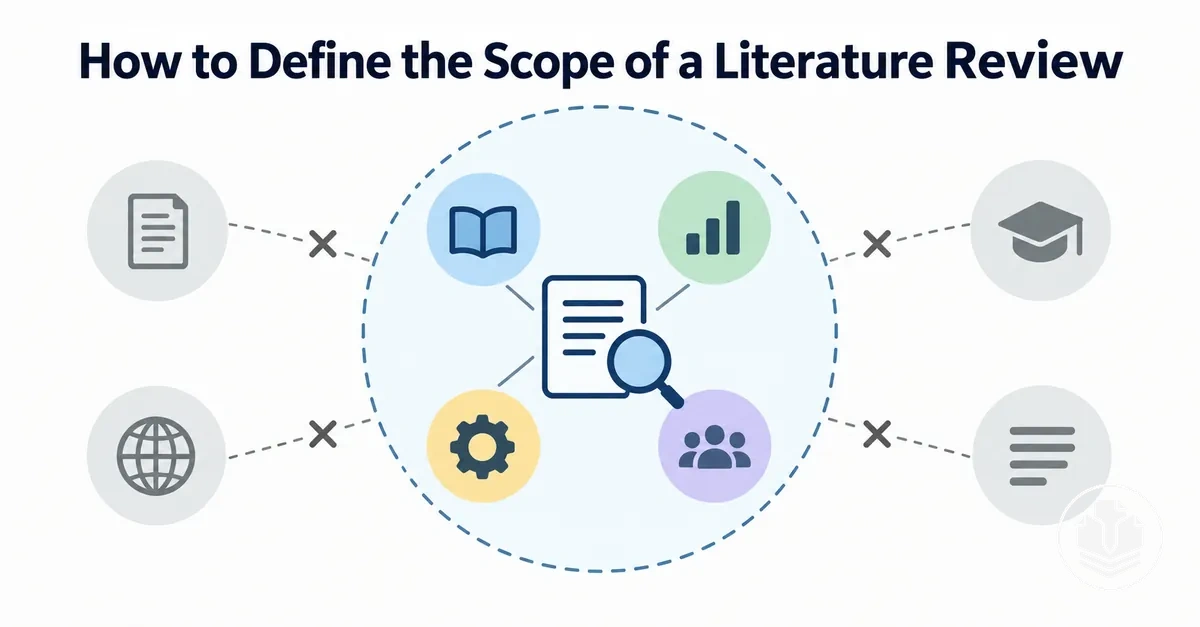
Literature review scope planner
Use the scope as a sequence of decisions: define the review need, set only boundaries that affect relevance or feasibility, turn them into eligibility rules, then test whether the result is workable.
There is no universal correct breadth: a workable range depends on the review purpose, evidence base, and project constraints, so restrictions should be added only when they materially improve relevance or feasibility.
A literature review scope is formed by several boundary dimensions that jointly control eligibility.
Scope dimensions can include the topic and concepts being examined, the population, setting or geography in context, the relevant time period, and applicable study characteristics and source characteristics.
Which dimensions need explicit limits depends on the review purpose and the evidence needed to address it.
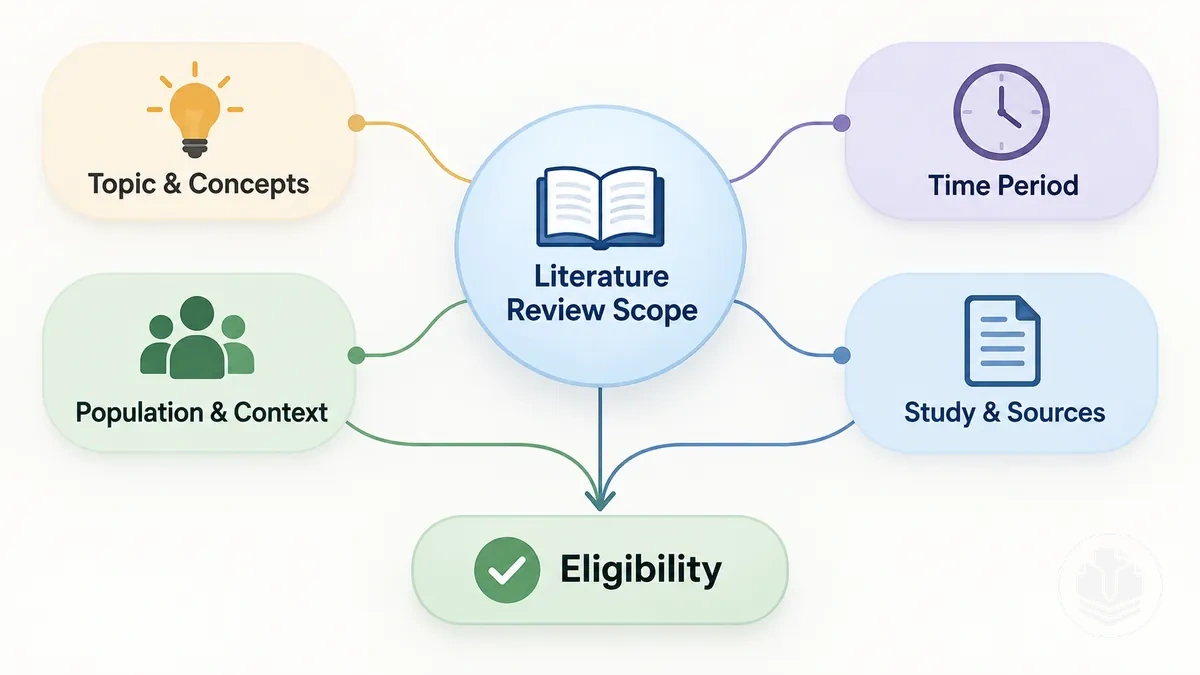
Each boundary dimension affects which literature is relevant and eligible for inclusion.
Conceptual boundaries limit the topic and concepts; contextual boundaries can limit the population, setting, or geography; and evidence and time boundaries can limit the time period, study characteristics, or source characteristics.
These scope criteria should work together coherently so that eligibility reflects the intended coverage rather than a set of disconnected filters.
Source characteristics define eligibility here, while source quality is a separate evaluative issue.
Conceptual boundaries identify which concepts, constructs, theories, phenomena, relationships, or sub-areas belong to the intellectual focus of a topic.
Included core concepts define the evidence domain that is relevant to the review question, while adjacent concepts may be excluded when they fall outside that focus.
Each conceptual limit therefore establishes a condition for whether literature is relevant to the review's intended coverage.
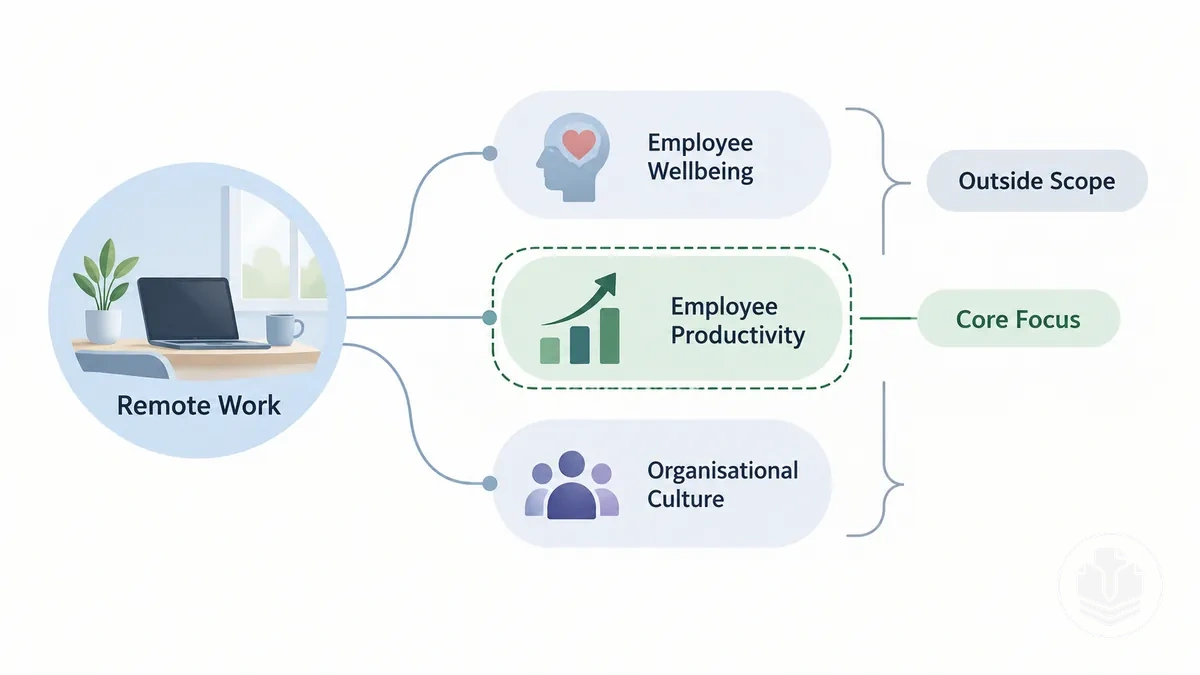
Tightening or relaxing a conceptual boundary changes which evidence qualifies as relevant.
For example, a broad topic such as remote work could be focused on the core concept of employee productivity, while adjacent concepts such as employee wellbeing or organisational culture remain excluded unless the review question requires them.
Expanding the conceptual scope to include employee wellbeing would make literature examining that construct relevant even when productivity is not its primary focus.
Conceptual boundaries therefore distinguish included core concepts from adjacent concepts that may relate to the topic but remain outside the chosen sub-area.
Population, setting, and geographic boundaries define whose evidence, which environments, and which locations are relevant when those differences affect the review question.
Population criteria determine which participants or participant characteristics affect eligibility, setting defines the context in which evidence needs to apply, and geography limits location when regional conditions affect applicability or comparability.
These boundaries should be applied only when the distinction can materially change which evidence addresses the review question.
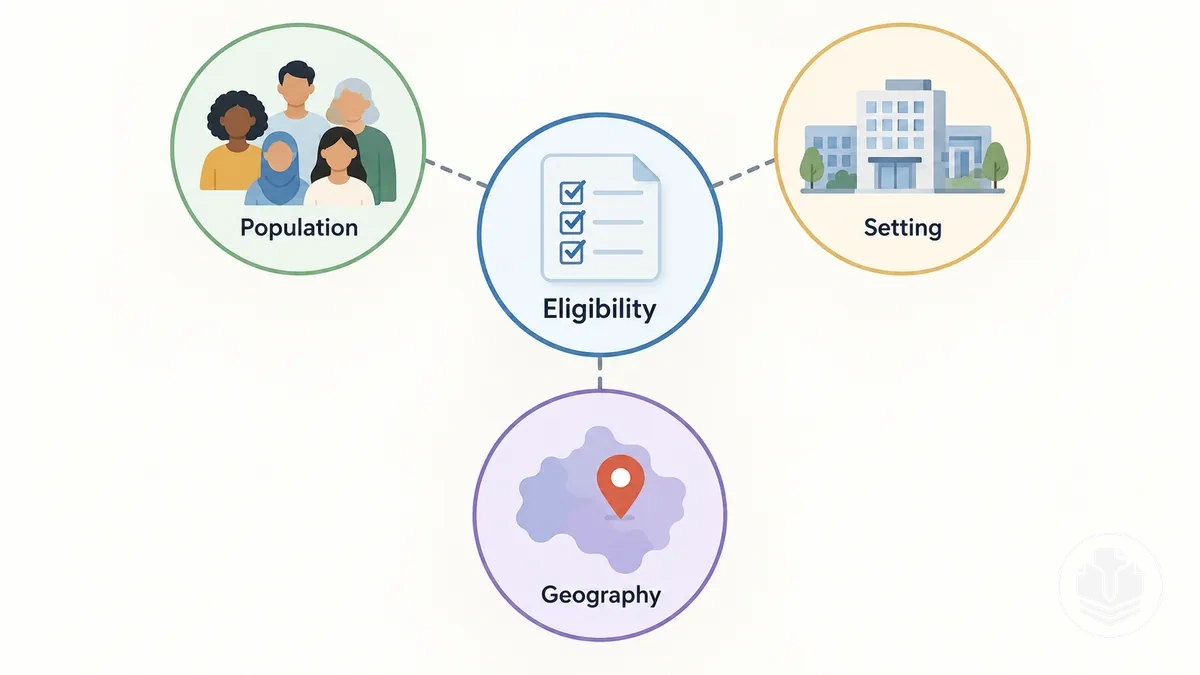
For example, a review concerned specifically with healthcare delivered in rural clinics may need a setting boundary if evidence from other care environments does not address the same context.
Population, setting, and geography therefore function as conditional eligibility criteria rather than restrictions that every literature review must use.
Evidence boundaries determine which time period, study characteristics, and source characteristics are eligible for consideration in a literature review.
A date range limits evidence by publication period, while study design or methodology and source characteristics such as publication type or language can qualify or exclude evidence according to the intended scope.
Each restriction requires a rationale when it materially affects whether evidence can address the review question.
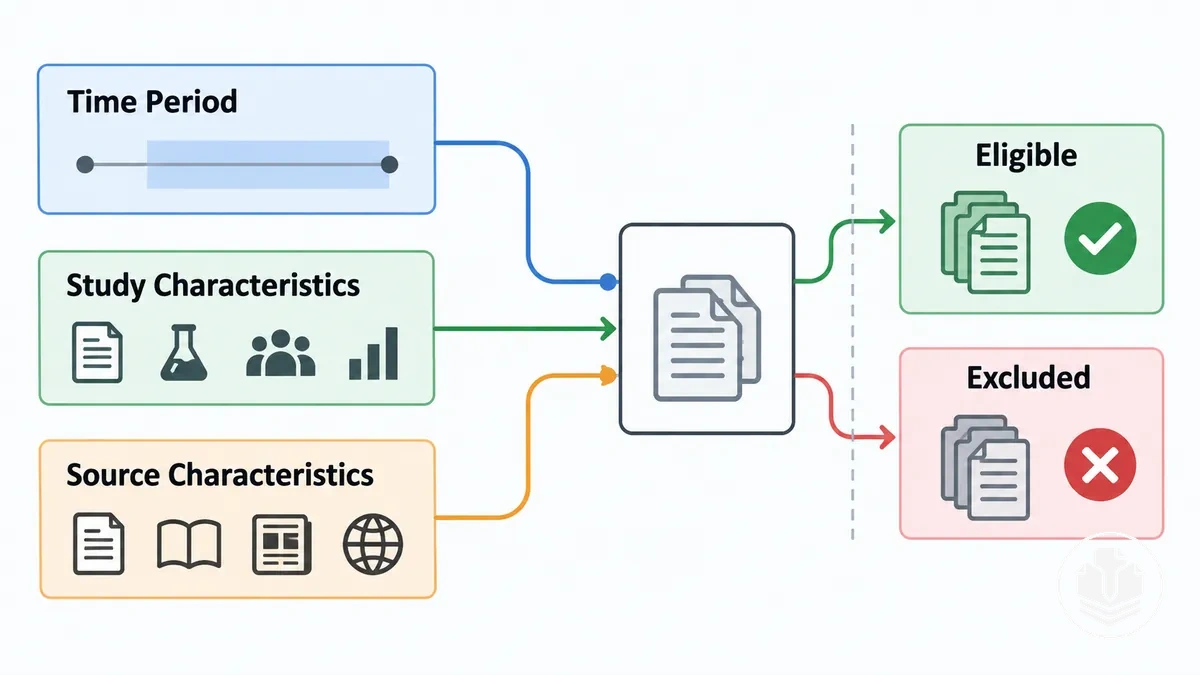
A time period should reflect a relevant temporal requirement rather than an arbitrary assumption that newer evidence is better.
Study characteristics may limit eligibility to a study design or methodology needed to answer the review question, while source characteristics may specify an appropriate publication type or document type.
Language can also function as an eligibility criterion when a justified practical or evidence-base requirement makes the restriction necessary.
The appropriate condition therefore depends on the review question, field, evidence base, or practical requirement.
Eligibility determines whether a source fits the scope; later appraisal of source quality is a separate task.
| Boundary | Possible condition | Inclusion implication | Rationale needed |
|---|---|---|---|
| Time period | Defined date range relevant to the review question | Includes evidence published within that period and excludes evidence outside it | Explain why the period is relevant to the field, question, or evidence context |
| Study design | Specified design or methodology relevant to the evidence needed | Includes studies with qualifying study characteristics | Explain why the design or methodology is necessary for the review question |
| Publication type | Specified publication or document type | Includes sources of the permitted type and excludes other document types | Explain why that source characteristic is appropriate to the evidence base |
| Language | Specified language or languages when justified | Includes sources available in the permitted language and excludes others | Explain the practical or evidence-related reason for the language boundary |
Set the literature review scope by moving from the review purpose and research question to explicit boundaries, translating those boundaries into inclusion criteria and exclusion criteria, and then testing whether the resulting scope is feasible.
The sequence provides planning checkpoints rather than a rigid one-pass workflow, because the available literature or practical constraints can require earlier decisions to be revisited.
The intended purpose of the literature review should therefore be clear before boundaries are chosen, so each limit supports the contribution the review is intended to make.
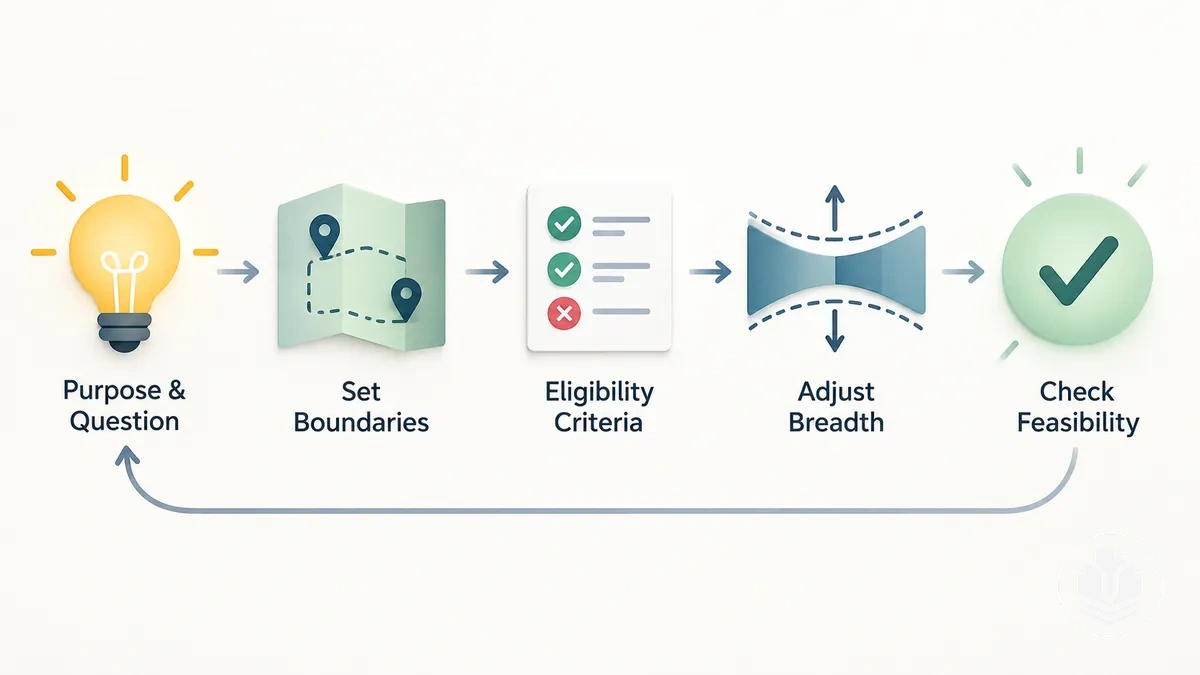
Scope refinement can be iterative when the available literature shows that the initial boundaries are too broad or too narrow for the intended review.
In that case, revisit the relevant boundary, narrow or broaden it with a clear rationale, and check feasibility again rather than treating the initial scope as fixed.
The scope should serve the review purpose and make the research question answerable by keeping the evidence focused on the intended contribution.
The review purpose establishes what the review is trying to accomplish, while the research question constrains which evidence is relevant to that objective.
Boundaries should therefore support the intended answer rather than introduce limits that are unrelated to the question focus.
Question elements can imply different scope boundaries depending on the field, review objective, and available literature.
Concepts may define the intellectual focus, population and context may narrow where the evidence applies, a time period may limit temporal coverage, and evidence characteristics may constrain which forms of evidence are eligible.
These dimensions are conditional rather than a universal question framework; detailed work to formulate the review question is a neighbouring task rather than part of scope alignment.
A vague or overextended question can leave the scope unstable, while an excessively restrictive question can narrow the boundaries until too little relevant evidence remains for the intended review.
Inclusion criteria and exclusion criteria convert abstract scope boundaries into explicit eligibility rules for deciding which studies or sources qualify and which do not.
Inclusion criteria state the conditions evidence must meet to qualify, while exclusion criteria state the corresponding conditions that disqualify evidence from the defined scope.
The table translates justified scope boundaries into paired eligibility decisions rather than source-quality judgments.
| Criterion | Inclusion rule | Exclusion rule | Rationale |
|---|---|---|---|
| Population | Include the population defined by the review objective | Exclude populations outside the defined boundary | Keeps participant eligibility aligned with the intended population |
| Concept and context | Include evidence addressing the defined concept in the relevant setting or geography | Exclude evidence outside the defined conceptual or contextual boundary | Keeps evidence focused on the concepts and contexts needed to address the review objective |
| Time period | Include evidence within the justified date boundary | Exclude evidence outside that time period | Applies the temporal boundary when time is relevant to the review objective |
| Evidence characteristics | Include qualifying study characteristics, publication type, or language when required by the scope | Exclude evidence that does not meet those justified characteristics | Limits eligibility to evidence characteristics necessary for the intended review |
Each rule should map to a relevant scope dimension and have a rationale tied to the review objective.
For example, if the chosen population boundary is adults, the inclusion rule can require adult participants and the corresponding exclusion rule can disqualify studies limited to children; both rules operationalize the same population boundary.
The appropriate criteria may involve population, concept, setting, geography, time period, study characteristics, publication type, or language only when those boundaries are justified.
These eligibility criteria can subsequently inform how researchers plan the literature search without treating eligibility rules as search syntax or source-quality scores.
Narrow the topic when the current scope admits too much heterogeneous or loosely relevant literature, and broaden it when existing restrictions exclude evidence needed to answer the research question.
Keep the scope unchanged when the relevant literature is sufficiently coherent and adequate for the intended review.
The decision should depend on relevance, coherence, and evidence sufficiency rather than on raw search-result counts.
For example, a topic covering workplace wellbeing across all occupations and settings may become more workable by narrowing the population to healthcare workers when that population is central to the research question.
Conversely, a scope limited to one narrowly defined workplace setting may need to broaden the setting boundary if that restriction excludes relevant literature needed for the intended answer.
After tightening or relaxing a boundary, recheck that the revised scope remains aligned with the research question and still contains sufficient relevant literature.
A workable literature review scope must satisfy three conditions together: it should fit the research question, contain enough relevant literature for the intended synthesis, and remain feasible within the project constraints.
Question alignment
The boundaries should keep the evidence focused on material that can answer the research question. Persistent material outside that focus signals that a boundary may need revision.
Evidence sufficiency
The scope should contain enough pertinent literature for the intended synthesis within its field and evidence base. Repeated exclusion of needed evidence can indicate that a restriction is too tight.
Feasibility
The required coverage and depth should be manageable within the available time, access, and other project constraints. A mismatch can require adjusting a boundary or the planned depth.
A scope is too broad when its boundaries admit more conceptual or contextual variation than can be synthesized coherently for the research question.
Excessive breadth may manifest as heterogeneous evidence, remote subtopics, conflicting lines of inquiry, or unclear boundaries for relevance and inclusion criteria.
These signals should be interpreted together because no single manifestation proves that the scope is overbroad.
For example, a review that covers employee wellbeing across unrelated industries, populations, organisational settings, and outcomes may be too broad if those differences produce disconnected lines of inquiry that cannot answer one coherent research question.
By contrast, a broad review can remain workable when its diverse evidence still addresses the same defined focus with clear relevance and inclusion boundaries.
In that case, breadth alone does not indicate that tighter boundaries are needed.
A scope is too narrow when restrictive boundaries exclude relevant literature needed to answer the research question or support the intended synthesis.
Excessive restriction can leave an evidence base that is too limited because pertinent evidence falls outside the chosen concepts, population, setting, geography, time period, study characteristics, or other exclusion criteria.
A small evidence base alone does not establish that the scope is too narrow, because an emerging topic or genuinely narrow question may legitimately have limited literature.
For example, broadening may be justified when a setting restriction repeatedly excludes otherwise pertinent studies needed to answer the research question.
If comparable evidence remains scarce after that restriction is considered because the topic itself is emerging, the limited evidence base may reflect legitimate narrowness rather than a scope problem.
The diagnostic task is therefore to identify which specific boundary is excluding relevant evidence before deciding whether that boundary should be relaxed.
Final scope validation should verify that the proposed boundaries align with the research question, provide sufficient relevant literature for the intended synthesis, and remain feasible within the project constraints.
These conditions need to hold together because intellectual fit does not by itself establish evidence sufficiency or practical feasibility.
The final scope check therefore tests fit and feasibility without imposing a universal source count or required page count.
A failed check identifies a boundary or eligibility rule that may require revision rather than proving that the whole scope is invalid.
Evidence sufficiency and feasibility remain conditional on the review purpose, available literature, expected depth, access, and project constraints.
The scope should also remain compatible when researchers select the review method, without using scope validation to determine the method itself.
Broad topic
Remote work and employee outcomes can span many concepts, populations, settings, geographic contexts, time periods, and evidence characteristics. The scope therefore needs to identify which dimensions actually matter to the intended question.
Refined scope
Studies of remote work and employee productivity among office-based employees in organisational workplace settings, limited in this example to evidence published from 2020 onward and to empirical studies reporting productivity-related outcomes.
Why the boundaries fit: each limit has a rationale tied to the example's intended research question, making inclusion and exclusion decisions more consistent while preserving a coherent evidence focus. These values are illustrative rather than universal scope rules.