
How to Conduct a Literature Review from Planning to Final Revision
To conduct a literature review, define the scope, review question, and eligibility criteria; translate the question into a search strategy; screen retrieved sources; compare and synthesise the evidence; draft from synthesis-level claims; and revise the draft for alignment with the question, scope, and evidence. The workflow is iterative: when later evidence or an unsupported claim exposes an earlier problem, return to the specific stage that needs correction rather than restarting automatically.
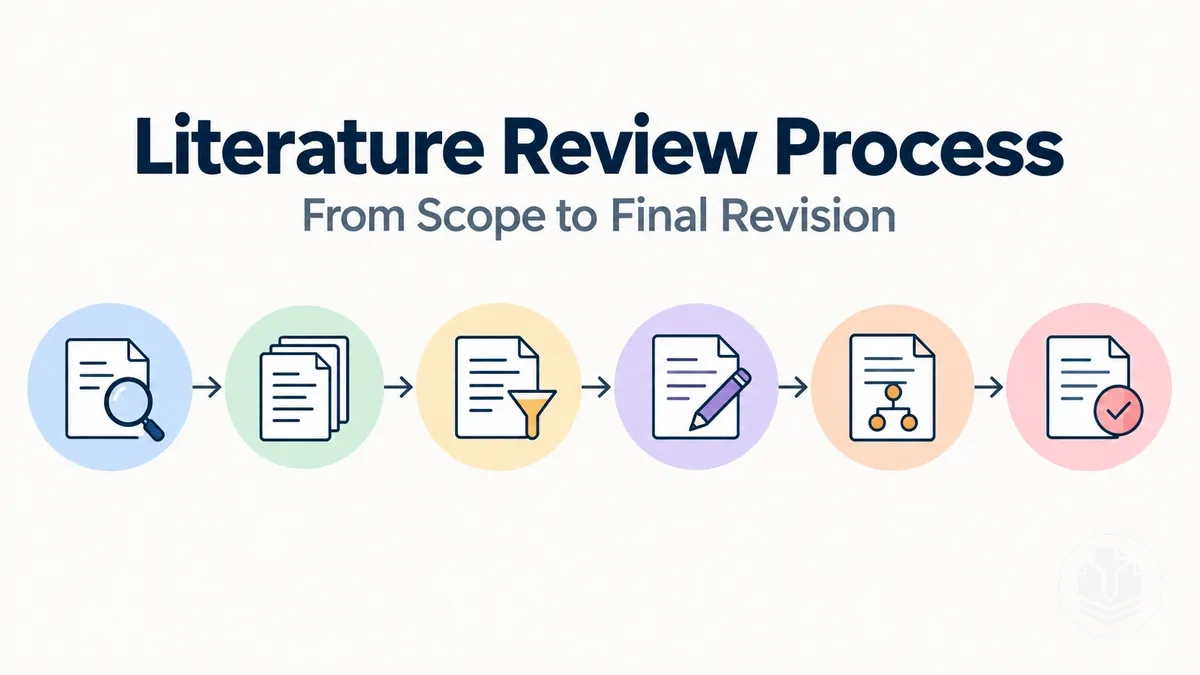
Whole-process view
Literature review workflow: six linked stages
Each stage produces information the next stage depends on. Use the links to move to the detailed part of the process.
- PlanSet scope, the review question, and source-selection criteria.Output: a search-ready evidence boundary.
- SearchTranslate concepts into terms and use suitable information sources.Output: candidate records for screening.
- ScreenApply the established eligibility criteria consistently.Output: included, excluded, or uncertain records.
- SynthesiseCompare context, method, findings, limitations, and uncertainty across studies.Output: qualified synthesis-level claims.
- DraftBuild the argument from integrated evidence and interpreted relationships.Output: connected analytical prose.
- ReviseCheck scope, question, evidence support, coherence, citations, and uncertainty before proofreading.Output: a verified final review.
Iteration rule: diagnose the mismatch first, then revisit only the stage that plausibly produced it.
Stage labels and exact execution can vary by discipline and review type, but the dependency chain remains consistent: planning sets retrieval boundaries, screening creates the evidence base, synthesis determines which claims are defensible, drafting turns those claims into an argument, and revision verifies that the final claims still match the evidence and original scope.
Table of Contents
Plan the Literature Review Before Searching
Literature review planning defines the scope, research question, and evidence-selection logic before the search begins.
These decisions set the boundaries for relevance by establishing what the review will examine and the conditions under which sources can enter it.
The planning sequence below visualizes how scope, question, and eligibility criteria depend on one another before retrieval begins.
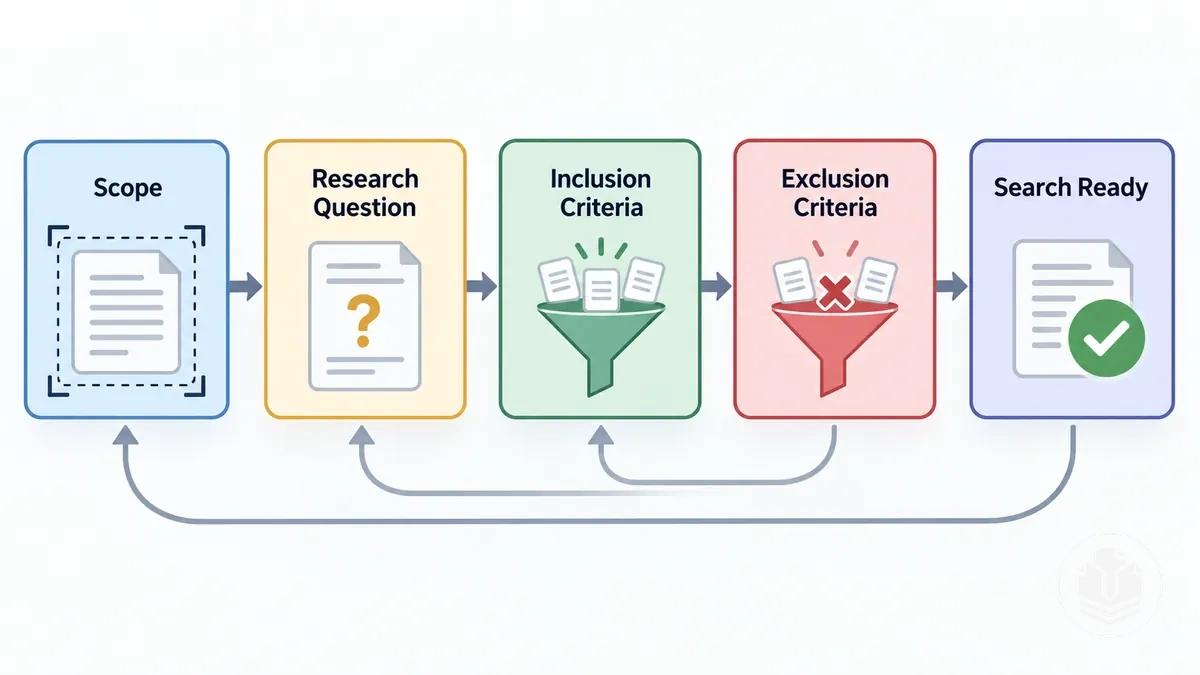
Unclear scope or criteria can produce retrieval that is too broad or inconsistent because the search has no stable boundary for distinguishing relevant evidence from material outside the review.
For example, a broad topic without defined context or limits can generate sources addressing substantially different questions, populations, periods, or source types.
Clarifying those constraints before searching gives the research question and evidence selection a common boundary while still allowing justified adjustments as the evidence base becomes clearer.
The ordered sequence below connects each prerequisite decision to a verification point so that searching begins only when the review boundary can be applied consistently.
Planning sequence
- Define the scope and boundaries. Specify the topic and relevant constraints, such as context, time period, or source type where these limits matter to the review. Verify that the boundaries distinguish material that belongs within the review from material outside its intended coverage.
- Set the research question. Express the review focus as a question that is answerable within the chosen scope and capable of guiding relevance decisions. Verify that the question is neither broader than the boundaries nor dependent on evidence outside them.
- Establish source-selection criteria. Translate the scope and research question into inclusion criteria and exclusion criteria that can be applied during evidence selection.
- Fix before searching: the core topic boundary, research question, and eligibility conditions needed to decide whether a source is relevant.
- Keep adjustable where justified: practical search terms or boundary refinements that become necessary as the evidence base reveals terminology or distinctions not apparent during initial planning.
- Check readiness to search. Confirm that the scope, research question, constraints, inclusion criteria, and exclusion criteria work together as one selection logic. The review is ready for searching when these boundaries are explicit enough to guide relevance and evidence-selection decisions consistently.
Define the Scope and Boundaries
Review scope is the operational boundary that determines which literature is relevant to the inquiry and which literature falls outside it.
The scope sets limits around the topic and, where relevant, dimensions such as population or context, time period, geography, discipline, and source type.
Each boundary condition shapes the potential evidence pool, so changing a scope limit can change both which studies qualify and which claims the review can support.
A broad scope may include multiple populations, contexts, periods, or source types, producing an evidence pool that addresses substantially different versions of the topic.
A more focused boundary limits those dimensions to the ones required by the research question, making relevance easier to judge without implying that one set of scope dimensions suits every review.
To define the review scope, state the applicable boundaries clearly enough to distinguish included literature from material outside the intended inquiry.
Claims are defensible only within the boundaries represented by the evidence selected for the review.
The scope dimensions below represent boundary conditions that can alter relevance and the range of supportable claims.
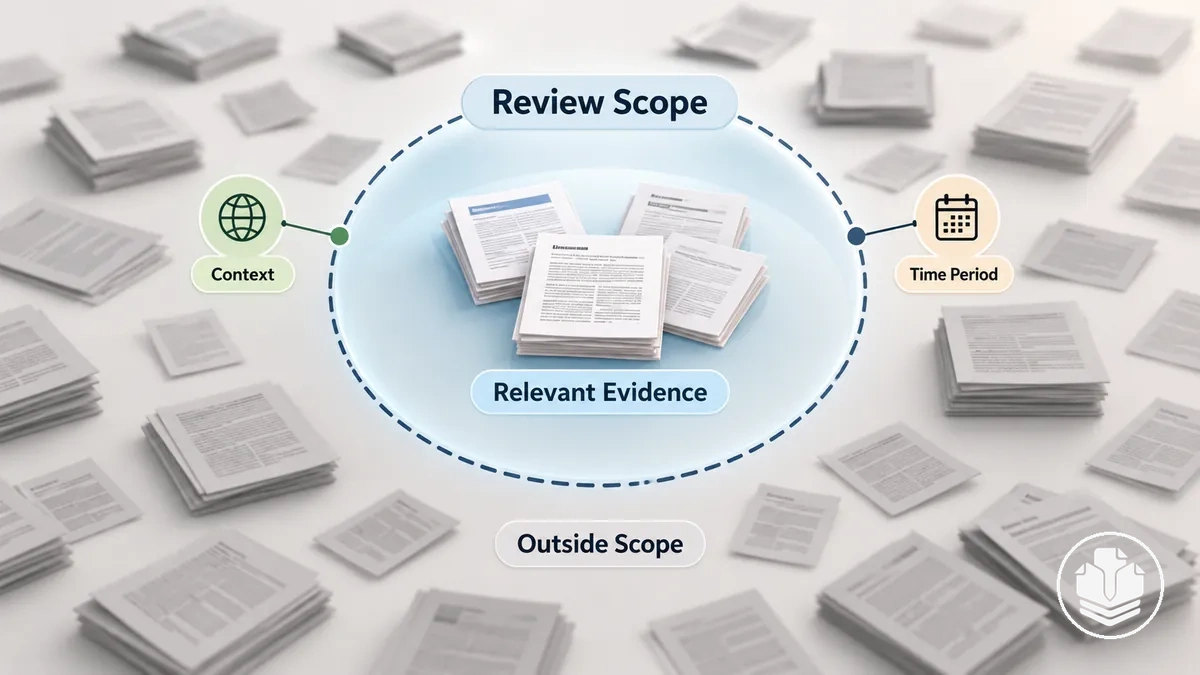
Scope dimensions
- Topic or phenomenon: limits the evidence pool to literature addressing the subject or relationship defined by the inquiry.
- Population or context: includes evidence from the people, settings, or circumstances relevant to the question and excludes contexts outside that boundary.
- Time period: limits eligibility to the period chosen for the inquiry when a temporal boundary is relevant.
- Geography: restricts the evidence pool to specified locations when place is part of the intended scope.
- Discipline: limits the evidence pool to relevant fields when the inquiry requires a disciplinary boundary.
- Source type: limits which categories of literature can enter the review when source or study type forms part of the scope.
Formulate the Review Question
A review question turns the chosen topic and scope into a focused inquiry that guides searching, screening, comparison, and synthesis.
Its concepts and relationships define what evidence is relevant, which concepts can become search terms, and which comparisons the later synthesis needs to make.
The exact wording and question framework can differ by review type, but the research question should remain answerable from the literature and aligned with the review scope.
A vague question leaves the evidence boundary and intended comparison unclear, whereas a focused question specifies the concepts and relationship that the review will examine.
To formulate the research question, express the inquiry specifically enough that its concepts can guide retrieval and its focus can be applied as a relevance test when evaluating evidence.
The contrast below shows how question focus changes the practical task of searching and synthesis.
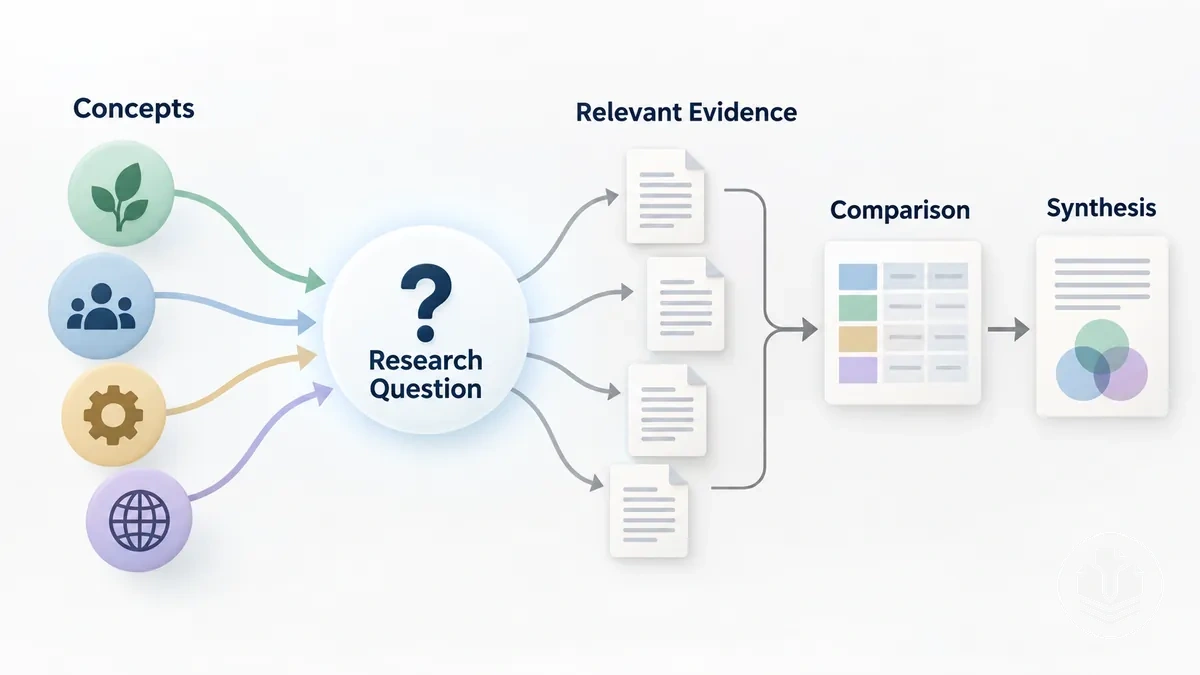
Question focus: vague vs focused
- Vague: “How does technology affect education?” leaves the technology, educational context, affected outcome, and intended relationship open, so retrieval can span substantially different topics and provide no consistent basis for comparison.
- Focused: “How does online formative feedback affect student engagement in undergraduate courses?” identifies the intervention, context, outcome, and relationship more clearly, giving retrieval a defined conceptual focus and giving synthesis a consistent comparison frame.
Set Criteria for Which Sources Belong in the Review
Source-selection criteria are pre-established conditions used to decide whether retrieved literature is eligible for the review.
Inclusion criteria identify conditions a source must meet, while exclusion criteria identify conditions that place it outside the review question and scope.
Defining these conditions before preferred sources are chosen reduces ad hoc selection and gives relevance decisions a consistent basis.
The eligibility decision can be include, exclude, or uncertain when the available information requires further checking.
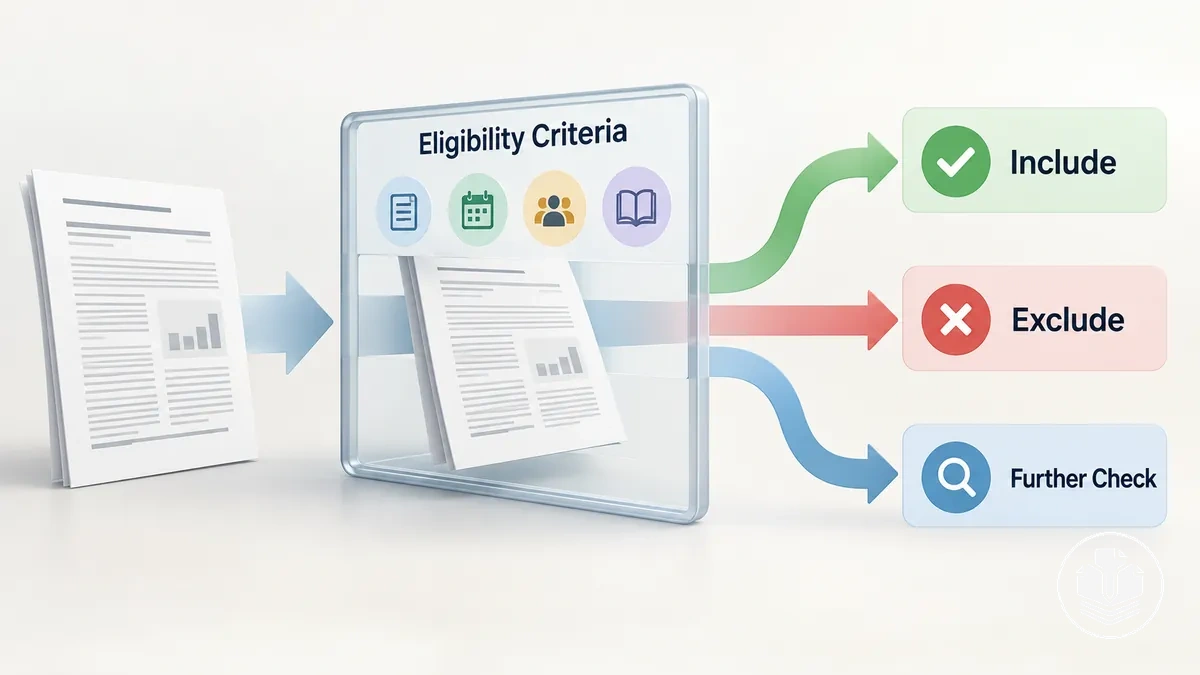
The criteria below organise common eligibility conditions and their decision implications; which conditions apply depends on the review question and scope.
A source that meets the applicable inclusion criteria qualifies for inclusion, one that fails a required condition is excluded, and one with unclear eligibility requires further checking before a decision.
Eligibility establishes whether a source belongs in the review, while deeper methodological quality appraisal remains a separate decision when the review method assesses quality independently.
Eligibility logic
- Inclusion criteria:
- Relevance: include a source when its topic addresses the research question within the defined scope.
- Publication period: include a source when its publication date falls within the review's stated period, if a time boundary applies.
- Population or setting: include a source when the studied population or setting matches the conditions defined by the review.
- Source type and language: include a source when its source type and language meet the review's stated eligibility conditions, where those attributes materially affect inclusion.
- Exclusion criteria:
- Relevance: exclude a source when its topic does not address the research question within the defined scope.
- Publication period: exclude a source when it falls outside an applicable time boundary.
- Population or setting: exclude a source when the studied population or setting falls outside the review's defined conditions.
- Source type and language: exclude a source when either attribute fails an eligibility condition that the review has established as relevant to its scope.
Search and Screen the Literature
Literature search and screening are connected but distinct parts of evidence acquisition: searching retrieves candidate literature, while screening applies the review's inclusion criteria and exclusion criteria to decide which records remain relevant.
The search strategy translates the research question's concepts into terms used with suitable databases or information sources, producing retrieved records for consideration.
Screening then converts those candidates into an eligible evidence base rather than assuming that every search result belongs in the review.
The image traces this general movement from search concepts through retrieval and screening to retained evidence.
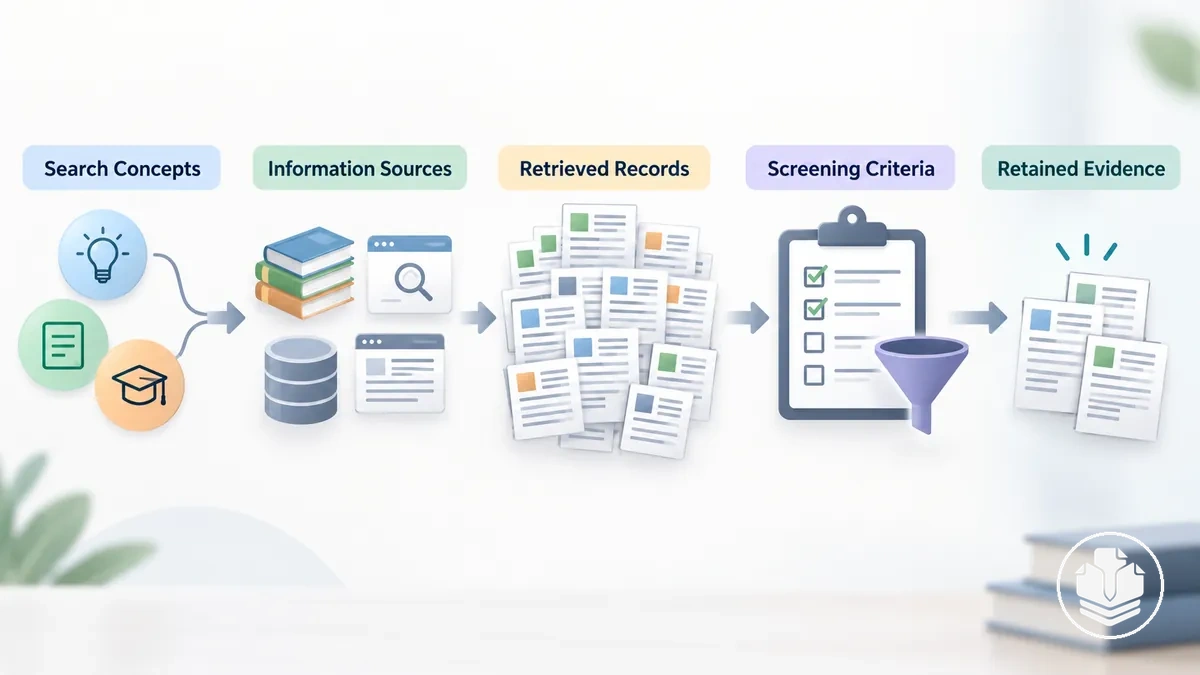
The ordered sequence below tracks how candidate records move from retrieval to eligibility decisions while keeping each action distinct.
Duplicate handling, clearly irrelevant records, and the number or form of screening stages can differ by review type and method, so these actions should be applied where relevant rather than treated as universal requirements.
Verification occurs when retrieved records are checked against the established criteria before analysis begins.
Retrieval-to-evidence sequence
- Translate the question into search concepts. Identify the concepts that the search strategy needs to represent so retrieval remains aligned with the review question.
- Search suitable information sources. Apply the search strategy in databases or other information sources appropriate to the review to retrieve candidate literature.
- Collect the retrieved records. Bring the search results together so candidate records can be handled consistently during screening.
- Resolve obvious duplicates or clearly irrelevant records where applicable. Identify duplicate records and, where the review method permits, set aside records that are clearly outside the review's relevance boundaries.
- Screen against the review criteria. Apply the inclusion criteria and exclusion criteria to each candidate at the screening stage required by the review method, checking whether the record meets the defined relevance and eligibility conditions.
- Retain eligible evidence. Keep records that satisfy the applicable criteria so the resulting evidence base is ready for analysis.
For example, a retrieved record whose topic appears relevant remains a candidate until screening confirms that it meets the applicable eligibility conditions; if it fails a required criterion, it is excluded rather than carried into analysis.
Some review methods use more than one screening stage, while others use a simpler process suited to the review's requirements.
Translate the Question into a Search Strategy
A search strategy translates the research question's core concepts into search terms and appropriate information sources so those concepts can retrieve relevant records.
Each core concept can be represented by synonyms and related terms because the literature may use different wording for the same or closely related idea.
Broader terms can increase the range of literature retrieved, while narrower terms can restrict retrieval to a more specific meaning or context.
The sequence below translates those conceptual choices into practical search logic without assuming that every database uses the same syntax.
Search strategy construction
- Extract the core concepts. Identify the concepts from the research question that the search needs to represent.
- Expand each concept into search terms. Add natural synonyms and related terms that authors may use; for example, a concept such as adolescents might also be represented by teenagers or youth, with the exact terms chosen according to the review's meaning and scope.
- Select suitable information sources. Choose databases or other information sources that cover the subject area and source types relevant to the review, because source coverage affects which records can be retrieved.
- Combine and test the concept groups. Combine variants within each concept and then connect the required concept groups so the retrieval reflects the intended question; adding related or broader terms can broaden retrieval, while requiring more specific or narrower concepts can make retrieval more selective.
A compact search logic might therefore treat adolescents OR teenagers OR youth as alternative terms for one concept and combine that group with another required concept from the research question.
Exact operators, fields, filters, subject headings, and syntax depend on the information source, and search logic may need adaptation when moving between databases with different search conventions.
Detailed query construction belongs in the method used to build a literature search strategy.
Screen Sources Against the Review Criteria
Source screening applies the previously defined eligibility criteria consistently to retrieved sources before they enter the evidence base.
Each source is checked for the conditions relevant to the review, such as topic fit, population or setting, date range, and source type, and the screening decision is recorded as include, exclude, or uncertain.
This eligibility check protects against selecting sources ad hoc or treating an apparently relevant title as sufficient evidence that all criteria are met.
When a title or abstract does not provide enough information for a criterion, the source remains uncertain until fuller inspection can resolve its eligibility.
The checklist below connects each source attribute to an eligibility decision rather than redefining the criteria themselves.
Eligibility decision
- Include
- The source meets the applicable eligibility conditions.
- Exclude
- The source fails a required eligibility condition.
- Uncertain
- Available information is insufficient; check fuller source information before deciding.
If the review method uses multiple screening stages, apply these checks at the stage specified by that method.
Screening checks
- Topic fit: check whether the source addresses the subject or relationship required by the review; include it when the criterion is met, exclude it when it clearly falls outside the defined topic, and mark it uncertain when the available title or abstract does not resolve the fit.
- Population or setting: verify that the studied population or setting matches the established eligibility condition; a mismatch supports exclusion, while missing or ambiguous information requires further checking.
- Date range: verify that the source falls within the review's defined publication period when a date criterion applies; sources outside that boundary are excluded on that criterion.
- Source type: check whether the publication or study type meets the established eligibility condition; include or exclude it according to that condition rather than according to preference for a particular source.
- Methodological relevance: check whether the source's reported approach is relevant to the question when methodology forms part of eligibility; if the title or abstract is insufficient to establish this, retain an uncertain decision until full-text checking provides enough information.
For example, a source may appear to match the topic from its title but leave the population or setting unclear in the abstract; that record remains uncertain rather than being included or excluded on an unsupported assumption.
Full-text checking resolves such cases when the required eligibility information is available only in the complete source.
The resulting screened set is eligible for later analysis, but screening alone does not establish the methodological quality of the included sources.
Analyse and Synthesise the Evidence
Evidence synthesis integrates findings across selected studies to develop an interpretation of the literature rather than accumulating isolated source summaries.
It compares each study's context, method, findings, and limitations so relationships across the evidence can be identified.
Synthesis therefore asks where studies converge, where they diverge, and where uncertainty remains before broader claims are formed.
A source-by-source summary keeps studies separate; synthesis connects them through comparison and interpretation.
From selected studies to synthesis claims
- Extract comparable information. Record the context, method, relevant findings, and limitations needed for the synthesis question.
- Align sufficiently similar studies. Compare studies that address related concepts while keeping material methodological and contextual differences visible.
- Identify cross-study relationships. Distinguish convergence, divergence, and unresolved uncertainty, and check whether study conditions explain apparent differences.
- Formulate a qualified claim. State what the combined evidence supports and keep the claim proportionate to the relevant conditions and limitations.
Differences in context, method, or limitations can qualify how findings should be interpreted, so disagreement does not by itself establish that one study is wrong.
For example, similar findings across studies conducted in comparable contexts may support a more consistent interpretation, while different findings across substantially different methods or settings may require the divergence to remain explicit rather than being combined into a single conclusion.
To synthesise the literature, connect cross-study relationships to claims that remain proportionate to the evidence and explicit about important limitations and uncertainty.
Organise Sources for Cross-Study Comparison
Selected studies need to be aligned on shared analytical dimensions before meaningful cross-study comparison is possible.
Cross-study organization compares attributes such as the theme or claim addressed, population or context, method where it affects interpretation, key finding, and limitation.
The relevant dimensions depend on the synthesis question, so alignment should retain only attributes that help interpret similarities, qualifications, or contrasts rather than treating different studies as equivalent.
This produces comparable evidence units while keeping important contextual and methodological differences visible.
The evidence matrix below aligns synthesis-relevant study attributes so comparison can reveal which studies support the same claim, qualify it, or create a meaningful contrast.
Columns should be retained because they affect synthesis, not merely because the information is available as study metadata; missing information matters only when that attribute is necessary for the comparison.
| Study | Theme or Claim | Population or Context | Method | Key Finding | Limitation |
|---|---|---|---|---|---|
| Each selected study | Identify the synthesis-relevant theme or claim addressed. | Record the population, setting, or context when it affects interpretation. | Record methodological features when they qualify comparison of the findings. | State the finding that bears directly on the theme or claim being compared. | Record the limitation that materially qualifies interpretation of the finding. |
Compare Findings Across Studies Rather Than Summarise Sources Separately
Cross-study comparison organises evidence around a shared claim, theme, or relationship, whereas isolated summary treats each source as a separate unit.
Synthesis compares findings across studies to identify agreement, contradiction, methodological difference, contextual difference, and differences in evidence strength.
These relationships qualify the interpretation of the shared claim rather than allowing the number of supporting studies alone to determine the conclusion.
The goal is an integrated interpretation, not a sequence of disconnected source descriptions.
Agreement across sufficiently comparable studies can support a more consistent interpretation, while contradiction may reflect genuine divergence or differences in population, context, measurement, or method.
A methodological difference can limit direct comparison, and a contextual difference can show that a claim is supported under one condition but not necessarily another.
Evidence strength also qualifies the conclusion because study count alone does not establish stronger support when relevance, design, or limitations differ.
Cross-study comparison therefore ends with an interpretation of what the combined findings support, under which conditions, and with which limitations.
Use Patterns, Disagreements, and Gaps to Shape the Synthesis
Patterns, disagreements, and apparent gaps are synthesis signals that require interpretation rather than conclusions by themselves.
A recurring pattern may suggest convergence, a disagreement may reflect genuine divergence or differences in method or population, and an apparent gap may reflect missing evidence, a narrow scope, or incomplete search coverage.
Each signal therefore requires a differentiating check before it can strengthen, qualify, or leave a claim unresolved.
The diagnostic task is to connect the signal to plausible explanations and then test which interpretation the available evidence supports.
Interpretive signals and checks
- Pattern: recurring findings may support a more consistent interpretation when studies examine sufficiently comparable questions, populations, contexts, and time periods. Check whether the apparent convergence persists after methodological and contextual differences are considered; if it does, the pattern can strengthen the synthesis claim within those conditions.
- Disagreement: conflicting findings may reflect a substantive inconsistency, but they may also arise because studies use different methods, populations, contexts, measurements, or time periods. Check those differences before interpreting the disagreement; if they explain the divergence, the synthesis should qualify the shared claim by condition rather than treat one finding as an error.
- Apparent gap: missing evidence on a topic is a signal to check evidence availability, review scope, terminology, time period, and search coverage before claiming that a research gap exists. A supported gap claim requires reasonable confidence that relevant evidence has been sought within the intended scope; otherwise, the synthesis should describe the absence as unresolved uncertainty rather than confirmed lack of research.
The same apparent inconsistency can support different interpretations under different study conditions: disagreement across comparable studies may leave a claim uncertain, while disagreement concentrated across different populations or methods may indicate that the claim is context-dependent.
Likewise, an empty area in the retrieved evidence may indicate a meaningful gap or simply a boundary of the search.
The synthesis should use these checks to strengthen the claim, qualify it, or leave the interpretation unresolved.
Draft the Review from the Synthesis
Drafting turns synthesis claims into an evidence-based argument by converting analytical relationships into connected prose.
The literature review draft should begin from what the synthesis supports, not from the order in which individual sources were read or noted.
Each claim therefore remains tied to the review question and to evidence relationships already established during analysis.
The sequence below moves from a synthesis-level claim to a coherent part of the written argument while keeping every drafting decision traceable to the evidence base.
From synthesis claim to argument
- Select the synthesis claim. Choose a claim that directly contributes to answering the review question and is already supported, qualified, or left uncertain by the synthesis.
- Integrate the relevant evidence. Bring together the studies that support, qualify, or contrast with the claim rather than reproducing separate source notes in source order.
- Interpret the relationship. Explain what the combined evidence means for the claim, including relevant convergence, divergence, contextual conditions, methodological differences, or limitations.
- Connect the claim to the larger argument. Develop progression by showing how the interpreted claim prepares the next analytical point or contributes to the review's broader answer, while keeping that progression aligned with the review question.
A synthesis note such as “Several studies report a similar relationship, but findings differ across contexts” becomes argumentative prose when the draft explains what the agreement supports, which contextual differences qualify it, and why that qualification matters to the review question.
Exact paragraph and section conventions can differ by discipline, but drafting cannot compensate for weak evidence selection or missing synthesis.
The literature review draft remains coherent when evidence integration, interpretation, and progression follow the synthesis and larger argument rather than individual source order.
Build Analytical Paragraphs Around Relationships in the Evidence
An analytical paragraph connects a focused claim with integrated evidence from multiple sources, a comparison or relationship among those sources, and an interpretation that advances the review's argument.
The paragraph should treat studies as evidence objects rather than isolated summaries, so findings are compared alongside relevant context, method, and limitation.
Citation quantity alone does not strengthen the paragraph; the analytical value comes from showing how the evidence supports, contrasts with, or qualifies the claim.
The pattern below maps those functions into one analytical unit without imposing a fixed sentence formula.
Analytical paragraph anatomy
- Claim: state the focused analytical point the paragraph will develop in relation to the review question.
- Integrated evidence: bring together evidence from multiple sources that bears on the same claim rather than presenting one source per paragraph.
- Relationship: compare the findings and identify agreement, contrast, methodological difference, contextual difference, or another relationship that affects how strongly the evidence supports the claim.
- Interpretation: explain what the relationship means for the claim and how that qualified interpretation contributes to the wider argument.
Context, method, and limitation determine how evidence should be integrated because superficially similar findings may support different interpretations under different study conditions.
A methodological difference may weaken a direct comparison, while a contextual difference may show that support applies only under particular circumstances.
An analytical paragraph therefore qualifies its claim according to the evidence rather than using a citation stack as a substitute for reasoning.
Exact paragraph patterns vary by discipline and argument type, but the paragraph should close by advancing the review's argument through interpretation rather than another source description.
Frame the Argument Across the Introduction, Body, and Conclusion
The review argument is distributed across three major components with different functions: the introduction frames the scope and purpose, the body develops the synthesis through evidence-based claims, and the conclusion consolidates what the evidence supports, qualifies, or leaves unresolved.
These components should remain connected to the same review question so the argument progresses rather than restarting in each part.
Their exact labels and conventions can vary by discipline or assignment, but their argumentative functions remain distinct.
The three-part grouping below shows how each component contributes to one continuous argument without prescribing a universal section formula.
One argument, three functions
- Introduction: frames the review question, scope, and purpose so the reader understands what the review will examine and the boundaries within which later claims should be interpreted.
- Body: develops the argument by integrating synthesis, evidence, and claims, showing where findings support, qualify, or complicate the review's developing interpretation.
- Conclusion: consolidates the argument by stating what the evidence supports, which claims require qualification, and which unresolved questions or uncertainties remain within the review's scope.
Coherence depends on alignment across all three components: the introduction should frame a question the body actually addresses, the body should develop claims supported by the synthesis, and the conclusion should reflect those claims without extending beyond the available evidence.
Exact structural conventions may differ, but each component is effective only when its function remains consistent with the same review question, evidence base, and developing argument.
The result is one continuous review argument whose scope, claims, synthesis, and unresolved questions remain aligned from opening to conclusion.
Revise and Verify the Review
Key distinction
- Revision
- Checks alignment among the review question, argument, claims, evidence, and scope.
- Proofreading
- Checks sentence-level language accuracy after substantive evidence-and-argument problems have been resolved.
Revision therefore evaluates whether each claim has adequate citation support, whether sections contribute coherently to the review question, and whether conclusions remain within what the evidence supports.
The exact number and order of revision passes can vary by assignment or review method, but substantive verification should precede final proofreading.
The revision passes below move from macro-level alignment to evidence support, coherence, and language accuracy, with each pass defining an acceptable state that can be checked without imposing an arbitrary numerical threshold.
Revision passes
- Check question and argument alignment. Verify that the draft's main argument addresses the review question and remains within the defined scope. Adjust claims or structure when the argument has moved beyond those boundaries.
- Verify evidence coverage. Check that substantive claims are supported by relevant evidence and that qualifications, disagreements, or unresolved points identified during synthesis have not been omitted. An acceptable state is one in which claims do not extend beyond what the available evidence can support.
- Check section coherence. Verify that each section advances the review question and that the progression between sections supports the developing argument rather than creating disconnected summaries or contradictory interpretations.
- Verify citation support. Check that evidence-dependent claims have citation support from the sources that actually substantiate them and that citations are positioned clearly enough to show which claims they support.
- Check language and uncertainty. Proofread for sentence-level accuracy after substantive revision, while checking that wording distinguishes supported conclusions from qualified or unresolved interpretations. Adjust language when its certainty is stronger than the evidence permits.
For example, revision may reveal that a conclusion makes a broad claim even though the synthesis supports it only for a narrower population or context; the correction may require returning to the synthesis or scope rather than merely rewriting the sentence.
To revise and edit the literature review, treat such mismatches as signals to correct the relevant earlier-stage decision before final proofreading.
The verified draft should leave its claims aligned with the evidence, review question, and scope while representing remaining uncertainty accurately.
Check Alignment from the Initial Scope to the Final Claims
The final claims should remain traceable to the original scope, review question, selection criteria, evidence base, and synthesis.
This alignment check verifies end-to-end consistency rather than introducing new research goals or treating minor wording issues as process failures.
Each condition below tests one verification point that can be confirmed or corrected before the review is considered complete.
End-to-end alignment checks
- Scope consistency: verify that the final claims and conclusions remain within the population, context, time period, source boundaries, and other limits established by the original scope. If a claim extends beyond those boundaries, narrow the claim or correct the earlier scope decision.
- Review question coverage: verify that the synthesis and conclusions address the substantive parts of the review question. If an important part remains unanswered, identify whether the evidence base cannot support it or whether relevant evidence was not adequately processed.
- Selection criteria consistency: verify that actual source use is consistent with the stated selection criteria. Any unexplained source exclusion or retained source that conflicts with those criteria requires correction or explicit justification.
- Evidence-base support: verify that each substantive claim is supported by relevant evidence from the selected sources. Claims without adequate support should be removed, narrowed, qualified, or returned to the evidence base for further checking.
- Synthesis-to-claim fit: verify that claims reflect the relationships established during synthesis, including relevant agreement, disagreement, contextual differences, methodological differences, limitations, and uncertainty. A claim requires correction when its strength exceeds what the synthesis supports.
- Conclusion restraint: verify that the conclusions remain within the review scope and consolidate what the synthesis supports without introducing broader claims, new questions, or interpretations not developed from the evidence.
- Citation and uncertainty consistency: verify that evidence-dependent claims have appropriate citation support and that wording reflects unresolved uncertainty accurately. Where evidence is conditional or limited, the final language should preserve that qualification rather than imply greater certainty.
Return to Earlier Stages When the Evidence Exposes a Gap
A downstream symptom in the literature review may indicate that an earlier process decision needs to be revisited, but it does not prove a single upstream cause.
Literature reviewing is iterative, so the useful response is to identify the likely cause, check whether that explanation fits the evidence, and then apply the corrective direction to the affected stage.
This avoids restarting the entire review when only one part of the workflow needs adjustment.
The diagnostic flow below separates recurring symptoms from their plausible causes so each corrective step follows a check rather than an assumption.
| Symptom | Likely Cause | Check | Corrective Direction |
|---|---|---|---|
| Too few relevant sources | The scope may be too narrow, search terms may miss common terminology, or the selected information sources may have limited coverage. | Check whether relevant concepts, synonyms, populations, time periods, and source coverage match the review question before concluding that the evidence base is genuinely sparse. | Revisit the scope or search strategy only where the check identifies an unnecessary restriction or coverage problem; if adequate searching still finds little evidence, retain the gap as a qualified evidence limitation. |
| Too many irrelevant results | Search concepts may be too broad, required concept groups may not be combined selectively enough, or the eligibility criteria may not reflect the intended scope. | Check which search terms or concept groups generate off-topic records and whether the selection criteria consistently exclude material outside the review question. | Narrow the problematic search concept, adjust search logic, or clarify the relevant eligibility condition rather than restricting unrelated parts of the search. |
| Incompatible evidence | Studies may differ materially in population, context, method, outcome definition, or time period. | Check whether the studies address sufficiently comparable claims and whether the differences explain why direct comparison is weak or inappropriate. | Revisit source alignment or the synthesis grouping so unlike evidence is separated, qualified, or compared only under clearly stated conditions. |
| Descriptive draft | The drafting stage may be following source order because the synthesis has not established clear relationships among findings. | Check whether each paragraph has a focused claim, integrated evidence from multiple sources, a comparison or relationship, and an interpretation. | Return to the synthesis stage to clarify agreement, divergence, context, or methodological differences, then redraft the affected paragraphs around those relationships. |
| Unsupported claims | The claim may exceed the evidence base, the synthesis may have overstated what the studies support, or relevant evidence may have been excluded inconsistently. | Check the claim against the selected evidence, synthesis notes, review scope, and selection criteria to determine where the mismatch originated. | Narrow or qualify the claim, correct the synthesis, or revisit source selection when the check identifies an upstream inconsistency. |
For example, too few relevant sources may initially look like a genuine evidence gap, but a check may show that the search used a narrow term while the literature commonly uses a broader synonym; in that case, the corrective direction is to revisit the search strategy rather than declare a gap.
Similarly, an unsupported final claim may require only a narrower conclusion if the evidence is adequate but more limited than the draft suggests.
Iteration should therefore target the stage that produced the mismatch instead of restarting the review automatically.