
Common Literature Review Mistakes and How to Fix Them
Common literature review mistakes occur when the review reports sources without synthesizing them, uses a scope or search that does not fit the research question, organizes evidence without a clear analytical idea, or connects claims to sources inaccurately. Fix them by diagnosing the symptom, verifying its cause, and correcting the blocking problem. If scope or evidence selection changes which sources belong, make that foundational correction before downstream prose polishing.
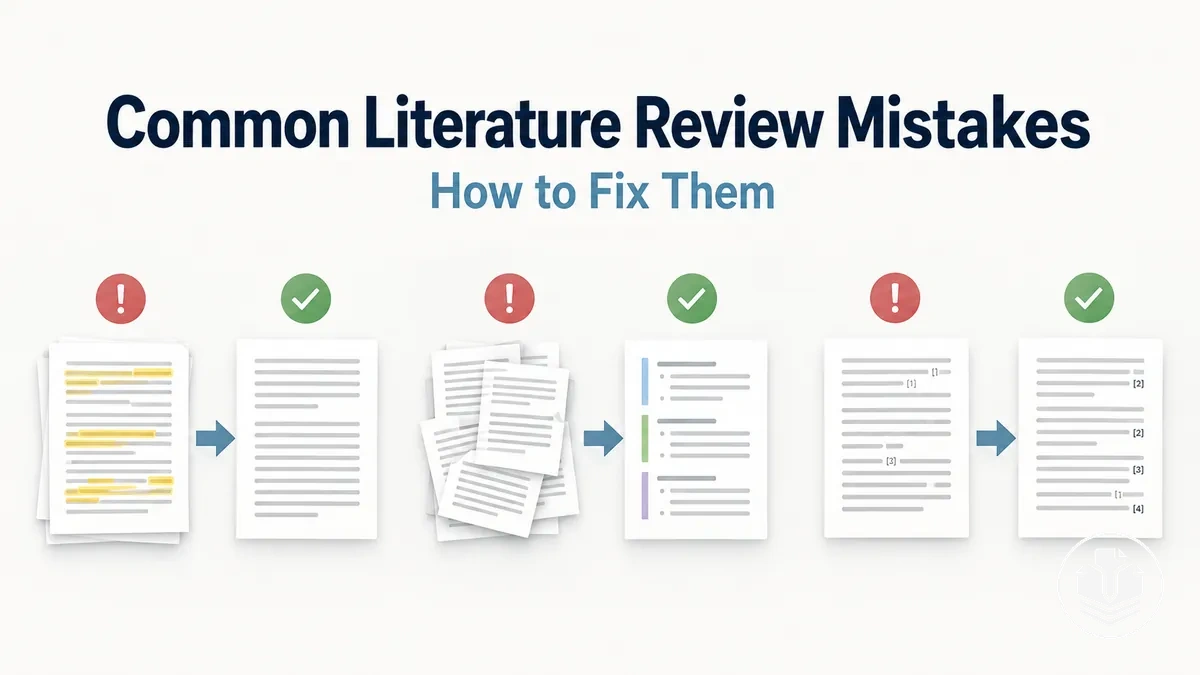
Diagnose the weakness before choosing the fix
Match the visible problem to the relationship that needs checking. A symptom is a diagnostic cue, not proof of a single cause.
Synthesis
- Signal
- Sources appear one by one, or several findings are present but their relationship stays implicit.
- Check
- Whether agreement, contradiction, complementarity, comparison, evaluation, or interpretation is stated across studies.
- Correct
- Connect findings under an analytical claim and state the supported cross-source relationship.
Scope and search
- Signal
- Retrieval is dominated by irrelevant material, or plausible evidence within the question is repeatedly missed.
- Check
- The review-question boundary, concept coverage, terminology, population or context, timeframe when relevant, and database or source breadth.
- Correct
- Adjust meaningful concept and scope boundaries rather than chasing a fixed source, database, or keyword count.
Evidence selection
- Signal
- Sources are credible but do not contribute evidence to the defined review question.
- Check
- Conceptual fit, population or context fit, methodological usefulness, temporal relevance when material, and evidential contribution.
- Correct
- Include evidence because it helps answer the scoped question, not merely because it mentions the topic or comes from a prestigious source.
Organization and coherence
- Signal
- Paragraphs follow authors or retrieval order, repeat material, or move between ideas without a clear progression.
- Check
- The governing analytical idea, paragraph progression, evidence relationships, and whether each piece of evidence serves the local purpose.
- Correct
- Group evidence by the analytical relationship that matters, unless chronology or authorship is itself the relevant analytical basis.
Citation and attribution
- Signal
- A citation is present but the claim-source connection, ownership of an idea, or level of certainty is unclear.
- Check
- Claim support, source identity, attribution, paraphrase fidelity, and citation placement.
- Correct
- Make the evidence-to-claim relationship explicit and revise wording that is broader or more certain than the source supports.
First-fix rule: prioritize the confirmed problem that blocks the review's central purpose. Foundational scope, search, or evidence-selection problems can make later paragraph-level polishing premature because they may change the evidence set itself.
The significance of a weakness depends on the research question, discipline, review type, and assignment requirements. Not every stylistic difference is a substantive mistake; it becomes important when it weakens evidence relevance or coverage, cross-source synthesis, analytical organization, coherence, or claim-source accuracy.
Table of Contents
Signs a Literature Review Is Weak
A weak literature review is usually identifiable through recurring signals such as source-by-source reporting, weak cross-study connections, unclear focus, poor coherence, unsupported claims, or citations that do not clearly support the surrounding analysis.
No single symptom confirms one underlying cause because the same signal may reflect different problems.
The useful distinction is therefore between what can be observed and what still needs to be checked.
The diagram groups observable signals while keeping them separate from their possible causes, which may differ according to the research question and the evidence being reviewed.
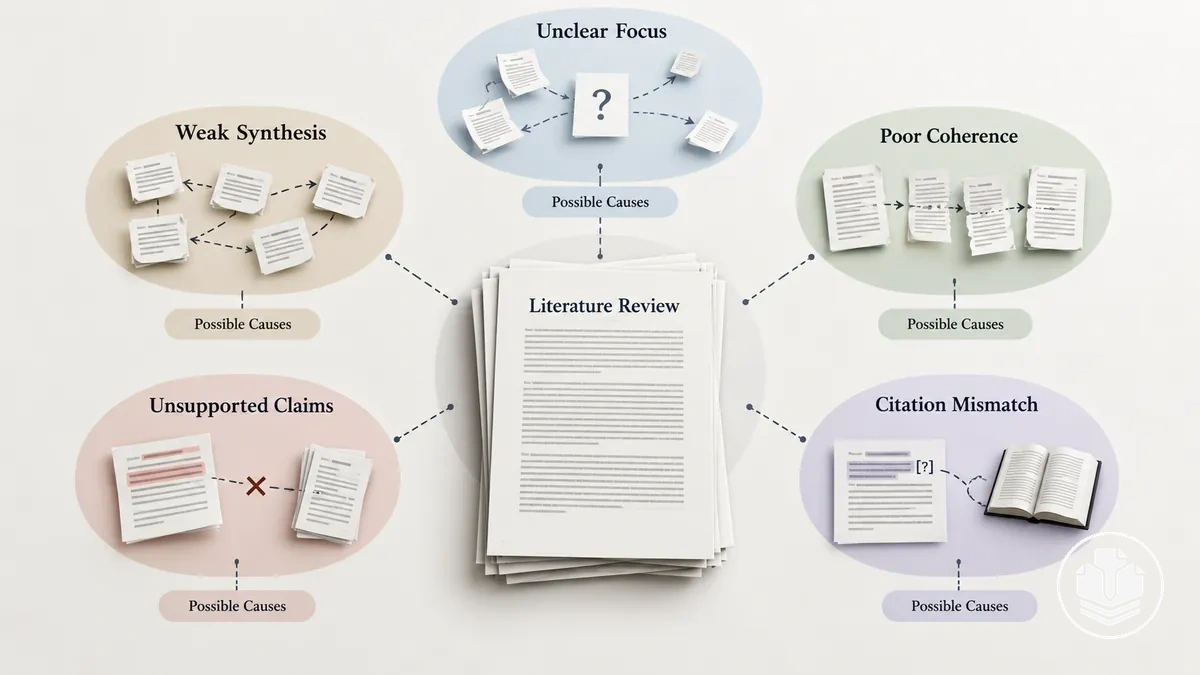
A compact diagnostic check can help distinguish each signal from its plausible interpretation and identify what warrants checking next:
- Sources are reported one by one: this may indicate weak synthesis; check whether the literature review explicitly states relationships such as agreement, contradiction, or complementarity across studies.
- Several studies are cited but their findings remain disconnected: this suggests that evidence may have been accumulated without a clear cross-study interpretation; check whether the combined evidence supports a shared analytical claim.
- The discussion repeatedly moves beyond the research question: this may reflect unclear focus or excessive scope; check whether each substantial source or discussion point is relevant to the review question.
- Paragraphs or sections do not form a clear progression: this may indicate a coherence or organization problem; check whether each part advances a recognizable line of reasoning rather than merely introducing another source or topic.
- A claim appears stronger than the evidence presented for it: this may indicate insufficient support or an interpretation that extends beyond the evidence; check whether the cited material supports the specific claim being made.
- A citation is present but its connection to the surrounding statement is unclear: this may signal an attribution problem rather than weak evidence itself; check which claim the cited source supports and whether that support is represented accurately.
Matching signals identify where further diagnosis is needed rather than establishing the cause by themselves.
For example, disconnected paragraphs may reflect weak organization, but they may also result from insufficient synthesis between sources; similarly, a poorly supported claim may reflect unsuitable evidence or an interpretation that extends beyond what the source establishes.
The next check should therefore distinguish the symptom from its plausible cause by examining the relationship between the research question, the claim, and the supporting evidence.
Correction should follow diagnosis rather than precede it.
Once the likely cause has been distinguished from the visible signal, the relevant weakness can be examined without treating every synthesis, focus, coherence, evidence, or citation problem as the same error.
Analysis and Synthesis Mistakes
Analysis and synthesis are connected but distinct functions in a literature review, and weakness in either can fragment the review's argument.
Analysis examines evidence through comparison, evaluation, and interpretation, while synthesis integrates findings and relationships across studies.
When sources remain isolated or their significance is unclear, the literature review may report evidence without developing the cross-study reasoning needed to justify its conclusions.
Reporting states what an individual source or study found, whereas comparison identifies similarities or differences between findings.
Evaluation assesses the significance, relevance, or limitations of evidence in relation to the review's purpose.
Integration connects evidence from multiple studies into patterns or relationships, while interpretation explains what those combined relationships mean for the argument.
These functions can work together, but analysis does not become synthesis merely because several sources appear in the same discussion.
The comparison graphic shows the evidence-processing relationship visually: separate-source reporting remains isolated, analysis compares or evaluates findings, and synthesis connects evidence across sources.
The connectors represent relationships among findings rather than a chronological sequence.

The following criteria distinguish the main evidence-processing functions and the contribution each makes to a literature review:
- Reporting: states a source's finding or position so the relevant evidence is represented.
- Comparing: identifies agreement, contradiction, similarity, or difference between findings from sources.
- Integrating: connects evidence across studies to establish a pattern, relationship, or combined line of reasoning.
- Evaluating: assesses the significance, relevance, or limitations of evidence for the question or argument being developed.
- Interpreting: explains what the compared, evaluated, or integrated evidence means for the review's argument or conclusion.
Weak analytical depth may leave findings insufficiently compared, evaluated, or interpreted, while weak synthesis may leave relevant studies disconnected even when each source is accurately summarized.
Either pattern can produce fragmented reasoning because the relationship between the evidence and the argument remains underdeveloped.
Recognizing whether the problem lies in separate-source reporting, limited analysis, or weak cross-source integration identifies the narrower error that needs correction.
Summarizing Sources Separately Instead of Synthesizing Across Them
Mentioning several sources does not create synthesis when the relationship among their findings remains unstated.
In that pattern, each source is reported as an isolated statement, so agreement, contradiction, complementarity, or another cross-study connection remains implicit.
The visual below isolates evidence integration rather than paragraph organization.
It contrasts separate findings with an explicit cross-source relationship such as agreement, contradiction, or complementarity.
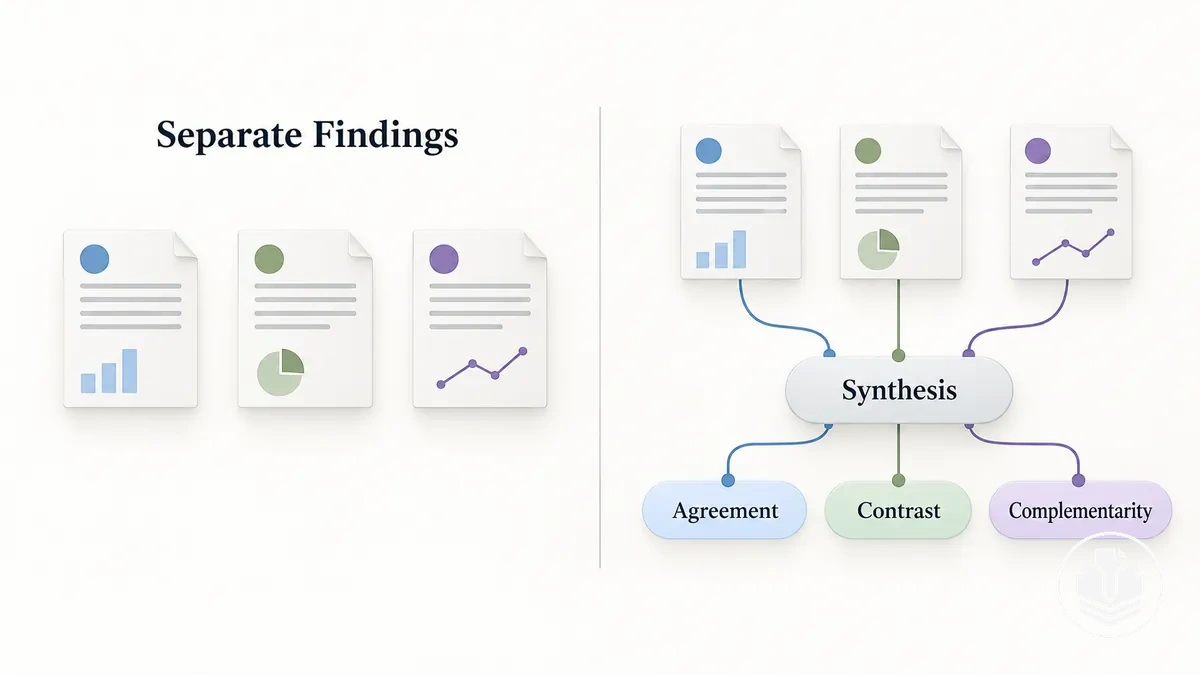
The same evidence can be reported separately or synthesized by making the cross-source relationship explicit.
Separate reporting
Source A reports that structured feedback supports revision decisions. Source B reports that feedback without specific guidance provides less direction for revision.
What remains missing: the relationship between the findings is left for the reader to infer.
Synthesis
The findings complement each other: Source A associates structured feedback with support for revision decisions, while Source B indicates that feedback provides less direction when specific guidance is absent, together suggesting that the usefulness of feedback depends partly on how clearly it guides revision.
What changes: the paragraph states both the cross-source relationship and its analytical implication.
A practical recognition cue is whether each source statement could stand alone without changing the paragraph's reasoning; if so, the cross-study relationship may still be missing.
The correction is to state the supported comparison or relationship among findings and connect it to the analytical claim rather than relying on transition words to imply synthesis.
Describing Studies Without Comparing or Evaluating Them
Descriptive reporting states what study findings say, while critical treatment evaluates their significance, limitation, or relevance to the review question.
Description can be necessary to establish the evidence, but the review remains descriptive when interpretation of that evidence never follows.
The contrast below uses relevance to the review question as the evaluative criterion and tests the difference between reporting evidence and interpreting it.
In this illustrative example, the descriptive version reports the finding: Descriptive: The study reports that structured feedback was associated with changes in students' revision decisions.
The critical version evaluates its relevance and implication: Critical: The finding is relevant to a review question about feedback and revision because it connects structured feedback with revision decisions, while its significance for a different review question would require evaluation against that question's criterion.
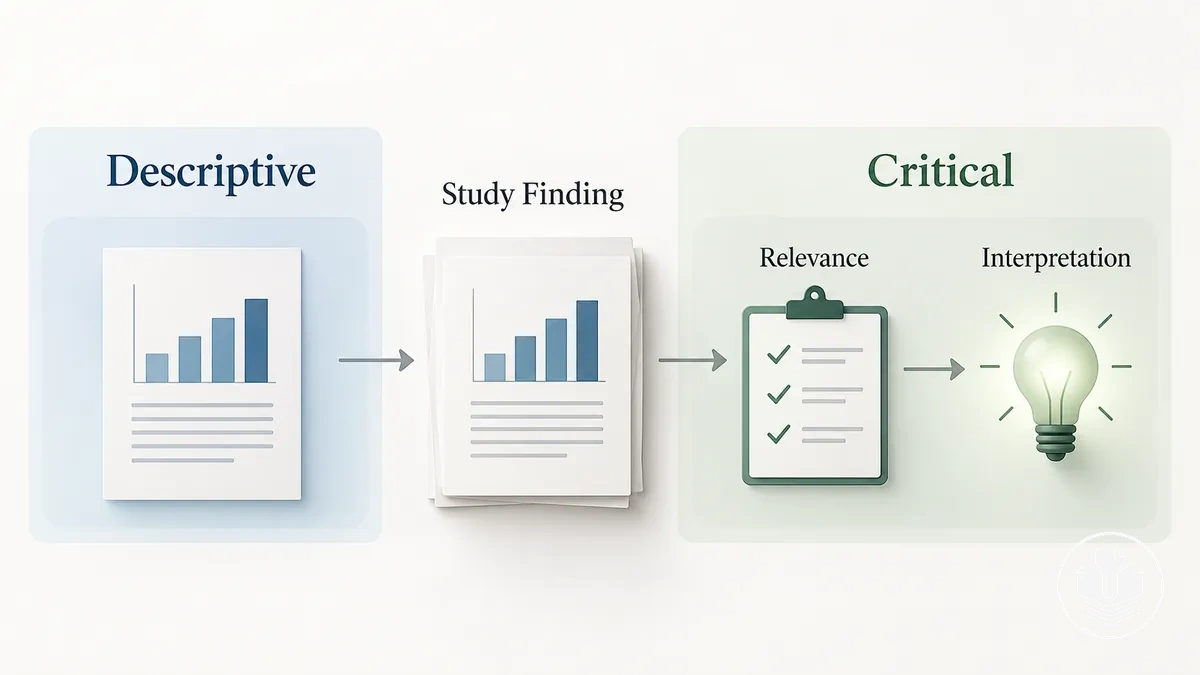
Description therefore has a legitimate role when it supplies evidence that analysis can assess, compare, or interpret; the mistake is stopping before evaluation establishes the evidence's significance, limitation, or relevance.
This subsection diagnoses that boundary, while descriptive versus critical writing addresses the fuller distinction.
Critical treatment means interpreting evidence against a relevant criterion, not treating the study negatively.
Failing to Show What the Combined Evidence Leaves Unresolved
Synthesis should show both what the combined evidence supports and what remains in conflict or uncertain.
The diagram classifies these evidence states rather than treating uncertainty as proof of a research gap, showing how evidence can converge on a pattern, conflict across findings, or leave an implication unresolved.
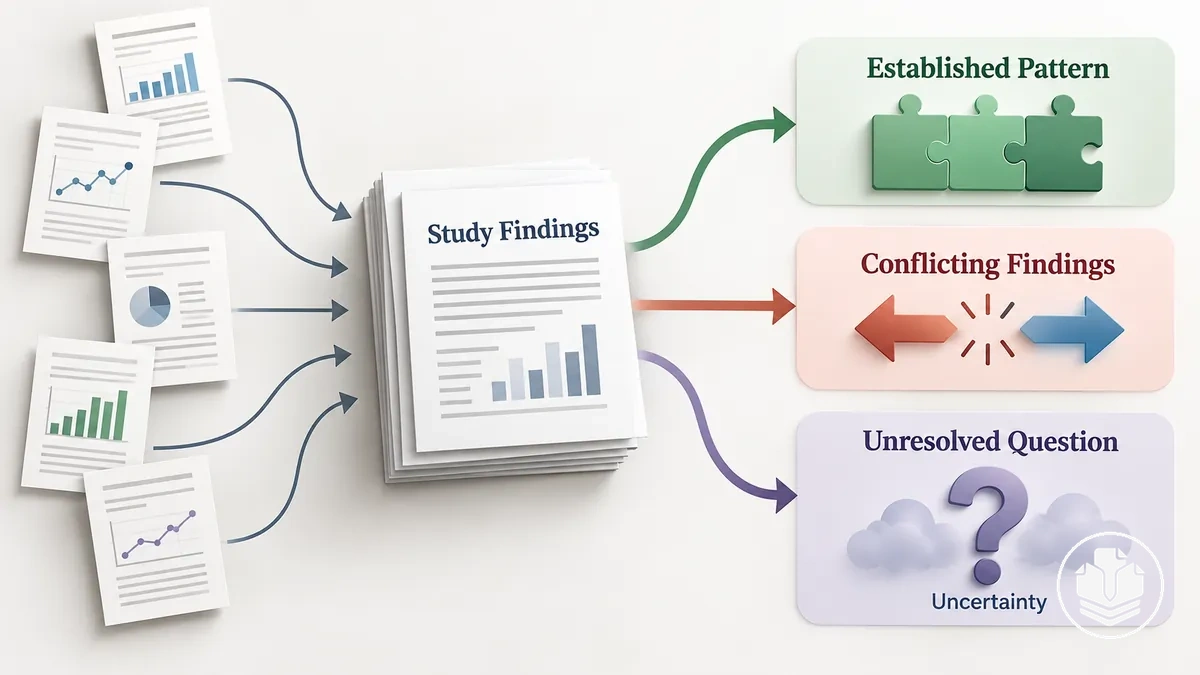
The combined evidence can support different interpretations according to its consistency, coverage, and explanatory completeness.
A consistent pattern may support a bounded conclusion, conflict may prevent one interpretation from representing all findings, and insufficient coverage may leave an unresolved question that the evidence does not establish.
The three evidence states below distinguish what the combined evidence can and cannot support and the implication of each state:
- Established pattern: findings converge sufficiently to support a bounded conclusion under the conditions represented by the reviewed evidence.
- Conflicting findings: findings differ in a way that limits a consistent interpretation, so the conflict should remain explicit in the conclusion.
- Unresolved question: the available evidence does not establish a particular implication because relevant coverage or explanatory completeness remains insufficient, so that point should remain uncertain.
For example, a group of studies could support the pattern that an intervention is associated with improvement under the conditions examined while leaving its implication for a different population unresolved.
The synthesis can state that supported conclusion and its limitation together without claiming that the uncertainty proves a research gap or that no relevant research exists.
Scope and Evidence-Selection Mistakes
Scope and evidence selection must align because the scope defines which evidence belongs in the literature review, while source selection determines whether the defined review question can be answered adequately.
A weak scope can admit evidence with limited relevance, while weak evidence selection can leave an otherwise appropriate boundary insufficiently supported.
The resulting conclusion may therefore become unfocused or incomplete even when the individual sources are credible.
Relevance is evaluated against the review question and its defined boundary rather than against source quality or quantity alone.
Population or setting matters when the review question is limited to particular groups or contexts, while the appropriate timeframe depends on the question, discipline, and purpose of the review.
Source type and methodological fit also matter conditionally because different questions may require different forms of evidence.
Coverage is adequate when the selected evidence supports the aspects of the defined question that the review intends to address, without implying that every potentially relevant source must be included.
More sources do not automatically produce a stronger literature review because source quantity does not resolve poor evidential fit.
For example, a study of university students may be relevant when the scope concerns higher education but outside the defined population when the same topic is reviewed specifically among primary-school pupils.
Adequacy therefore depends on alignment among the review question, scope, evidence, and review method.
The criteria below test that alignment rather than source quantity, while detailed scope errors, search problems, and source-selection errors remain separate issues.
- Concept and topical relevance: the source should address a concept or relationship included within the scope and contribute evidence relevant to the review question.
- Population or context: where the review question specifies a population or setting, the source should match that boundary or have a clearly justified role despite a contextual difference.
- Timeframe: evidence should fall within the defined time boundary when time is part of the scope; the appropriate boundary depends on the review question and purpose rather than a universal recency rule.
- Source type: the included source type should be suitable for the evidence the review question requires rather than included solely because it is available.
- Methodological fit: a source's method should be capable of contributing evidence to the particular question or relationship being examined.
- Coverage: the selected evidence should provide sufficient support for the aspects of the defined scope being addressed; weak coverage may leave the resulting conclusion incomplete even when many sources have been included.
Using a Scope That Is Too Broad or Too Narrow
A literature review scope that is too broad can reduce depth by spreading the review across more concepts, contexts, or evidence than can be examined meaningfully, while a scope that is too narrow may omit necessary context or leave inadequate evidence for the review question.
Scope breadth is therefore workable when its boundary supports sufficient coverage and depth without weakening relevance or manageability.
The point at which a scope becomes broad, workable, or overly narrow depends on the review question, discipline, review type, and available evidence rather than a universal number of topics, years, or sources.
The comparison evaluates each scope state by coverage depth, relevance and manageability risk, and its likely implication for synthesis.
| Scope state | Coverage depth | Relevance/management risk | Likely implication |
|---|---|---|---|
| Broad | Coverage extends across many relevant areas, which can limit the depth given to each area. | Greater risk of including material with weaker relevance or creating an unmanageable boundary. | Synthesis can become superficial when relationships across the included evidence cannot be examined adequately. |
| Workable | Coverage is sufficiently focused to examine the evidence at the depth required by the review question. | The boundary keeps included evidence relevant and manageable for the review's purpose. | Synthesis can develop supported relationships across evidence while retaining necessary context. |
| Overly narrow | Coverage may exclude context or evidence needed to address the defined question. | Greater risk of excluding relevant populations, concepts, timeframes, or contextual evidence. | Synthesis may rest on insufficient context or evidence for the conclusion being developed. |
For example, a review question about an intervention across all educational settings has a broader population boundary than the same question limited to primary schools; narrowing the population changes which studies are relevant and may permit greater depth, but it also excludes evidence from other educational settings.
The appropriate scope is the boundary that fits the review question and available evidence closely enough to support relevant coverage, depth, and manageable synthesis.
Using an Unfocused or Overly Narrow Search
An unfocused literature search retrieves excessive irrelevant material, while an overly narrow search can miss plausible evidence that belongs within the review question.
Search focus is therefore a diagnostic balance: excessive breadth reduces relevance, whereas excessive restriction can reduce evidence coverage.
Search alignment depends on whether the concepts and terminology represent the review question closely enough to retrieve relevant evidence without excluding plausible variants.
Database or source breadth may also affect retrieval when relevant evidence is distributed across different sources, but the appropriate breadth depends on the review question and method rather than a fixed database count.
Precision describes the proportion of retrieved material that is relevant, whereas recall concerns how much of the relevant material is retrieved.
The criteria below use these relationships to distinguish noisy retrieval from incomplete retrieval and identify a corrective direction.
- Review-question alignment: an unfocused search may include concepts outside the defined question, while an overly narrow search may constrain a concept more tightly than the question requires; correct the boundary by aligning each included concept with the review question.
- Concept coverage: excessive concept breadth can introduce irrelevant results, while omitted or unnecessarily restricted concepts can leave relevant evidence outside retrieval; adjust the concept boundary rather than adding arbitrary keywords.
- Terminology coverage: broad but weakly related terminology can reduce precision, while excluding plausible synonyms or disciplinary terminology can reduce recall; retain terminology that represents the intended concept under the review conditions.
- Database or source breadth: retrieval may be incomplete when relevant evidence falls outside the sources searched, while indiscriminate expansion can increase irrelevant material; judge breadth according to where evidence relevant to the review question is likely to be represented.
- Precision and recall: a search dominated by irrelevant results indicates a precision problem, whereas plausible relevant evidence repeatedly missed by the search indicates a recall problem; correction should address the observed retrieval pattern rather than maximize either measure in isolation.
For example, if a review question concerns digital feedback in higher education, a search covering feedback in every educational setting may be diagnostically narrowed by applying the higher-education concept boundary; if the search instead restricts the concept to one unnecessarily specific type of digital feedback, broadening that concept boundary may recover relevant evidence.
This adjustment diagnoses search breadth by changing a meaningful concept boundary rather than adding arbitrary terms.
Detailed construction and refinement of searches belongs to the search strategy context.
Including Sources That Do Not Clearly Relate to the Review Question
A source is not relevant merely because it mentions the literature review's topic; it must contribute evidence to the review question within the defined scope.
Credibility and relevance are separate attributes: a source may be credible yet unsuitable for inclusion when its evidence answers a neighbouring question rather than the question being reviewed.
Source relevance depends on conceptual fit, population or context fit, methodological usefulness, temporal relevance when time materially affects the question, and the source's evidential contribution to a specific analytical point.
These conditions vary with the review question and discipline, so recency or publication prestige cannot substitute for contextual fit.
The criteria below assess whether a source contributes pertinent evidence rather than whether it is prestigious:
- Conceptual fit: include the source when its concepts or relationships directly address an element of the review question; topical mention without that connection indicates weak relevance.
- Population or context fit: check whether the population, setting, or conditions represented by the source fit the defined scope or provide a justified contextual contribution.
- Methodological usefulness: assess whether the source's method produces evidence capable of supporting the particular relationship or analytical point being examined; methodological usefulness depends on the review question rather than credibility alone.
- Temporal relevance: when the review question makes time consequential, check whether the source represents the required period or remains informative for the point being examined; recent publication alone does not establish relevance.
- Evidential contribution: retain the source when its evidence supports, qualifies, contrasts with, or otherwise informs a specific analytical point within the review's scope; exclude it when no clear contribution to the review question can be identified.
For example, a credible study about digital feedback in workplace training may discuss the same broad topic as a review of digital feedback in higher education, yet it can remain outside the review when the question specifically concerns university students and the workplace evidence does not contribute to that defined context.
The exclusion reflects weak contextual relevance, not weak credibility.
Organization and Coherence Mistakes
Organization becomes weak when the order of material obscures the analytical relationships the literature review is meant to establish.
Arrangement and coherence are related but distinct: organization determines where evidence appears, while coherence depends on whether the reader can follow the governing idea, progression, and relationship among parts.
A fragmented structure can therefore weaken the argument even when the individual evidence is relevant.
Each paragraph should have a governing idea that determines which evidence belongs there and how that evidence contributes to the local analytical purpose.
Progression between paragraphs should make the movement from one idea to the next intelligible rather than abrupt.
Relationships among evidence should also be explicit enough for the reader to see agreement, contrast, qualification, or another relevant connection.
Content-purpose fit matters because evidence that does not serve the paragraph's analytical function can interrupt coherence even when it is individually useful.
Fragmented organization can appear as repetition, abrupt transitions, or source-by-source reporting in which the order follows authors or retrieval sequence rather than an analytical relationship.
For example, the same evidence may be clearer when studies are grouped around a shared analytical relationship instead of being presented in author order.
The criteria below test coherence without assuming that one organizational method is correct for every literature review.
- Governing idea: each paragraph should organize evidence around a clear analytical point rather than around whichever source appears next.
- Paragraph progression: each paragraph should connect logically to the preceding and following material so the argument develops rather than restarts.
- Evidence relationship: the organization should make relevant relationships among sources visible, such as agreement, contrast, qualification, or complementarity.
- Content-purpose fit: the evidence included in a paragraph should support its stated analytical purpose; material that does not contribute can create repetition, distraction, or an abrupt transition.
Organizing the Review Around Sources Rather Than Analytical Ideas
Source-led organization can turn a literature review paragraph into a catalogue when each author or study becomes the organizing principle.
Idea-led organization instead groups sources around analytical ideas, such as a theme, debate, pattern, or method, so the paragraph focus and cross-source connection are easier to follow.
The same body of evidence can produce a very different paragraph depending on what governs its order.
Source-led paragraph plan
Begin with Source A and summarize its study, move to Source B and summarize its study, then introduce Source C as another separate contribution.
Likely effect: repeated author-name openings and one-source units can leave the governing relationship implicit, so the paragraph reads mainly as a sequence of sources.
Idea-led paragraph plan
Begin with the analytical idea that governs the paragraph, then group Source A, Source B, and Source C according to how they contribute to that theme, debate, pattern, or method.
Likely effect: the shared analytical focus and cross-source connection remain visible without requiring author order.
Chronological or author-focused organization is not inherently weak; it can be appropriate when chronology, authorship, or the development of a particular scholar's position is itself analytically relevant.
The practical task is to choose an organizing principle that serves the paragraph's analytical purpose, while detailed construction of literature review paragraphs belongs to the paragraph-writing context.
Citation and Attribution Mistakes
Citation and attribution mistakes are evidence-use and traceability problems, not merely formatting defects.
A citation identifies the source connected to a claim, while attribution clarifies whose idea, finding, or interpretation is being represented.
When that relationship is inaccurate or unclear, the claim may misrepresent the evidence or become difficult to trace back to its source.
Claim support concerns whether the cited evidence actually supports the statement being made, while source accuracy concerns whether the correct source is identified for that evidence.
Attribution clarity makes the origin of an idea or claim explicit rather than leaving authorship ambiguous.
Paraphrase fidelity requires the rewritten wording to preserve the source's relevant meaning without making the claim broader or more certain than the evidence supports.
Citation placement affects traceability because the citation should correspond clearly to the claim or evidence it supports rather than leave its referent uncertain.
Citation quantity alone does not establish the quality of a literature review because a large number of references can still contain weak claim support, inaccurate attribution, or poor relevance.
Style-specific requirements determine details of reference formatting and placement, but those conventions are secondary here to maintaining an accurate and traceable relationship between each claim and its source.
The following criteria distinguish these evidence-use functions and provide the basis for identifying the more specific citation and attribution errors that follow.
- Claim support: the cited source should provide evidence that corresponds to the specific claim being made; a citation does not validate a claim when the source supports a different or narrower proposition.
- Source accuracy: the citation should identify the source from which the represented evidence, finding, or idea actually comes so the claim can be traced accurately.
- Attribution clarity: the wording should make clear which idea, finding, or interpretation belongs to the cited source and which analysis belongs to the literature review writer.
- Paraphrase fidelity: a paraphrase should preserve the relevant meaning and level of certainty of the source rather than alter, overstate, or detach the evidence from its original qualification.
- Citation placement and traceability: the citation should be positioned so its relationship to the supported claim is clear enough for the reader to identify and verify the relevant source.
Adding Citations Without Explaining Their Relevance
A citation does not explain its own relevance to a literature review claim.
The surrounding prose must state how the cited evidence supports, qualifies, agrees with, or contrasts with the claim, pattern, or limitation being interpreted.
The key question is not whether a citation is present, but whether the prose explains the evidence-to-claim relationship at the level of certainty the source supports.
Weak connection
Structured feedback may influence revision decisions (Source A).
Problem: the citation identifies a source, but the sentence does not explain what relationship the source actually supports.
Explained connection
Source A reports an association between structured feedback and revision decisions, supporting the claim that feedback structure is relevant to revision decisions while leaving causation unresolved.
Improvement: the sentence states both the supported relationship and its evidential limit.
Citation presence and analytical explanation perform different functions: the citation identifies the source, while the prose makes the evidence's relevance to the claim explicit.
Where the evidence instead shows agreement, contrast, or a limitation, the explanation should name that supported relationship rather than simply add another reference.
Citing Sources Inaccurately or Without Clear Attribution
Claim-source accuracy can fail in several distinct ways: citation details may identify the source incorrectly, attribution may leave the origin of an idea unclear, a paraphrase may distort the source's meaning, or the cited source may not support the written claim.
These errors affect traceability or fidelity even when a citation is present.
Verification should compare the written claim with the original source rather than treat citation presence as sufficient.
Traceability concerns whether the correct source can be identified and connected to the relevant statement, while fidelity concerns whether the quotation or paraphrase preserves what that source actually supports.
The checks below move from source identity to claim meaning and attribution placement so each claim-source pair can be verified directly.
- Source identity: check that the author or source named in the citation matches the original source being used; a mismatch fails traceability and requires correction of the reference detail.
- Claim correspondence: check that the original source supports the specific proposition attributed to it; if the source supports a narrower or different claim, revise the written claim or use appropriate supporting evidence.
- Paraphrase fidelity: compare the quotation or paraphrase with the source's meaning, scope, and level of certainty; wording that broadens, narrows, or strengthens the conclusion should be corrected to match the source.
- Attribution placement: check that the citation is positioned so the reader can identify which claim, finding, or idea it supports; unclear placement requires attribution to be made explicit.
For example, a source might report an association under specified conditions while a paraphrase states that the factor causes the outcome; the citation is present, but the paraphrase overstates the source's conclusion and fails fidelity.
A failed verification check establishes a citation or attribution problem that requires correction, but an ordinary error does not by itself establish intentional misconduct.
Which Literature Review Problems to Fix First
The first correction should target the problem that most directly prevents the literature review from answering its research question.
Priority then depends on severity, dependency, and whether the problem affects synthesis, relevance, coherence, or evidence integrity strongly enough to block useful downstream work.
Severity indicates how much the problem weakens the review's ability to support its central purpose, while dependency asks whether other weaknesses arise from it or cannot be corrected properly until it is resolved.
A scope or search problem, for example, can affect which evidence is available, whereas a paragraph-level issue may depend on that evidence already being appropriate.
Locating the weakness within the broader literature review process helps distinguish a foundational problem from a downstream symptom.
The sequence below therefore prioritizes dependency rather than assigning a universal ranking to every mistake.
- Identify the blocking symptom: determine what currently prevents the review from answering the research question, such as irrelevant evidence, missing coverage, fragmented synthesis, unclear coherence, or weak evidence integrity.
- Test the likely cause: treat the symptom as a diagnostic cue rather than proof of one cause. Check whether the weakness originates in scope, search, evidence selection, synthesis, organization, citation, or another relevant condition before choosing a correction.
- Judge severity and dependency: assess how strongly the confirmed problem affects the research question and whether later corrections depend on it. A foundational problem should be addressed before downstream polishing when leaving it unresolved would make that polishing premature or misleading.
- Choose the corrective direction: correct the verified cause at the level where it occurs, then reassess whether related symptoms remain. Do not assume that one correction automatically resolves every downstream issue.
For example, polishing transitions between paragraphs has limited value when the review first needs a scope correction because relevant evidence has been excluded or unrelated evidence included.
Correcting the structural problem may change which sources and arguments remain, after which sentence-level refinement becomes more meaningful.
Once the blocking cause has been identified and prioritized, the systematic process to revise and edit the review belongs to the dedicated revision context.