
Literature Review Writing: Building a Coherent Critical Synthesis
A literature review is written by defining a research question and scope, finding and evaluating relevant evidence, organizing studies around relationships rather than individual sources, and synthesizing those relationships into a qualified argument. Critical synthesis—not source-by-source summary—is the central analytical task, and the strength of each conclusion should match the quality, comparability, and limits of the evidence.
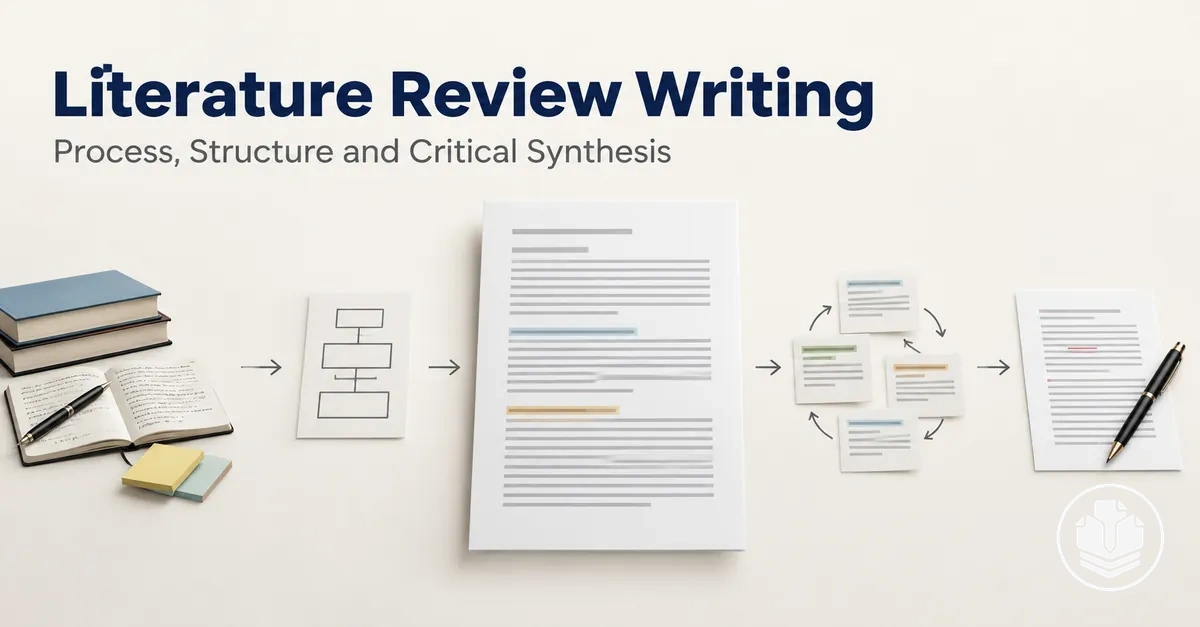
Literature review writing at a glance
Use the research question as the control point for the whole review: each stage should narrow, test, organize, or interpret evidence in a way that serves that question.
- Define the boundaryPurpose + research question + scope → evidence requirements and inclusion boundaries.
- Find and evaluate evidenceUse a review method and selection logic that fit the question, then assess relevance and evidence quality.
- Organize relationshipsGroup evidence by themes, claims, methods, chronology, debates, or another logic that makes cross-source connections visible.
- Synthesize and qualifyCompare, contrast, critique, and connect findings; explain how methodology, context, and limitations affect the interpretation.
- Write and reviseAlign the final argument with the research question, the reviewed evidence, and the limits of what that evidence can support.
When studies differ, examine method, population, setting, measurement, context, and evidence quality before deciding what the combined evidence supports.
Not a fixed formula: searching, evaluation, synthesis, and revision can send the review back to an earlier stage, and the exact method or stage count depends on the review purpose and discipline.
The process is connected rather than strictly linear: later searching, analysis, or writing can expose gaps that require earlier decisions to be revisited. Fixed descriptions such as five-step or seven-step processes are organizing frameworks rather than universal rules.
Table of Contents
Planning Decisions That Shape the Review
Literature review planning sets the review’s evidence boundaries and evidence-handling logic before detailed execution begins.
Planning decisions shape which scholarly evidence is relevant to the research objective and which evidence falls outside the intended scope.
They also affect manageability by constraining the body of evidence that the review needs to examine.
The purpose of a literature review provides the basis for making narrower decisions about scope and methodological approach.
Scope sets inclusion boundaries, while the research question expresses the specific research focus those boundaries must support.
The review method then shapes how evidence will be identified, handled, and synthesized in relation to that objective.
These decisions can be refined iteratively, but each creates constraints for the evidence requirements that follow.
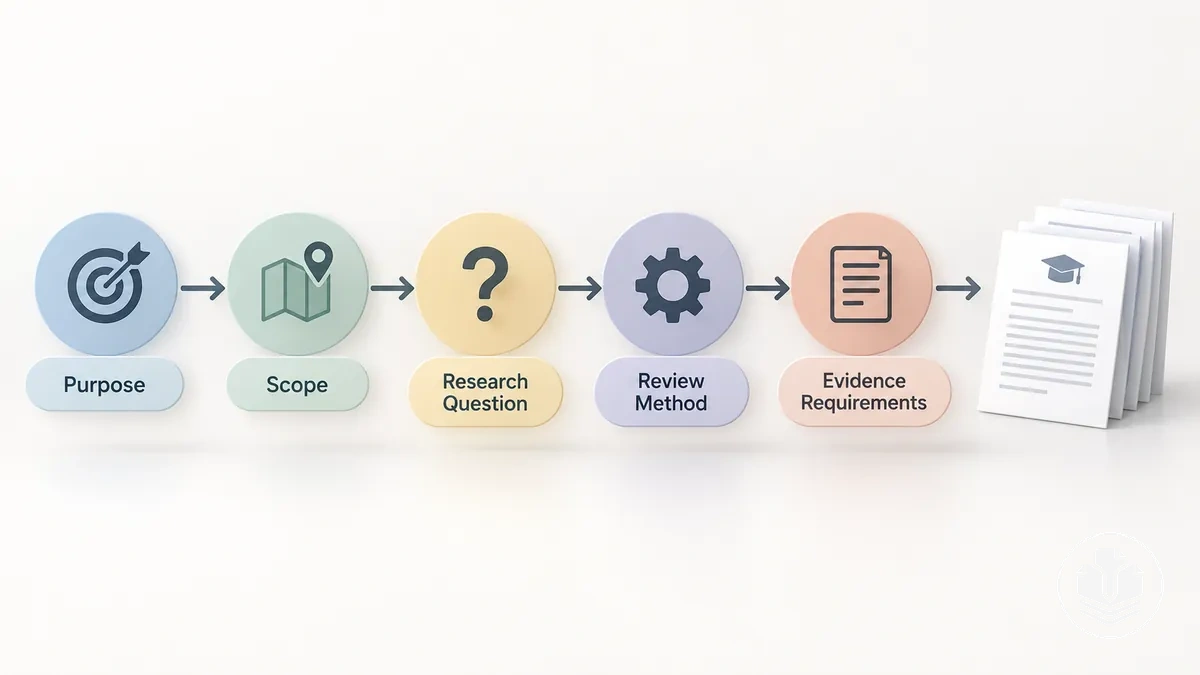
The four planning nodes create related constraints on what evidence remains relevant and manageable:
- Purpose: establishes what the review is intended to accomplish, providing the criterion for judging the relevance of later planning decisions.
- Scope: bounds the subject, context, or evidence considered relevant, limiting what can legitimately enter the review and helping keep the evidence base manageable.
- Research question: specifies the focus the evidence must address, connecting the review’s purpose and scope to more precise evidence requirements.
- Review method: defines the methodological approach to handling evidence, with the appropriate choice depending on the research objective, scope, and type of synthesis required.
The planning diagram shows the directional relationship between the review’s purpose and boundaries, the methodological approach, and the resulting evidence requirements.
For example, a review intended to map the breadth of research on a topic may require broader evidence boundaries than one designed to answer a narrowly defined question.
That change in purpose can alter the appropriate scope or review method, changing the evidence requirements and the amount of material that remains relevant and manageable.
Scope and Research Question Define the Review Boundaries
Scope and the research question define the review boundaries by specifying what the review examines and what falls outside its focus.
These boundaries affect source inclusion because evidence remains relevant only when it fits the conditions established for the review.
Boundary dimensions can include the topic focus, time period, evidence type, population, setting, and disciplinary context when these conditions are relevant to the research question.
Each dimension changes the evidence set by establishing an inclusion condition rather than an arbitrary limit.
The main dimensions and their implications for source inclusion are:
- Topic focus: includes evidence that addresses the defined subject or relationship and excludes material outside that research focus.
- Time period: includes evidence from the period relevant to the research question when a temporal boundary is necessary.
- Evidence type: limits source inclusion to the forms of evidence appropriate to the review’s purpose and intended synthesis.
- Population: includes evidence concerning the population specified by the research question when population characteristics affect relevance.
- Setting: limits the evidence set to contexts, locations, or environments relevant to the question when setting changes the applicability of findings.
- Disciplinary context: includes literature from the field or fields needed to address the research question without assuming that every review requires a disciplinary restriction.
The diagram clarifies how these scope dimensions filter a broad research question into an included evidence set while keeping out material beyond the review boundaries.
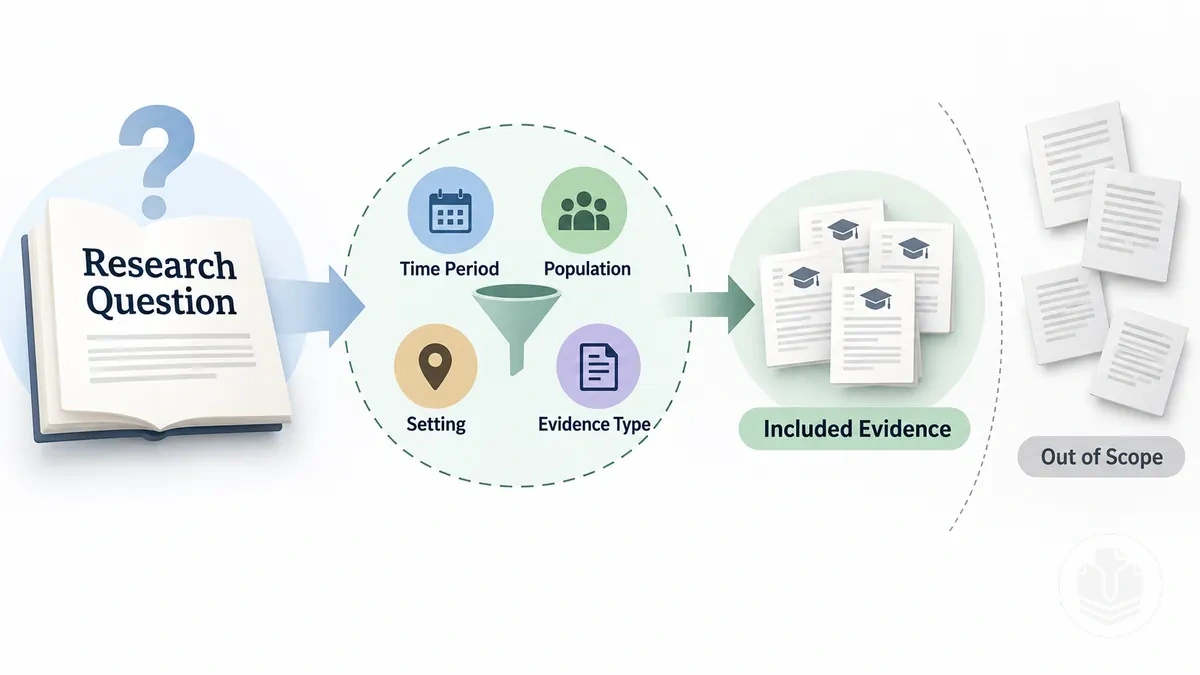
For example, a broad question about social media and student mental health could produce a wider evidence set than a question limited to a specified population and outcome.
Researchers who need to define the scope of a literature review can specify only the boundary conditions justified by their research question, keeping source inclusion relevant and the resulting synthesis manageable.
Review Method Determines How Evidence Is Handled
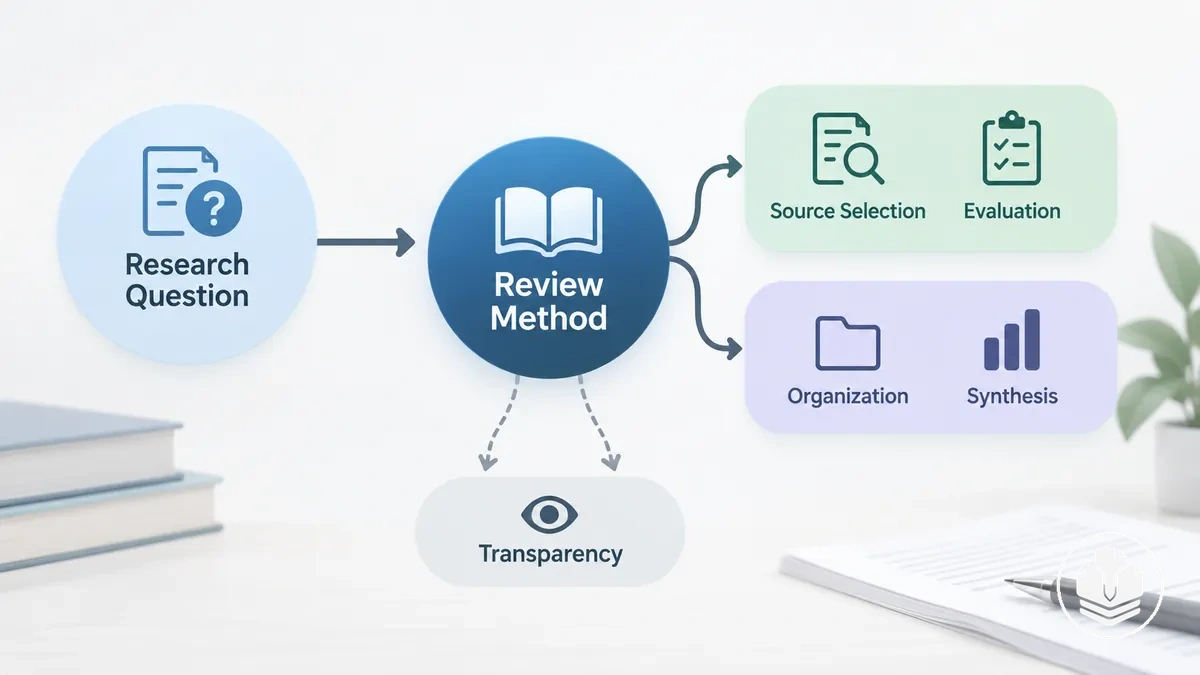
A review method shapes how evidence is identified, selected, evaluated, organized, and synthesized.
Different methods can therefore impose different evidence-handling requirements, including how source selection and evaluation are documented.
Common approaches include systematic, scoping, narrative or traditional, integrative, and rapid reviews. Their search, selection, appraisal, and reporting expectations differ, so method choice should follow the review question, scope, and evidence requirements rather than a universal hierarchy.
Method fit depends on the review’s purpose, research question, scope, and the evidence requirements needed to answer that question.
These conditions affect the appropriate approach to evidence handling without making one review method inherently superior.
The diagram shows how the research question connects through the review method to source selection, evaluation, organization, and synthesis.
- Research question: the review method should fit the kind of question the evidence is expected to address.
- Scope: the methodological approach should support the intended coverage and the boundaries of the evidence being examined.
- Evidence requirements: the method should provide an appropriate basis for source selection, evaluation, organization, and synthesis within the review context.
Requirements for transparency, coverage, and protocol detail can differ by research objective, discipline, and review type, so method fit remains context-dependent.
Writers who need to choose a literature review method should base detailed selection on the review’s purpose, research question, scope, and evidence-handling requirements rather than treating one approach as appropriate for every review.
How the Major Stages of Literature Review Writing Fit Together
The literature review workflow moves through connected stages from defining the research question and scope to finding evidence, source evaluation, organization, synthesis, writing, and revision.
Each stage produces decisions or material that support the next stage.
The workflow is often iterative because searching, analysis, or writing can reveal reasons to revisit earlier decisions.
Published guides group these broad functions into different numbers of stages, so no single step count is universal.
The sequence is more useful as a functional literature review process than as a rigid formula.
The image organizes the major stages and makes feedback between later and earlier work visible.

- Define the review focus: establish the research question and scope, producing boundaries to guide the search and later source selection; verify that these boundaries match the intended review focus before continuing.
- Search for evidence: use the defined focus to identify potentially relevant literature, producing a candidate evidence set for assessment.
- Evaluate and select sources: assess candidate evidence against the review requirements, producing a selected evidence set; verify that retained sources satisfy those requirements before analysis.
- Organize the evidence: arrange selected sources, notes, findings, and relationships into a synthesis base; verify that the organization supports comparison across the evidence.
- Synthesize and interpret: compare the organized evidence to identify patterns, differences, relationships, and limitations, producing an interpretation that can support the review’s argument.
- Write and revise: develop the synthesis into coherent writing, then revise it to produce a review whose evidence, interpretation, organization, and research question remain aligned.
Iteration can loop backward when source evaluation changes the evidence set, synthesis exposes a gap, or revision indicates that further search or organization is needed.
The fuller literature review process develops these stages in more procedural detail without treating the workflow as a one-pass sequence.
How Structure and Organization Support a Coherent Argument
Literature review structure organizes reasoning so the introduction, body, and conclusion perform distinct rhetorical functions within one coherent argument.
The introduction frames the review, the body develops relationships across the evidence, and the conclusion consolidates the resulting synthesis and implications.
Coherence depends on these components connecting their reasoning rather than functioning as isolated sections.
The components are distinguished by function rather than fixed length or paragraph count.
The introduction establishes purpose, scope, and framing; the body organizes evidence around relationships that develop the argument; and the conclusion draws together the synthesis and its implications.
The table maps each component to its rhetorical function, evidence or reasoning emphasis, and contribution to coherence.
The image clarifies how evidence flows through the organized body while all three components support one connected argument.

| Component | Primary function | Evidence or reasoning emphasis | Contribution to coherence |
|---|---|---|---|
| Introduction | Frames the review’s purpose, scope, and direction. | Establishes the problem, context, boundaries, and organizing focus needed to interpret the review. | Gives the later evidence and reasoning a clear argumentative frame. |
| Body | Organizes and develops the main argument across the evidence. | Groups and connects evidence through themes, chronology, methodology, or another justified organizational pattern. | Makes relationships among sources visible so the argument develops across sections rather than source by source. |
| Conclusion | Draws together the review’s main synthesis and implications. | Connects the principal patterns, relationships, limitations, or implications established in the body. | Closes the argumentative flow by relating the developed synthesis back to the review’s purpose. |
Body organization may follow themes, chronology, methodology, or another logic justified by the review’s purpose and evidence; relationship-based organization can make argumentative connections clearer than grouping material source by source.
Detailed guidance on literature review structure develops these organizational choices beyond this functional overview.
How Critical Synthesis Connects, Compares, and Evaluates Evidence
Critical synthesis relates evidence across studies to produce an integrated interpretation rather than reporting each source independently.
It compares relevant findings, methodology, and limitations to identify relationships across the evidence.
Those relationships provide the basis for a qualified claim that reflects both agreement and variation among studies.
- Compare
Look for agreement, contradiction, and broader patterns across relevant findings instead of counting studies on each side.
- Explain variation
A contradiction does not automatically mean one study is wrong; differences in methodology, population, setting, measurement, or research context may contribute to the variation.
- Weight the evidence
Evidence quality and methodological limitations affect how strongly a finding should contribute and whether apparently similar results are directly comparable.
- Form the claim
State what the combined evidence supports under the relevant conditions, while retaining material limitations, differences, and contradictions.
Example: if several studies report a similar relationship but use different populations or measures, the synthesis can identify the shared pattern while preserving those differences as limits on interpretation.
Writers learning to synthesize studies in a literature review can use this relationship-based method to connect findings, methodology, context, and evidence quality before forming a qualified claim.
Synthesis Goes Beyond Source-by-Source Summary
Both summary and synthesis report evidence, but they organize and interpret it differently.
A source-by-source summary treats each source as the main organizing unit, while synthesis groups evidence around relationships, comparisons, themes, or claims that support an argument.
Source-by-source organization can limit cross-source reasoning because findings remain attached to individual studies rather than connected across the evidence set.
Synthesis instead uses evidence grouping to make cross-source relationships explicit and support interpretation.
The comparison focuses on organizing unit, treatment of evidence, cross-source relationship, and analytical result.
| Writing pattern | Organizing unit | Treatment of evidence | Cross-source relationship | Analytical result |
|---|---|---|---|---|
| Source-by-source summary | Individual source | Reports each source’s findings or position separately. | Relationships between sources may remain implicit or undeveloped. | Produces mainly descriptive reporting of what each source says. |
| Synthesis | Theme, claim, issue, or relationship | Groups and compares evidence from multiple sources around a shared analytical focus. | Makes relationships among sources explicit through comparison and connection. | Supports interpretation and development of an evidence-based argument. |
For example, a summary might report two related findings separately, while synthesis connects them around a shared claim and explains their relationship.
Concise summary can therefore contribute to synthesis, but it does not replace the cross-source interpretation that gives synthesis its analytical value.
Quality Criteria for a Strong Literature Review
Literature review quality depends on several interacting criteria rather than a single metric.
A strong review is relevant to the research question, uses appropriate source selection, evaluates evidence quality, applies critical synthesis, maintains coherence, provides method-appropriate transparency, and presents information accurately.
No single criterion establishes overall quality.
Observable indicators help distinguish stronger from weaker performance across these dimensions.
Evidence-selection criteria indicate whether sources are relevant and appropriate for the review’s purpose, while analytical and organizational criteria reflect how effectively evidence is interpreted, connected, and communicated.
The table links each criterion to a strong indicator, a weak signal, and its implication for credibility, clarity, or usefulness.
| Criterion | Strong indicator | Weak signal | Why it matters |
|---|---|---|---|
| Relevance | Evidence directly addresses the research question and defined scope. | Sources are only loosely connected to the review focus. | Relevance keeps the evidence aligned with the review’s intended argument. |
| Source selection and evidence quality | Sources are selected using criteria appropriate to the review purpose, with evidence limitations considered. | Selection is inconsistent, weakly justified, or conducted without evaluating evidential strength. | Appropriate selection supports the credibility and usefulness of the evidence base. |
| Critical synthesis | Evidence is compared and integrated across sources to develop relationships and interpretation. | The review mainly reports sources separately with limited cross-source analysis. | Critical synthesis supports analytical reasoning rather than predominantly descriptive reporting. |
| Coherence | Ideas and evidence follow a clear argumentative flow with explicit relationships between claims. | Sections or source discussions are disconnected, repetitive, or difficult to relate to the argument. | Coherence helps readers follow how evidence contributes to the review’s reasoning. |
| Transparency | Relevant evidence-handling decisions are reported at the level appropriate to the review method and purpose. | Important selection, evaluation, or synthesis decisions are unclear or insufficiently reported. | Method-appropriate transparency helps readers understand how the review reached its interpretation. |
| Accuracy | Sources, findings, terminology, and qualifications are represented faithfully and consistently. | Claims misstate evidence, omit relevant qualifications, or contain citation and factual inconsistencies. | Accuracy supports reliable interpretation and reduces the risk of misleading conclusions. |
| Limitations | Relevant limitations in the evidence, method, or interpretation are acknowledged and connected to the claims made. | Constraints are omitted or conclusions extend beyond what the reviewed evidence supports. | Acknowledging limitations keeps conclusions proportionate to the strength and scope of the evidence. |
The relative emphasis of these criteria can vary by discipline, assignment, and review method, so literature review quality should be evaluated within its purpose and methodological context.
Reference count, word count, source recency alone, or adherence to one fixed formula should not be treated as universal proxies for quality.
The 5 C's of Literature Review Writing
Texas Tech University’s Graduate Writing Center documents a 5 C’s framework for literature review writing: Cite, Compare, Contrast, Critique, and Connect.
Its guide presents these principles as ways to organize and evaluate research while identifying connections within the literature and to the writer’s own contribution.
The five labels organize related evidence-handling behaviors that can support critical writing, synthesis, and coherence:
- Cite: credit the authors of relevant research and identify publication context, grounding evidence in its scholarly source.
- Compare: examine similarities among findings, methodologies, or research questions so shared patterns become visible across sources.
- Contrast: examine differences among findings, methodologies, or research questions so variation and disagreement remain visible in the synthesis.
- Critique: consider how well a study’s research question, methodology, and results fit together, supporting reasoned evaluation rather than unsupported judgment.
- Connect: relate findings from reviewed sources to the writer’s research, helping integrate evidence into a coherent analytical argument.
This documented 5 C’s framework is a writing aid rather than a universal academic standard for literature reviews.
Specific expectations for evidence handling and critical writing still depend on the discipline, assignment, and review context.
Problems That Commonly Weaken Literature Review Quality
Literature review quality problems commonly appear as lack of focus, weak source selection, poor organization, excessive source-by-source summary, insufficient critical analysis, or unsupported conclusions.
These observable states can emerge during planning, evidence handling, organization, or synthesis, but one visible symptom does not establish a single underlying cause.
Planning and evidence-handling weaknesses often become visible through relevance and source-selection problems.
A lack of focus may appear when included material does not consistently address the research question or scope, weakening relevance and making the review harder to delimit.
Weak source selection may appear when evidence quality or relevance is insufficiently evaluated, which can limit the rigor of the resulting interpretation.
- Lack of focus: evidence repeatedly drifts beyond the research question or scope, which can weaken relevance; briefly recheck the review boundaries.
- Weak source selection: included sources show unclear relevance or insufficient evaluation of evidence quality, which can limit rigor; briefly reassess selection criteria.
- Poor organization: sections or paragraphs lack a clear relationship to the developing argument, which can reduce coherence; briefly review the organizing logic.
- Excessive source-by-source summary: sources are reported separately with few explicit cross-source connections, which can restrict synthesis; briefly regroup evidence around relationships.
- Insufficient critical analysis: findings receive limited comparison, evaluation, or interpretation, which can weaken analytical depth; briefly examine relationships and limitations across evidence.
- Unsupported conclusions: conclusions extend beyond the presented evidence or omit important qualifications, which can weaken credibility; briefly align claims with the reviewed evidence.
Organization and synthesis problems become visible when the review reports sources separately, develops weak connections between sections, or provides limited critical analysis.
Unsupported conclusions are observable when claims extend beyond the evidence presented or overlook relevant limitations.
These symptoms indicate where closer review may be needed without confirming a particular underlying cause.
These problems can reduce relevance, coherence, rigor, or synthesis quality, depending on where and how extensively they occur.
Corrective work should address the specific observable weakness rather than assume that one remedy fits every case.
Detailed recognition and correction of common literature review mistakes belongs in the dedicated guidance.