How to Identify Research Gaps in a Literature Review
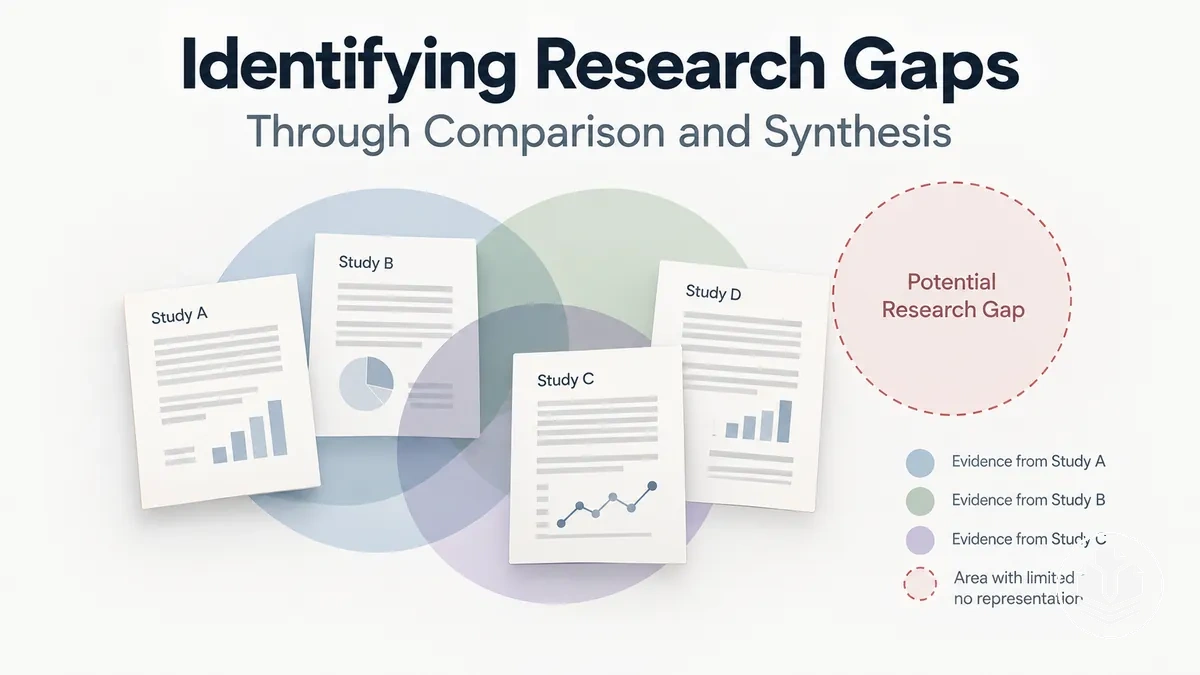
To identify a research gap in a literature review, compare recent and relevant studies for a recurring pattern of missing, insufficient, inconsistent, or underexamined evidence, then verify that the unresolved issue persists within the defined review scope. A gap becomes defensible when the claim is specific, evidence-based, and researchable without overstating novelty.
Research-gap validation path
Use the same four checks for any candidate gap: identify the signal, compare the evidence pattern, verify that it persists, then decide whether to retain, refine, or reject the claim.
1Find a candidate signalLook for an unanswered question, contradictory findings, insufficient or outdated evidence, a narrow population or context, or a future-research recommendation.
2Test the cross-study patternCompare scope, population, method, measurement, context, time period, and findings. One study, one recommendation, or one contradiction is only a clue.
3Verify the apparent gapCheck recent and relevant literature, terminology coverage, search breadth, source quality, and evidence fit to confirm that the unresolved issue remains within the review scope.
4Make the evidence-bounded decisionKeep the claim only when the unresolved relation is specific, supported by the evidence pattern, and researchable without claiming more novelty than the literature supports.
Retain
The unresolved pattern persists and the gap is specific and researchable.
Refine
The evidence supports a narrower population, condition, mechanism, context, or time boundary.
Reject
Better-matched or newer evidence resolves the apparent gap, or the signal came from a search or scope mismatch.
The key distinction is between a candidate signal and a validated research gap: indicators guide where to look, while validation determines what the literature actually leaves unresolved. This guide stays focused on research-gap identification and validation within a literature review rather than the entire literature-review or source-evaluation process.
Table of Contents⌄
What Counts as a Research Gap in a Literature Review
A research gap is missing information, inadequate information, an unresolved question, or insufficiently tested knowledge within the relevant literature.
The University of Louisiana Monroe Library describes a gap in the literature as missing pieces or insufficient information in published research on a topic.
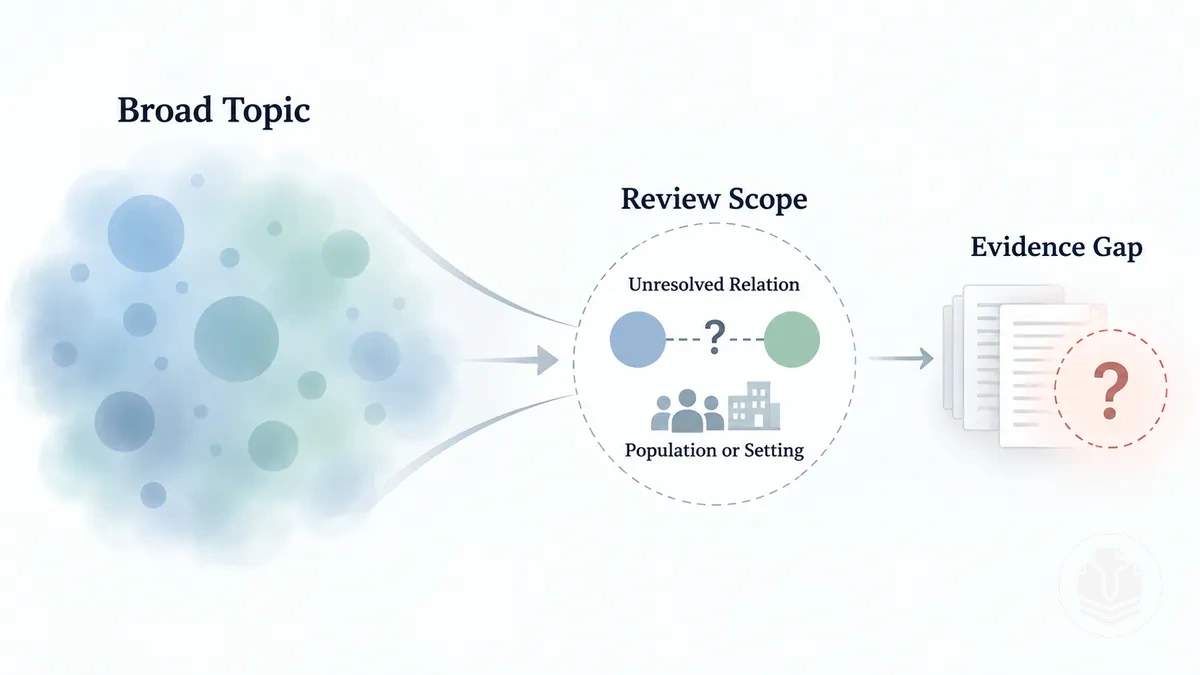
A research gap therefore describes a condition in the evidence base, not merely a broad topic that interests the researcher.
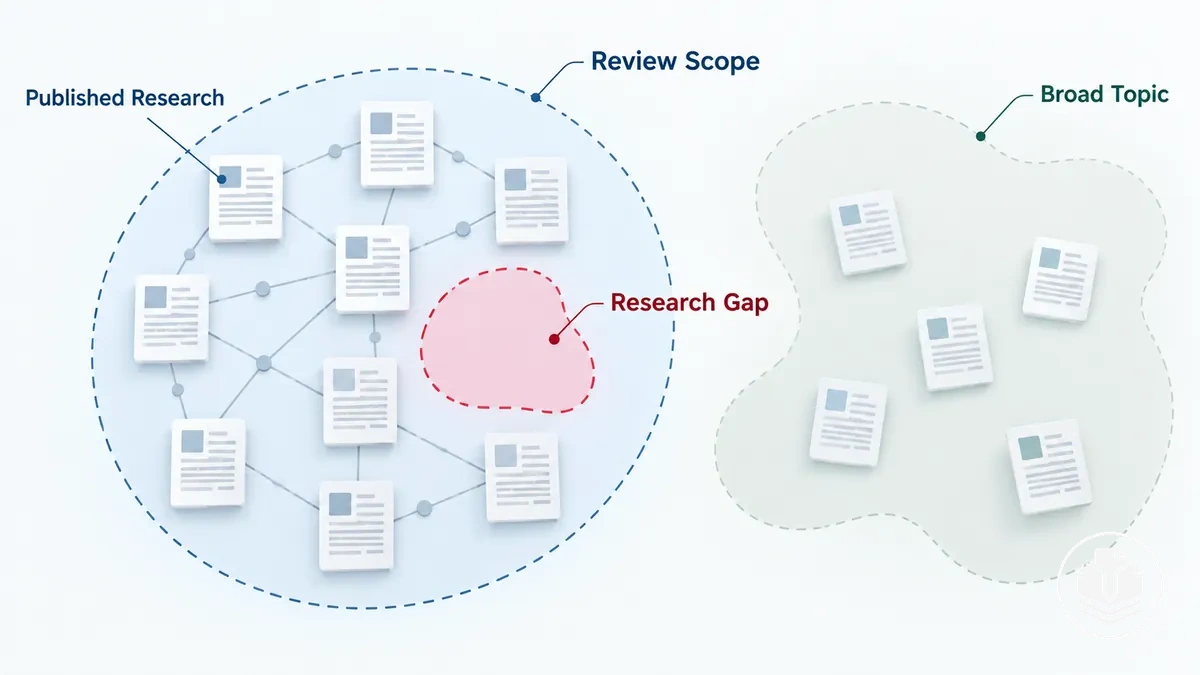
A research gap must be supported by the published research and bounded by the review scope, including the literature considered relevant to the question.
An apparent absence can change with search terminology, recency, or coverage, so one absent source is insufficient by itself to establish a gap.
The relevant distinction is whether the evidence base leaves knowledge missing, inadequate, or unresolved within the defined boundary.
The diagram makes this scope-and-evidence relationship visible by distinguishing a broad topic from an evidence-supported research gap.
For example, finding few studies on a broad topic does not by itself justify a research gap claim.
If relevant published research repeatedly examines an issue in one context while evidence needed to answer the review's question remains insufficient in another relevant context, the defensible claim is that knowledge is underexplored within that review scope, not that the topic has never been studied.
Research Gap vs Limitation
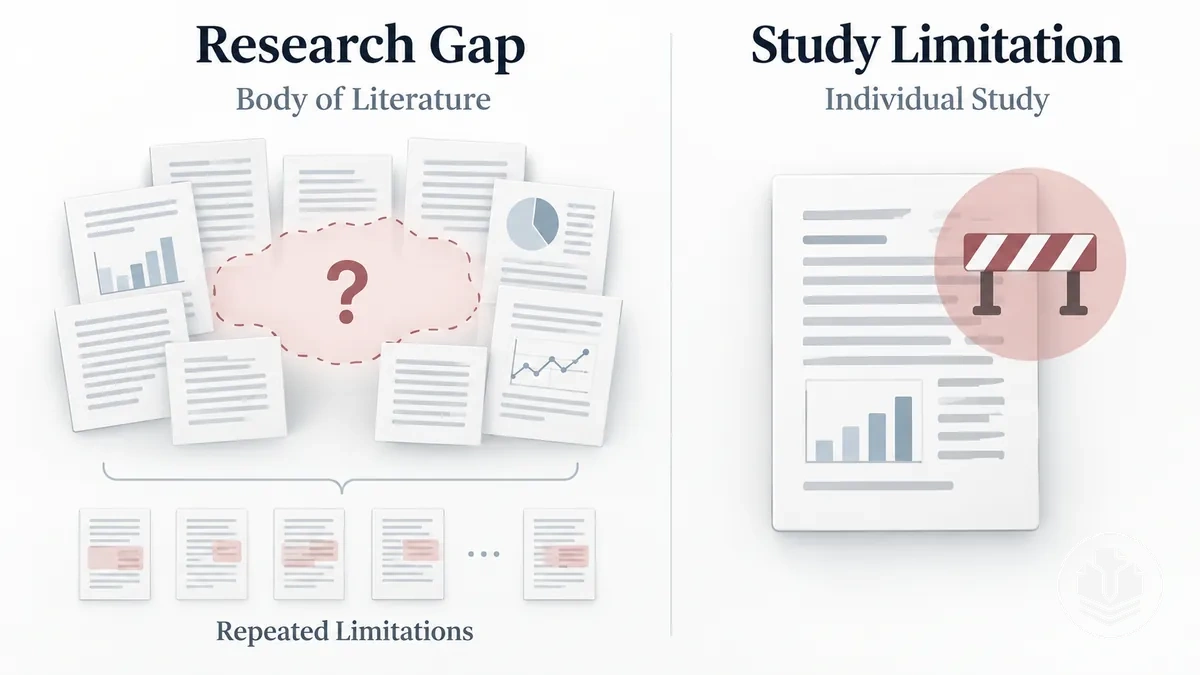
A research gap and a study limitation are not the same: a research gap concerns missing or unresolved knowledge across a body of literature, whereas a limitation constrains an individual study's design, evidence, or applicability.
Ross and Bibler Zaidi describe study limitations as weaknesses within a research design that may influence research outcomes and conclusions.
The comparison separates the unit of analysis, what is missing or constrained, the typical evidence, and the implication for further research.
Dimension
Research Gap
Study Limitation
Unit of analysis
Body of literature
Individual study
What is missing or constrained
Knowledge or evidence remains missing, insufficient, or unresolved across relevant literature
Study design, evidence, interpretation, or applicability is constrained
Typical evidence
A pattern across relevant studies showing unresolved or insufficient knowledge
A constraint or weakness identified in the design, methods, data, or applicability of one study
Implication
May justify further investigation when the gap is supported within the evidence base
Qualifies how the individual study's findings should be interpreted or applied
Repeated limitations across multiple studies may contribute evidence of a research gap when they form a consistent pattern that leaves an important question unresolved.
A limitation in one individual study does not automatically establish a research gap, so the distinction between study-level constraints and literature-level evidence should remain explicit.
Indicators That the Literature Contains a Research Gap
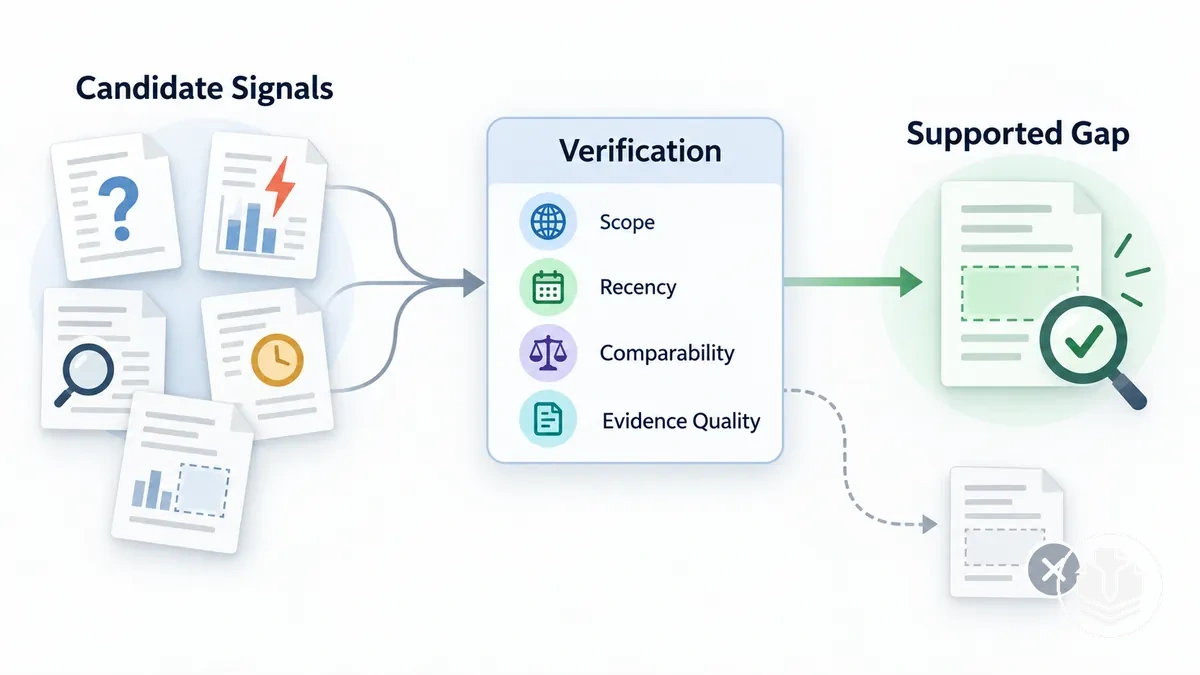
Research gap indicators are candidate signals that require interpretation and verification before they support a gap claim.
Their meaning depends on whether the signal remains relevant after checking the literature's scope, recency, comparability, and evidence quality.
The diagram shows how candidate signals move through verification before they can support a research gap interpretation.
Recurring signals include recommendations for future research, unanswered questions, contradictory findings, insufficient evidence, outdated evidence, and research concentrated in a narrow population or context.
Southern New Hampshire University Library identifies unanswered problems, outdated research, and insufficient study of a specific population as examples of possible research gaps.
Future-research recommendations can direct attention to unresolved issues, while contradictory findings may indicate an unresolved evidence pattern when the studies are sufficiently comparable.
Sparse coverage can also suggest a gap, but limited retrieval may reflect the search scope or terminology rather than missing knowledge.
The criteria below organise each candidate signal around the check needed before it is interpreted as evidence of a research gap.
Future research recommendations: Check whether the recommendation addresses an unresolved issue within the current review scope and is supported by other relevant literature rather than relying on one author's suggestion.
Unanswered questions: Check whether relevant studies leave the question unresolved after the available evidence has been examined.
Contradictory findings: Check whether the studies examine sufficiently comparable populations, contexts, variables, and conditions; differences between unlike studies may explain the apparent inconsistency.
Insufficient evidence: Check the breadth and quality of the available evidence before interpreting sparse coverage as a gap, because limited retrieval can also result from a narrow search or terminology choice.
Outdated evidence: Check whether recency materially affects the review question; older publication dates alone do not establish that the evidence is inadequate.
Narrow population or context: Check whether an underexamined population, setting, or context is relevant to the review question and whether existing findings adequately address it.
Validation depends on matching each signal to the appropriate check rather than counting indicators.
Scope determines whether the suspected gap belongs inside the review, recency determines whether older evidence remains adequate for the question, comparability affects the interpretation of contradictory findings, and evidence quality affects how strongly sparse findings support a gap claim.
No single indicator is automatically conclusive.
Explicit Gap Statements and Future-Research Recommendations
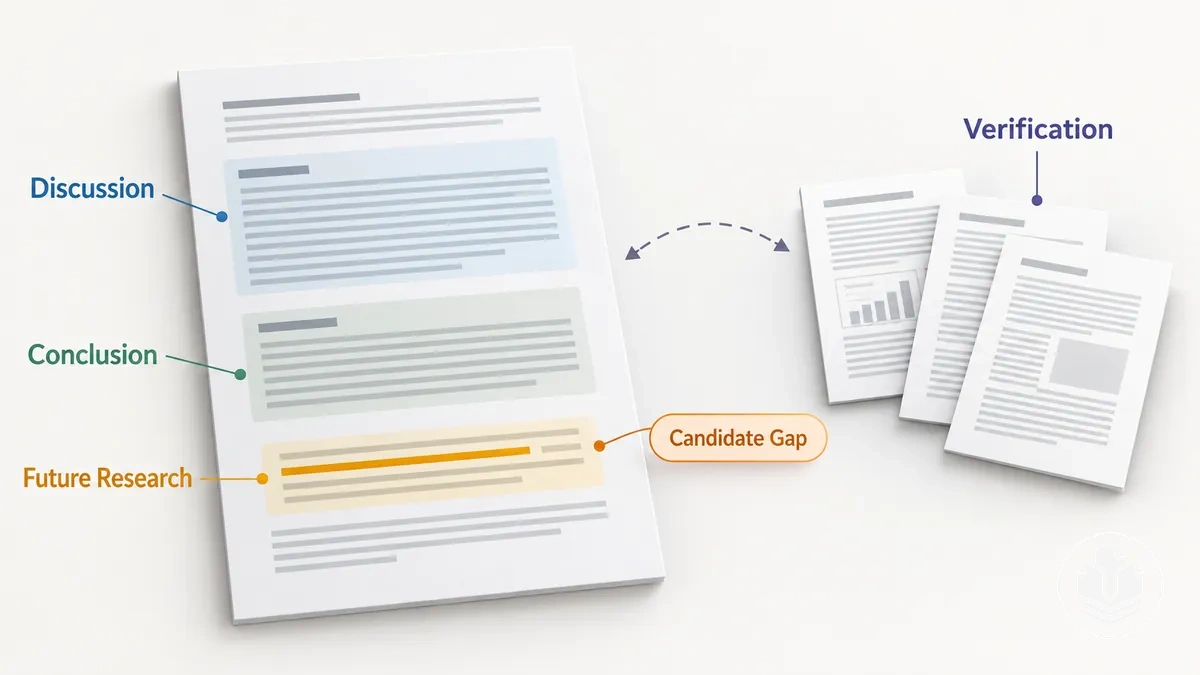
Future-research recommendations and explicit gap statements can identify a candidate gap because authors may flag unresolved questions, underexamined populations, or needed methods in a study's discussion section or conclusion section.
These discovery cues require verification across relevant literature before they support a field-level research gap claim.
The annotated example shows where such cues may appear while keeping the wider evidence base as a separate verification step.
For example, an author may recommend future research on a population not represented in that study; this recommendation identifies a candidate gap, but it does not establish that the population is missing from the wider evidence base.
Verification requires checking whether the issue recurs or remains unresolved across credible, relevant, and sufficiently recent studies.
If other recent studies already address the issue adequately, the original recommendation remains an author-suggested research direction rather than a currently supported field-level gap.
An independently supported research gap therefore depends on corroborating evidence beyond the individual author's statement.
Unanswered or Underexplored Questions
An unanswered question or underexplored issue may indicate a research gap when a specific relationship, variable, mechanism, population, setting, or time period remains insufficiently investigated within the review scope.
The useful diagnostic distinction is between naming a broad topic and identifying a bounded unresolved question whose missing evidence can be specified.
To assess the signal, identify what relationship or evidence remains unresolved, then locate its boundary: the relevant population, setting, time period, or other condition within the review scope.
An issue is meaningfully underexplored only when the available evidence remains insufficient for that bounded question after appropriate search coverage and terminology have been considered.
This distinguishes a possible research gap from an apparent absence created by a poorly scoped or poorly phrased search.
Broad topic: “Remote work and productivity” names an area of inquiry but does not identify what evidence is unresolved.
Specific unresolved question: whether a defined relationship between remote-work conditions and productivity remains underexamined for a particular population or setting identifies both the missing relation and its boundary, but still requires confirmation from the relevant literature.
A low publication count alone is insufficient to establish a research gap.
Contradictory Findings Across Studies
Contradictory findings may indicate an evidence gap when comparable studies produce conflicting results and the reason for the inconsistency remains unresolved.
Missing or Insufficient Evidence Within the Review Scope
Evidence sufficiency requires distinguishing missing evidence, insufficient evidence, weak evidence, and evidence that exists but does not match the review scope.
These states are not interchangeable, and each requires a different check before it can support a research gap interpretation.
The criteria below separate the evidence state from possible explanations involving relevance, coverage, quality, recency, or terminology.
Missing evidence: No relevant evidence is retrieved for the defined population, context, variable, or outcome; verify that search coverage and terminology adequately represent the review question before treating the apparent absence as a gap.
Insufficient evidence: Relevant evidence exists but remains too sparse or incomplete to resolve the review question; assess whether the limited coverage reflects the literature itself or an overly narrow scope or search.
Weak evidence: Studies address the question, but methodological or evidentiary weaknesses limit how confidently their findings support an interpretation; evaluate evidence quality rather than treating study presence alone as sufficient coverage.
Scope-mismatched evidence: Published evidence exists but concerns a different population, setting, variable, outcome, or condition from the review scope; determine whether it can reasonably answer the defined review question before inferring missing evidence.
Outdated evidence: Relevant studies exist but may no longer adequately address a time-sensitive review question; assess whether recency materially changes the relevance of the available evidence.
A research gap is supported only when the apparent insufficiency remains after relevance, coverage, quality, recency, and fit with the review question have been evaluated.
For example, an apparent absence for a concept may disappear when field-specific terminology is used or when an unnecessarily narrow review scope is corrected.
In that case, the original absence reflects a search or scope mismatch rather than missing evidence within the literature.
Types of Research Gaps You May Identify
Types of research gaps are practical classification lenses for describing what kind of knowledge, evidence, method, explanation, population, or context is missing or unresolved.
These categories may overlap, so classification should follow the evidence pattern rather than assume a universally fixed number of research-gap types.
The table organises the main categories by what is missing or unresolved, the typical signal, and the diagnostic implication.
Gap Type
What Is Missing or Unresolved
Typical Signal
Diagnostic Implication
Evidence or Empirical Gap
Relevant empirical evidence is insufficient, inconsistent, outdated, or does not adequately address the review question.
Insufficient evidence, contradictory findings, sparse coverage, or unresolved observed relationships.
The evidence base may not yet support a clear conclusion within the defined review scope.
Methodological Gap
Existing studies rely on methods, measures, designs, or approaches that leave an important aspect inadequately tested.
Repeated use of similar designs, limited measurement approaches, or unresolved results associated with methodological differences.
The methodological gap may concern how the question has been investigated rather than whether the topic has been studied.
Theoretical or Conceptual Gap
An explanation, concept, mechanism, or relationship remains incomplete, unclear, or insufficiently integrated.
Competing explanations, weak conceptual links, or findings that existing theory does not adequately account for.
The theoretical gap or conceptual gap may concern the explanation or conceptual relationship needed to account for the relevant evidence.
Population or Context Gap
Evidence does not adequately cover a relevant population, setting, context, or condition within the review scope.
Research is concentrated in particular groups, locations, settings, or circumstances while another relevant context remains underexamined.
The population gap or context gap may concern the applicability or completeness of knowledge across relevant populations or contexts rather than the topic as a whole.
Published taxonomies use overlapping labels and different category counts, so boundaries between an evidence gap and empirical gap, a theoretical gap and conceptual gap, or a population gap and context gap may vary.
The useful classification is the one that describes which dimension of the evidence pattern is actually missing or unresolved.
A research-gap type is therefore most defensible when its label follows the observed evidence condition rather than a memorized taxonomy.
Evidence and Empirical Gaps
Key distinction
Evidence gap
Focuses on the state of the body of evidence: relevant empirical evidence may be insufficient, inconsistent, outdated, or unable to resolve the review question.
Too few relevant studies or conflicting findings can fit this label when the available body of evidence remains insufficient or inconsistent for resolving the question.
Example: limited evidence about a relationship in a particular context is an evidence gap when the concern is inadequate overall coverage.
Empirical gap
Focuses on missing or inadequate empirical testing with observed data for a specific question, relationship, or proposition.
Use this label when a specific relationship has not been adequately examined through empirical testing, even if the broader topic already has literature.
Example: the same limited relationship evidence is an empirical gap when the missing element is adequate testing with observed data.
The labels overlap because inadequate empirical testing can also produce an insufficient evidence base. Published taxonomies use different labels and category boundaries, so classify the gap by the unresolved dimension the evidence actually shows rather than by a fixed taxonomy.
Methodological Gaps
A methodological gap is a recurring limitation in how a research question has been studied across the relevant evidence base, where an important study design, measurement, sample, data source, or analytic approach remains untested or underrepresented.
The gap exists at the pattern level when that recurring limitation may leave an unresolved question insufficiently examined, rather than arising from a weakness in one study alone.
Different method attributes can leave different parts of the question unresolved:
Study design: Repeated reliance on one design may leave another dimension of the question underexamined; for example, repeated cross-sectional designs may leave change over time unresolved.
Measurement: Recurrent use of measures that do not capture a relevant construct may leave that aspect of the relationship insufficiently tested.
Sample: Repeatedly studying similar samples may leave the question unresolved for a relevant population that remains underrepresented.
Data source: Reliance on similar data sources may leave necessary observations or perspectives insufficiently represented.
Analytic approach: Repeated use of the same analytic approach may leave a relevant relationship, pattern, or condition insufficiently examined.
For example, if relevant studies repeatedly use cross-sectional study designs, longitudinal change may remain unresolved; a longitudinal design could examine that unresolved dimension but would not automatically confirm or resolve a methodological gap.
The important relation is method attribute → recurring limitation → unresolved implication, not whether one method is inherently superior to another.
A methodological weakness in one study is insufficient to establish a methodological gap unless a relevant recurring pattern is visible across the broader evidence base.
Theoretical and Conceptual Gaps
What is unresolved?
Theoretical gap
An explanation or relationship within a theory or framework remains underdeveloped, conflicting, weakly integrated, or insufficiently tested by the available evidence.
Example: two competing explanations may account for the same observed finding, but the evidence may not directly distinguish which explanation better accounts for the relationship under the relevant conditions.
Conceptual gap
A relationship among concepts or constructs remains unresolved because the literature does not clearly explain how they relate, under which conditions the relationship holds, or how competing conceptualisations differ.
Example: a framework may contain relevant constructs while their proposed relationship remains weakly integrated or untested, leaving the explanatory connection unresolved.
Future research can test competing explanations or examine the unresolved conceptual relationship rather than merely adding another study on the topic. The absence of a named theory alone does not establish a theoretical or conceptual gap when the question and evidence do not require a formal theoretical explanation.
Population and Context Gaps
A population gap or context gap occurs when a population, setting, region, institution, condition, or time period relevant to the research question is underexamined and existing findings may not transfer reliably to it.
Uneven evidence coverage becomes substantively meaningful only when the difference may limit applicability or materially change interpretation of the evidence; not every demographic or geographic difference creates a research gap.
The relevant contextual dimensions can be tested by asking whether each difference changes what the evidence can support for the review question.
Population: Check whether an underexamined group differs in characteristics relevant to the relationship or outcome being reviewed; underrepresentation matters when it may change interpretation or applicability.
Region or setting: Check whether evidence is concentrated in one geographic or social setting and whether conditions in another relevant setting may alter how the findings apply.
Institution: Check whether findings come mainly from one institutional context and whether organisational conditions relevant to the research question differ in the underexamined context.
Condition: Check whether the evidence covers the conditions under which the relationship is expected to operate; a context gap may exist when a relevant condition remains underexamined and affects interpretation.
Time period: Check whether evidence coverage reflects a period that remains applicable to the review question; a different time period is meaningful when changed circumstances may alter the relationship being examined.
For example, evidence concentrated in one region may leave applicability to another region uncertain when the research question depends on materially different institutional, environmental, or social conditions.
If those contextual conditions affect the relationship being examined, the underexamined region can represent a meaningful context gap because the existing evidence does not resolve applicability there.
By contrast, dividing the same evidence into another demographic or geographic category without a relevant change in interpretation, applicability, or the research question is superficial segmentation rather than sufficient evidence of a population or context gap.
How to Identify and Validate a Research Gap
Research-gap validation follows a concise evidence-driven sequence: detect a candidate gap from an observable literature pattern, verify it by comparing studies against broader and recent literature, then test whether the gap has sufficient specificity and is researchable.
Detection alone is insufficient because a candidate gap becomes credible only when verification shows that the unresolved issue persists within the relevant evidence base.
The sequence can be understood as detect → verify → test, but these phases are iterative checkpoints rather than a rigid workflow.
Comparing studies or reviewing recent literature may reveal evidence that narrows, changes, or removes the original candidate gap.
Verification therefore requires returning to the candidate claim when new evidence changes its relevance, coverage, or specificity.
The purpose is to keep the gap evidence-based rather than treat one search result, database, or author statement as final validation.
The decision endpoint is to retain, refine, or reject the candidate gap according to the evidence: retain it when the unresolved pattern remains specific and researchable, refine it when the evidence supports a narrower or differently bounded gap, or reject it when verification resolves the apparent absence or inconsistency.
A validated research gap is therefore the result of evidence-based checking, not detection alone.
Compare What Studies Find, Contradict, and Leave Unexplored
Compare studies across their findings to identify agreements, contradictions, recurring omissions, and boundaries that remain unexplored rather than treating each source as an isolated summary.
A research gap becomes a credible inference only when the cross-study pattern leaves an unresolved issue after relevant differences between the studies have been considered.
Compare the research question or scope, population, method or measurement, context, and main finding before interpreting a difference as an unresolved pattern.
Studies that address sufficiently similar questions may agree on one relationship while differing by population or method, contradict one another under comparable conditions, or repeatedly omit the same relevant boundary.
Material differences in these attributes can weaken a gap inference because an apparent contradiction may reflect non-comparable evidence rather than a genuinely unresolved issue.
A compact evidence comparison makes the relationship between study attributes, observed findings, and unresolved issues explicit.
Study or Evidence Group
Question/Scope
Population/Method
Main Finding
Unresolved Issue
Evidence Group A
Examines the same bounded relationship
Population and method are sufficiently comparable with Group B
Findings generally agree on the relationship
A relevant context remains unexamined
Evidence Group B
Examines the same bounded relationship
Population and method are sufficiently comparable with Group A
Findings contradict Group A under a specified condition
The reason for the conflicting result remains unresolved
Evidence Group C
Addresses the relationship within a narrower scope
Uses a different population or method
Findings differ from the other groups
Comparability must be resolved before the difference supports a gap inference
For example, if several studies agree that a relationship occurs in one population, comparable studies report conflicting findings under another condition, and the literature repeatedly leaves that condition unexplained, the bounded research gap is the unresolved relation under that condition rather than the topic as a whole.
To synthesize the literature for this purpose, combine the study-level observations into a cross-study interpretation while preserving differences in scope, population, method, and findings.
The gap statement should therefore identify the unresolved relation and its relevant boundary instead of treating simple variation between studies as proof of a gap.
Check the Apparent Gap Against Recent Relevant Literature
An apparent gap should be checked against recent literature, relevant literature, and credible sources before it is accepted as current.
Verification tests whether the apparent absence persists after evidence coverage, terminology variants, search breadth, and source selection have been considered.
The checks should distinguish evidence that weakens the gap claim from evidence that strengthens confidence that the unresolved issue remains current:
Recency: Check whether newer literature addresses the claimed gap; if later studies resolve or substantially narrow the issue, the apparent gap no longer remains current in its original form.
Relevance: Assess whether the retrieved literature directly addresses the same research question, population, context, variable, or outcome rather than only a superficially similar topic.
Terminology coverage: Verify whether terminology variants, field-specific labels, or related concepts retrieve evidence that the original wording missed; newly identified evidence may invalidate the apparent absence.
Search breadth: Check whether the evidence coverage is broad enough to support the claim across the relevant literature rather than reflecting a narrow search scope or limited source set.
Source quality: Assess whether the evidence used to support or challenge the gap is credible and sufficiently relevant; where needed, evaluate sources before relying on them in the verification decision.
Direct or adjacent evidence: Check whether studies directly address the claimed unresolved issue or provide adjacent evidence that already answers part of it; such evidence may require the gap to be narrowed or reinterpreted.
If recent literature, terminology coverage, search breadth, source quality, or evidence coverage remain incomplete, the verification status should remain provisional.
Confidence in the apparent gap strengthens only when current and relevant evidence still leaves the issue unresolved after these checks.
Confirm the Gap Is Specific, Evidence-Based, and Researchable
A validated research gap should be specific, evidence-based, and researchable.
The final check is whether the gap statement identifies a bounded unresolved relation, is supported by the reviewed evidence, and can be investigated within a clear scope without overstating a novelty claim.
The following criteria test whether the candidate gap is defensible enough to retain or requires refinement.
Specificity: The gap statement should identify the precise relationship, population, context, mechanism, or condition that remains unresolved; if the claim is only a broad topic, it requires refinement.
Evidence support: The claimed gap should be supported by the reviewed evidence rather than by an unsupported novelty claim; if the literature shows only limited, conflicting, or context-specific knowledge, the wording should reflect that evidence state.
Relevance to the review question: The unresolved issue should materially affect the review question or its interpretation; if it does not, the gap may be peripheral to the current review.
Researchability: The proposed unknown should be stated in a form that can be investigated with observable evidence; if it is too abstract or indeterminate, it requires a clearer researchable boundary.
Scope: The gap should be bounded by relevant conditions such as population, context, variable, or time frame where appropriate; an excessively broad scope requires narrowing.
Non-exaggerated wording: The gap statement should describe what the evidence leaves unresolved without asserting absolute absence or originality beyond what the evidence support justifies; otherwise the claim requires qualification.
For example, a vague statement such as “There is no research on remote work and productivity” makes a broader claim than limited or inconsistent evidence may support.
A more precise, evidence-bounded statement would be: “The reviewed evidence remains limited and inconsistent on how specific remote-work conditions relate to productivity within the defined population and context.” The revised gap statement identifies the unresolved relation and scope while keeping the claim proportionate to the evidence.
That refinement makes the candidate gap more defensible without requiring a claim of absolute novelty.
Common Mistakes When Identifying Research Gaps
Research-gap identification mistakes usually weaken a gap claim through overclaiming, insufficient verification, or confusion between a research gap and an adjacent concept such as a study limitation.
A defensible correction connects the claimed gap to an evidence pattern and specifies what must be checked or qualified rather than treating novelty or absence as self-evident.
The table maps recurring identification errors to the evidence problem they create, the recognition cue that exposes the problem, and the corrective direction needed to make the gap claim more defensible.
A broad topic or vague gap lacks specificity; a narrow search or outdated evidence can misstate evidence coverage; a future-research statement or limitation can be misinterpreted as field-level evidence; and a contradiction requires comparability checks before it supports an unresolved pattern.
Mistake
Why It Weakens the Gap Claim
Recognition Cue
Corrective Direction
Treating a broad topic as a gap
A broad topic does not identify the specific unresolved relationship, condition, population, or context that remains unknown.
The claim names an area of interest but cannot state what knowledge is missing or unresolved.
Narrow the claim to a specific unresolved relation and define the relevant scope so the gap becomes researchable.
Claiming no studies exist after a narrow search
A narrow search may miss relevant evidence because of limited coverage, terminology, or source selection.
The gap claim depends on one search string, one database, or a limited set of retrieved studies.
Broaden the evidence check, test relevant terminology variants, and qualify the claim according to the coverage actually achieved.
Relying only on a future-research statement
An author's recommendation identifies a possible research direction but does not establish that the wider literature still leaves the issue unresolved.
The claimed gap is supported mainly by one paper's future-research statement.
Check whether the proposed issue recurs across relevant literature and remains unresolved after comparison with other evidence.
Confusing a limitation with a research gap
A limitation constrains an individual study, whereas a field-level gap claim requires an unresolved pattern across relevant evidence.
The gap claim is inferred directly from one study's sample, method, measurement, or design weakness.
Determine whether the limitation or its unresolved consequence recurs across relevant studies before treating it as evidence of a broader gap.
Treating one contradiction as proof of a gap
Different findings may result from differences in population, method, measurement, scope, or context rather than an unresolved evidence problem.
The gap claim cites conflicting findings without establishing that the studies are sufficiently comparable.
Compare the relevant study conditions and retain the contradiction as gap evidence only when the inconsistency remains unresolved under sufficiently comparable conditions.
Using outdated evidence to support a current gap
More recent studies may have addressed, narrowed, or changed the apparent unresolved issue.
The claim relies on older evidence without establishing whether later relevant literature changes the evidence state.
Check whether sufficiently recent relevant evidence changes what remains unresolved and qualify the gap accordingly.
Proposing a vague gap that cannot be investigated
A vague gap lacks the specificity needed to connect the unresolved issue to a bounded research question.
The claim uses wording such as “more research is needed” without identifying the relationship, condition, population, or context that remains unresolved.
State the unresolved relation and its relevant scope precisely enough for the proposed unknown to be investigated.
Correction requires moving from descriptive observations to evidence-based interpretation; critical analysis helps distinguish an evidence pattern from a descriptive summary.
For example, instead of claiming “There is no research on remote work and productivity” after retrieving few studies, a qualified correction is “The reviewed evidence remains limited or inconsistent on how specific remote-work conditions relate to productivity within the defined population and context” when that interpretation is supported by the literature.
The correction narrows the claim to what the evidence can support rather than asserting an unsupported absence.
Research Gap Examples in Literature Review Evidence
Useful research gap examples show how an observable evidence pattern supports a bounded gap statement rather than simply assigning a gap label.
The key relation is evidence pattern → gap interpretation: the statement should specify what remains unresolved, under which relevant conditions, and what the reviewed evidence actually supports.
The following hypothetical examples illustrate that reasoning without claiming factual findings from real studies.
Contradictory evidence can support an unresolved evidence gap only when the relevant studies are sufficiently comparable, while recurring method choices, unresolved explanatory relations, or uneven population coverage can support different bounded interpretations.
Each gap statement should remain proportionate to the observed evidence rather than assert proven novelty.
The examples therefore separate the evidence condition from the inference and explain why that inference would be defensible.
Evidence pattern → gap interpretation
Contradictory evidence
Evidence pattern
In a hypothetical literature review, several sufficiently comparable studies examine the same relationship under similar conditions but report contradictory evidence, and the reviewed literature does not resolve why the findings diverge.
Gap interpretation
The unresolved gap concerns the conditions or mechanisms that account for the conflicting findings, rather than an absence of research on the broader topic.
Why it is defensible
The bounded claim follows from a persistent inconsistency in comparable evidence and does not imply that the topic itself is unstudied.
Methodological constraint
Evidence pattern
Suppose relevant studies repeatedly examine a question with similar methods, while a method capable of investigating an unresolved dimension of that question remains underrepresented.
Gap interpretation
A methodological gap may concern whether that unresolved dimension has been adequately investigated using the alternative approach.
Why it is defensible
The interpretation identifies the recurring methodological constraint and the knowledge implication it leaves unresolved without assuming that the alternative method will produce a particular result.
Competing explanations
Evidence pattern
In an illustrative theoretical scenario, the literature offers competing explanations for the same observed relationship, but the reviewed evidence does not adequately distinguish which explanation applies under the relevant conditions.
Gap interpretation
The theoretical gap is the unresolved explanatory relation between the competing accounts and the conditions under which each may apply.
Why it is defensible
The claim is tied to an unresolved explanatory problem in the evidence rather than merely to the existence of multiple theories.
Population applicability
Evidence pattern
Imagine that studies relevant to a review question concentrate on one population, while another population within the review scope remains underexamined and contextual differences could affect how the findings apply.
Gap interpretation
The population gap concerns the applicability of the existing evidence to that underexamined population within the specified context.
Why it is defensible
The bounded claim identifies the population, the context, and the unresolved applicability question instead of treating any demographic difference as sufficient evidence of a gap.
A weak statement such as “Little research exists on this topic” does not identify the evidence pattern or the unresolved relation.
A stronger evidence-bounded formulation is “The reviewed evidence remains insufficient or conflicting for the specified relationship within the defined population and context, leaving that relationship unresolved under those conditions.” This bounded claim states what is missing, where the uncertainty applies, and the evidence condition supporting the gap statement without claiming more novelty than the literature review establishes.