
Building Literature Review Paragraphs Around Synthesized Evidence
A strong literature review paragraph organizes evidence from multiple studies around one analytical focus. State the analytical point first, select evidence that serves it, show the cross-study relationship through agreement, contrast, or qualification, interpret what that relationship means, and close with a bounded implication.
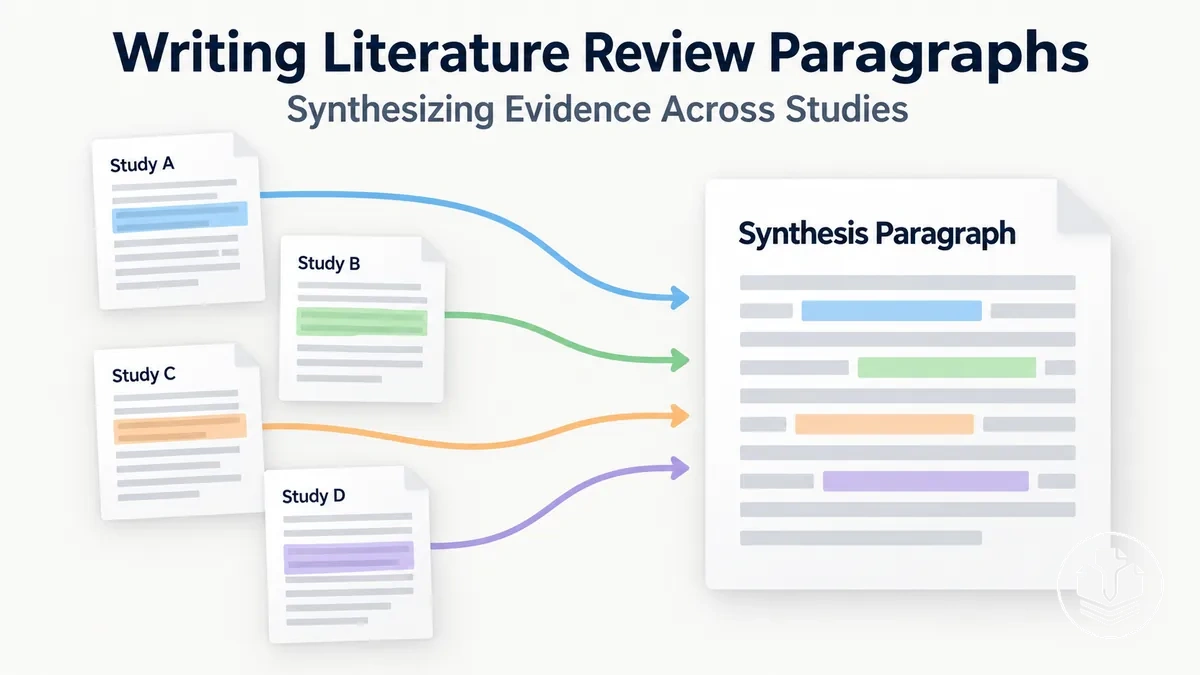
The synthesis paragraph model
Use this sequence as a functional model, not a fixed sentence count. Each stage should remain tied to the same analytical point.
- Analytical focusDefine the one claim, theme, or relationship the paragraph will develop.
- Relevant evidenceSelect studies that support, qualify, contrast with, or otherwise bear directly on that focus.
- Cross-study relationshipState whether the evidence shows agreement, contrast, partial alignment, or qualification.
- InterpretationExplain what the relationship contributes to the analytical point while preserving material conditions and limits.
- Bounded implicationClose with what the combined evidence supports or indicates without making the claim broader than the evidence.
Core rule: organize the paragraph around the relationship among studies, not around one source at a time.
A literature review paragraph follows a functional relationship: the analytical focus determines which evidence is relevant, synthesis connects that evidence across studies, and interpretation explains what the connection means for the paragraph's analytical point.
The number of studies and the paragraph length depend on the argument and the evidence needed to develop it clearly; there is no fixed source count or word limit that makes a paragraph synthetic.
Paragraph construction therefore begins by choosing one analytical focus that controls the selection, connection, and interpretation of evidence.
Table of Contents
Structure Each Paragraph Around One Analytical Focus
An analytical focus defines the one analytical job a paragraph performs, whether that focus is a claim, theme, or relationship.
Every piece of evidence included in the paragraph should support, qualify, contrast with, or otherwise contribute to that same focus.
The focus should be specific enough to guide evidence selection while remaining broad enough to support a meaningful relationship among studies.
A workable analytical focus aligns the analytical point, selected evidence, and intended interpretation.
Specificity limits the paragraph to one manageable claim or relationship, while relevance keeps that focus connected to the review question or current theme.
Evidentiary support means the available studies can actually develop the proposed focus, and manageable scope prevents the paragraph from becoming either diffuse or too narrow to support interpretation.
The image illustrates this paragraph-level relationship by showing multiple sources filtered toward one analytical focus.

- Specificity: the focus identifies a distinct claim, theme, or relationship rather than a broad subject that could contain several separate analytical jobs.
- Relevance: the focus fits the review question or current theme, so the paragraph contributes to the intended line of analysis.
- Evidentiary support: the selected evidence can develop the focus through relevant agreement, difference, qualification, or another meaningful cross-study relationship.
- Manageable scope: the focus is neither so broad that the paragraph becomes diffuse nor so narrow that the available evidence cannot support useful interpretation.
An aim such as examining all findings about a broad topic is too diffuse when it requires several distinct claims or relationships; a workable focus isolates one relationship that the available evidence can develop coherently.
This decision concerns the analytical scope of one paragraph, while literature review structure concerns broader organization across the review.
The final test is whether every included study contributes to the same analytical job.
Write a Topic Sentence That States the Analytical Point
A topic sentence states the paragraph's analytical point before individual studies are introduced.
It frames the theme, claim, or relationship that the evidence from multiple studies will develop, rather than opening with one author's contribution.
The topic sentence should therefore express the paragraph focus at a level of specificity that the selected evidence can support.
A topic sentence creates an analytical opening when it foregrounds the relationship being examined; a source-led opening instead foregrounds an individual study before that relationship is clear.
The image shows how an analytical topic sentence governs the evidence positions that follow and keeps them aligned with the same paragraph focus.
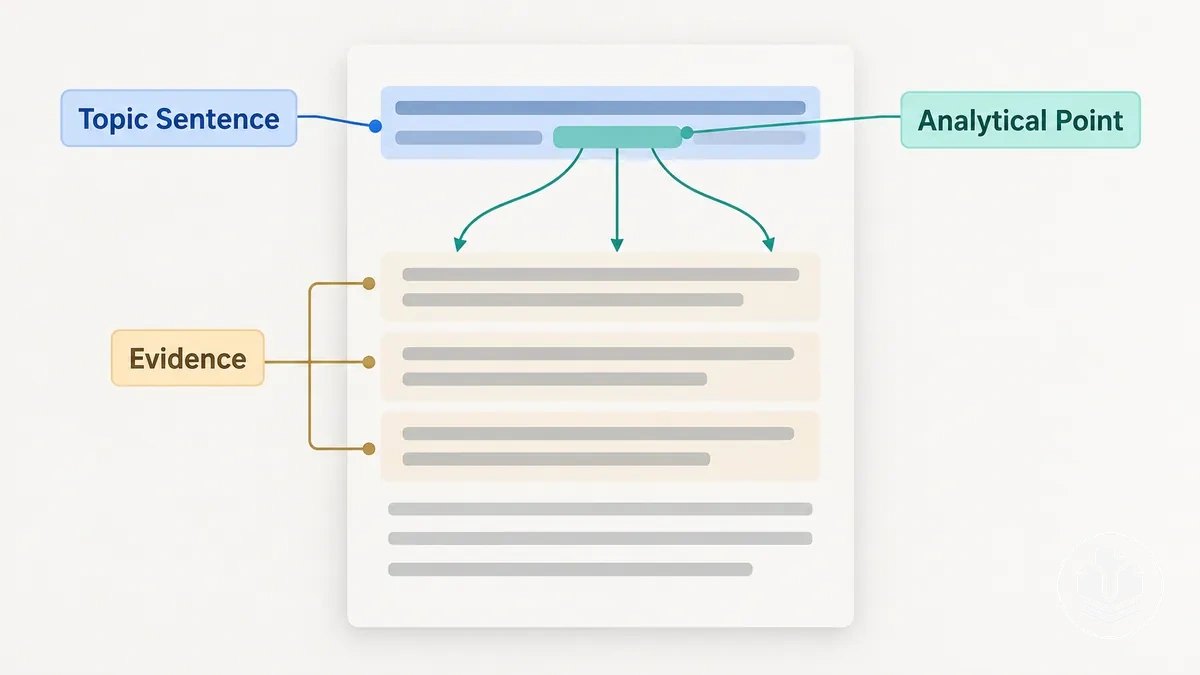
Source-led: “Study A reports one pattern, while Study B reports a different pattern.” Analytical: “The evidence shows contrasting patterns across the studies under review.” The analytical version states the relationship first and can accommodate multiple studies without inventing specific research findings.
When a topic sentence contains an externally sourced factual claim, that claim requires appropriate citation; its scope should remain broad enough to include the selected studies but narrow enough to be supported by their evidence.
Select Evidence That Directly Serves the Paragraph Focus
Selected evidence belongs in a paragraph when it directly serves the analytical focus and can enter a meaningful relationship with the other selected studies.
Relevance depends on whether a study addresses the paragraph's analytical question, not on adding sources for volume.
Comparability and contextual fit may differ across relevant studies, so those differences should remain visible when they affect interpretation.
The four criteria below test whether evidence fits the paragraph's analytical job through relevance, comparability, contribution, and contextual fit.
They distinguish evidence that contributes to the intended analytical point from source material that merely increases the number of studies.
For example, two studies may belong together when both address the same relationship under sufficiently comparable conditions, while a third useful study should be excluded from this paragraph if it answers a different analytical question.
A useful source can therefore be appropriate for the wider review but unsuitable for this paragraph.
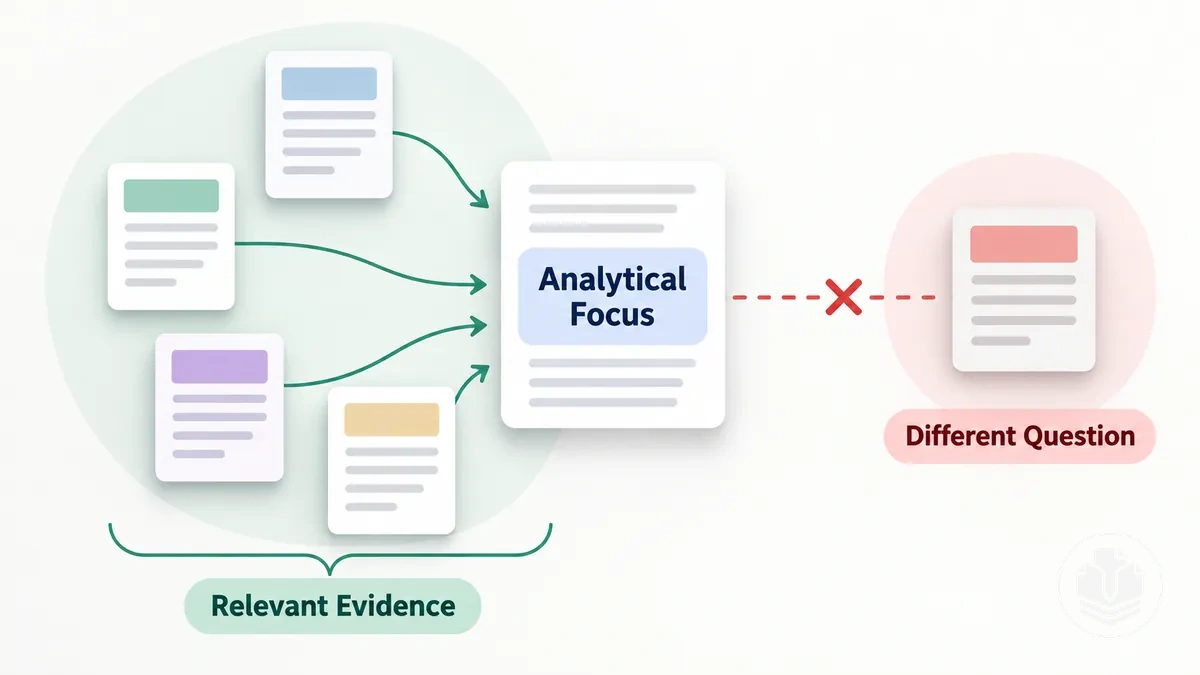
- Relevance: Does the source address the analytical focus? Include it when its evidence directly supports, qualifies, contrasts with, or otherwise bears on the paragraph's claim.
- Comparability: Can the study be meaningfully compared or combined with the other selected studies? Differences in population, setting, method, or measured concept may limit which relationships can reasonably be interpreted.
- Contribution: Does the study add distinct evidence? Include it when its finding contributes support, qualification, contrast, or another useful addition to the intended interpretation rather than simply increasing source count.
- Contextual fit: Does the study's context fit the scope of the analytical point? Include contextual differences when they help explain the relationship among findings, but exclude evidence whose context places it outside the question being addressed.
Synthesize Multiple Studies Within the Same Paragraph
Paragraph-level synthesis relates evidence from multiple studies to one analytical point rather than presenting each study as an isolated summary.
The analytical relationship becomes the organizing unit: findings may show agreement, contrast, or qualification, and the paragraph explains what that relationship means.
Source-by-source reporting organizes the paragraph around individual studies; synthesis organizes it around the connection among their findings.
The sequence below moves from a shared analytical point to a cross-study relationship and then to interpretation, which helps prevent the paragraph from becoming a series of separate summaries.
The image visualizes this paragraph-level movement by making the relationship among studies more prominent than the individual sources.
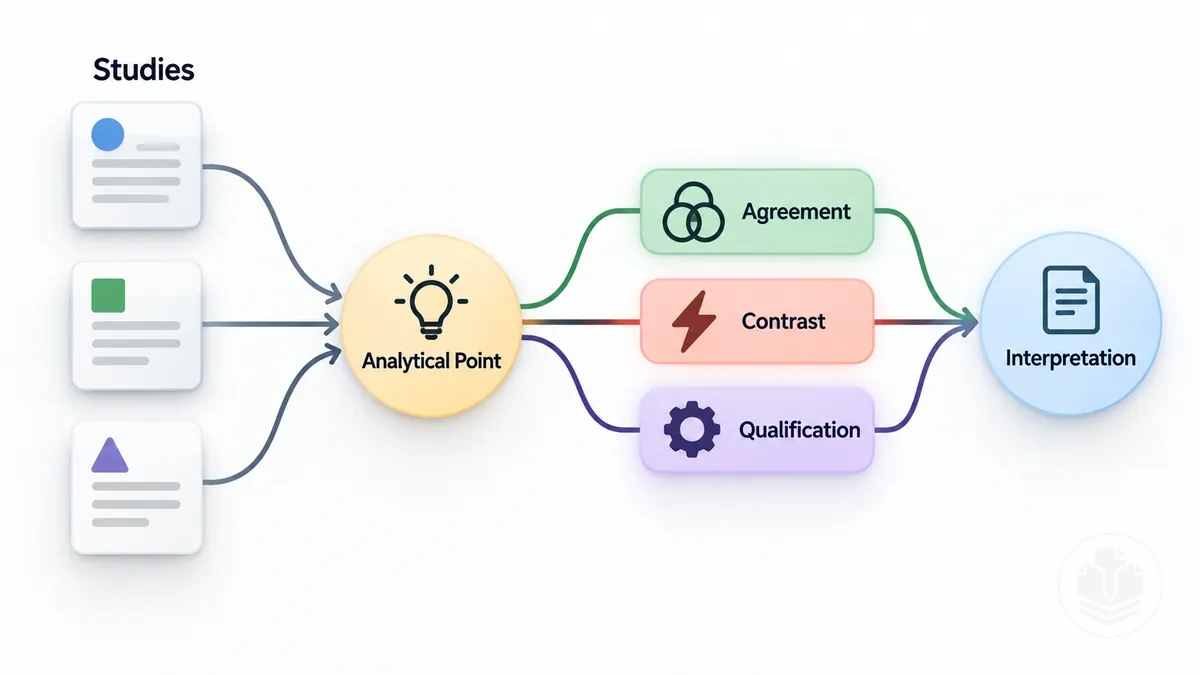
- Identify the common analytical point: establish the question, claim, or theme that the selected studies address within the paragraph.
- Relate the findings: state whether the studies show agreement, contrast, or qualification instead of reporting each finding separately.
- Qualify the relationship: note relevant differences in method, population, measure, or context when those conditions affect how the findings can be compared.
- Interpret the significance: explain what the cross-study relationship contributes to the paragraph's analytical point without claiming more than the evidence supports.
For example, consider three studies that address the same analytical point.
Instead of giving three consecutive summaries, the paragraph can state that two findings align while a third qualifies that pattern under a different condition, then interpret why the qualification matters.
Agreement can support a shared pattern, contrast can establish a meaningful difference, and qualification can narrow the conditions under which an interpretation applies.
This sequence concerns synthesis within one paragraph; the broader method for how to synthesize studies extends beyond this paragraph-level execution.
Combine Studies That Support a Shared Finding
Studies supporting a shared finding should be combined around the common proposition while preserving material differences in population, method, measure, or context.
Convergence means the evidence aligns on the relevant analytical point under the conditions represented by the studies; it does not require the studies to be identical.
The image shows this common direction while retaining a condition or context that qualifies how the studies align.
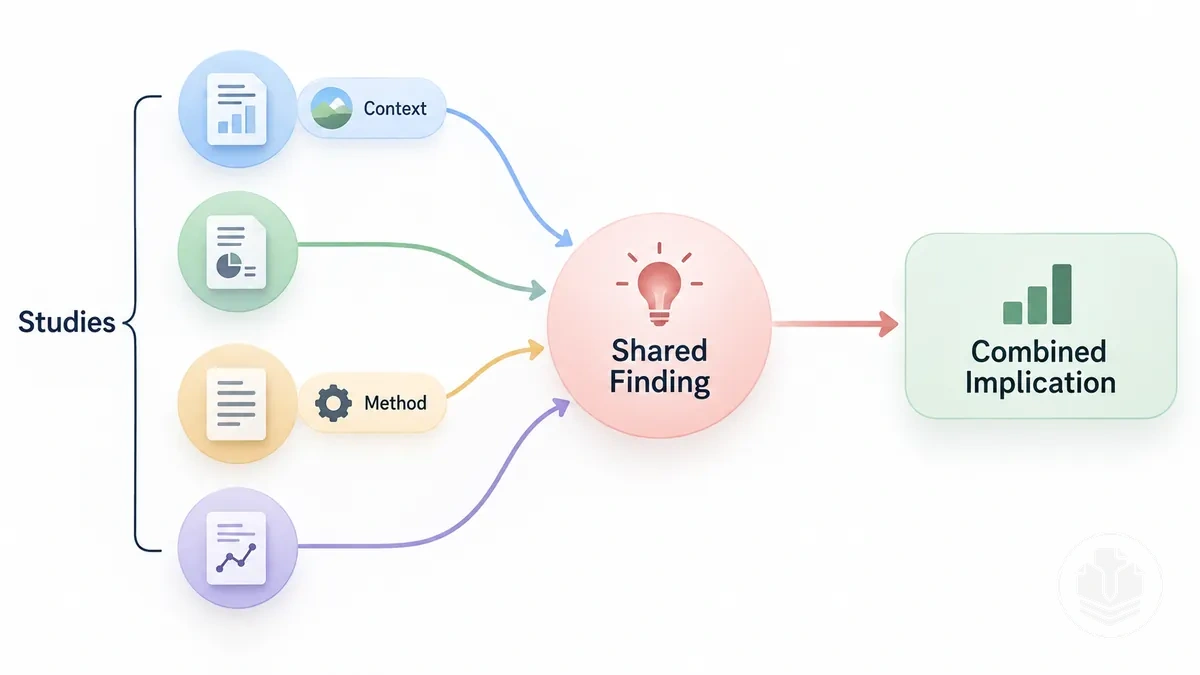
Qualification can accompany convergence by stating both the shared finding and the condition under which the evidence aligns.
Shared finding: “Across the studies, the evidence supports the same general pattern, although the degree of convergence differs with the population, method, measure, or context represented.” Combined implication: “Taken together, the studies support the analytical point under those stated conditions rather than establishing an unqualified finding.” This wording makes the relationship among studies explicit and closes with the combined implication instead of repeating each study separately.
Contrast Studies That Differ in Findings or Conditions
Cross-study contrast should begin with a shared comparison basis so differences between studies are analytically meaningful rather than merely presented as conflicting findings.
Compare the studies on the same relevant dimension, such as population, method, measure, or context, and then state how the finding differs under that condition.
This approach identifies what is comparable before interpreting the difference and avoids treating conditional variation as a contradiction.
Two studies may address the same analytical point but report different findings while also differing in population, method, measure, or context.
Shared comparison basis
“Both studies examine the same relationship, but their findings differ under the populations or methods represented.”
Interpretation
“The contrast is associated with different study conditions, although the difference alone does not establish that those conditions caused the findings to diverge.”
Boundary: specifying the relevant condition makes apparently conflicting evidence more interpretable without asserting unsupported causality. The resulting implication is that the finding varies across the represented conditions and should be interpreted within those boundaries.
Explain What the Cross-Study Relationship Means
Interpreting the cross-study relationship connects the combined evidence directly to the paragraph's analytical point.
- Agreement
- Supports a shared pattern when the evidence aligns on the relevant analytical point.
- Contrast
- Indicates that the finding differs across a shared comparison basis or represented conditions.
- Qualification
- Narrows how broadly the claim can be stated by making a condition, limitation, or partial alignment explicit.
The implication should explain what the relationship contributes to the paragraph claim rather than repeat the studies' findings.
That interpretation should preserve any limitation or condition that materially changes its meaning, such as differences in context, population, method, or measurement.
Where the evidence aligns only under particular conditions, the paragraph should state those conditions instead of implying a broader conclusion.
Where findings differ, the relationship may suggest that the analytical point is context-dependent, but the difference alone does not establish a causal explanation.
The final interpretation should therefore return to the paragraph claim by stating what the combined evidence supports, qualifies, or limits.
End the Paragraph With the Implication of the Combined Evidence
The closing sentence should state the implication of the combined evidence for the paragraph's analytical point.
It should draw the established interpretation into one appropriately bounded claim, including any qualification that limits its scope.
A strong close therefore explains what the combined evidence supports or indicates without introducing a new study, a new major claim, or a conclusion for the literature review as a whole.
Restatement
“The studies report similar findings under the conditions examined.”
Repeats what the studies found.
Implication
“Taken together, the combined evidence supports the paragraph's analytical point under those stated conditions, while the qualification limits how broadly that implication can be applied.”
States why the combined findings matter for the paragraph claim.
Use Synthesis Language and Transitions to Show Relationships
Synthesis language and transitions are useful when they signal a real relationship among studies, findings, or analytical claims rather than merely linking sentences grammatically.
A transition should help the reader interpret whether the evidence shows agreement, contrast, qualification, continuation, or consequence.
Cohesion therefore depends on the underlying conceptual connection being explicit, with linguistic signals making that relationship easier to follow.
The categories below organize transitions by semantic function rather than by preferred vocabulary.
Agreement signals that evidence aligns on a relevant analytical point, while contrast signals a meaningful difference on a shared basis.
Qualification narrows or conditions a claim, whereas continuation develops an established line of reasoning and consequence indicates an implication that follows from it.
The strength of each signal should match the evidence, because lexical signals support cohesion only when the conceptual relationship they represent is explicit.
- Agreement: signals that findings or claims align, helping the reader interpret the evidence as support for a shared analytical point.
- Contrast: signals that findings differ on a relevant dimension, directing attention to the basis and significance of that difference.
- Qualification: signals that an earlier claim requires a condition, limitation, or narrower scope, preventing the relationship from appearing more certain than the evidence supports.
- Continuation or consequence: signals either that the analysis extends an established relationship or that an implication follows from it, making the direction of the reasoning explicit.
Signal Agreement, Contrast, and Qualification Explicitly
A relational signal should match the relationship that the evidence actually supports.
Agreement signals convergence on the relevant analytical point, while contrast signals a difference on a shared basis of comparison.
Partial alignment indicates that studies agree on part of the relationship but differ in another relevant respect, and qualification marks a condition or limitation that narrows how the evidence should be interpreted.
These distinctions make the relation explicit without implying greater certainty than the evidence permits.
The strength of the wording should reflect the strength and conditions of the evidence.
Stronger agreement can be described as evidence that aligns or is consistent with a shared point, whereas conditional differences should be described as contrast under the relevant condition rather than as outright contradiction.
Partial alignment and qualification require wording that preserves both the common ground and the limitation, so the reader can interpret the evidence at the appropriate level of certainty.
A connector becomes informative only when the relation it signals is named or clearly inferable from the comparison.
- Agreement: “The studies are consistent in supporting the same analytical point under the conditions examined.”
- Contrast: “The studies differ on the analytical point when the relevant conditions are compared.”
- Qualification: “The evidence partially aligns, but the relationship is qualified by a difference in the relevant condition.”
Use Synthesis Sentence Patterns to Link Evidence and Analysis
A synthesis sentence should link evidence from at least two sources to the writer's analytical point rather than report each source as a separate unit.
The sentence should make the relationship among the evidence visible and show how that relationship supports, contrasts with, or qualifies the analytical point.
Convergence identifies compatible evidence, contrast identifies a meaningful difference, and qualification limits the interpretation when alignment is partial or conditional.
These functions should be expressed according to the evidence rather than treated as fixed wording.
The patterns below show how convergence, contrast, qualification, cumulative evidence, and interpretation can be expressed while keeping the source relationship visible.
When reporting specific study findings, the reporting verb and tense should fit how those findings are being presented; a broader current claim may require different wording, so no single tense applies to every synthesis sentence.
Each pattern should move beyond source enumeration by showing what the combined evidence means for the analytical point.
Adapt the wording, reporting verbs, and strength of the claim to the actual evidence rather than copying a sentence formula mechanically.
- Convergence: “Evidence from both studies aligns on the relevant finding, supporting the analytical point that the pattern is consistent under the conditions examined.”
- Contrast: “Although the two sources address the same analytical point, their evidence differs under the relevant conditions, indicating that the relationship is not uniform across those contexts.”
- Qualification: “The sources partially align, but the difference in the relevant condition qualifies how broadly the shared finding can be interpreted.”
- Cumulative evidence and interpretation: “Taken together, the evidence from the sources supports the analytical point under the stated conditions, indicating how the combined findings contribute to the interpretation.”
Carry the Analytical Thread Into the Next Paragraph
An effective transition carries the analytical thread from the prior implication into the next paragraph through a specific relation rather than an unrelated connector.
The next paragraph focus may continue the established idea, contrast with it, follow from it as a consequence, or narrow or broaden its scope.
Naming or making that relation clear preserves conceptual continuity while allowing the analysis to develop in a new direction.
- Continuation
- Develops an implication already established.
- Contrast
- Introduces a meaningful difference on a shared analytical basis.
- Consequence
- Moves to an implication that follows from the prior point.
- Narrowing
- Tests a more specific condition or boundary.
- Broadening
- Extends the analysis to a wider context or scope.
Superficial
“Furthermore, the next paragraph considers a different condition.”
Relation-specific
“Because the prior implication applies under the conditions already examined, the next paragraph narrows the analysis to whether that relationship holds under a more specific condition.”
The transition should connect the prior implication to the new focus without simply repeating the previous conclusion.
Diagnose and Correct Paragraph-Level Synthesis Problems
A paragraph-level synthesis problem is usually visible as source-by-source summary, an unfocused scope, or a transition that does not state the relationship between ideas.
Each symptom suggests a possible structural issue, but it does not prove one likely cause on its own.
Diagnose the paragraph by checking whether its analytical focus controls the evidence and whether the relationship among sources is explicit before changing sentence-level wording.
The diagnostic sequence below connects each symptom to a likely structural cause, an observable check, and a corrective direction.
It keeps the diagnosis at paragraph level so the correction addresses synthesis and cohesion rather than assuming that every weak paragraph requires the same revision.
| Symptom | Likely Structural Cause | Check | Corrective Direction |
|---|---|---|---|
| Evidence appears as source-by-source summary. | The paragraph may be organized around individual sources rather than a shared analytical focus. | Check whether the evidence is explicitly related through agreement, contrast, qualification, or another relevant relationship. | Reorganize the evidence around the analytical focus and state the cross-source relationship before interpreting its significance. |
| The paragraph feels unfocused or covers several analytical jobs. | The topic sentence or analytical focus may be too broad for the evidence being developed. | Check whether every included source contributes to the same paragraph-level claim or relationship. | Narrow the analytical focus or separate evidence that serves a different analytical job. |
| Transitions connect sentences but not ideas. | The paragraph may use connectors without specifying the conceptual relationship between the evidence and the analytical point. | Check whether the transition identifies the actual relation, such as continuation, contrast, consequence, or qualification. | Replace the superficial connector with wording that names or clearly expresses the relationship and its analytical direction. |
After identifying the likely cause, correct the structural relationship before polishing individual sentences.
If the symptom persists because the analytical focus, evidence selection, or organization is inconsistent across several sections rather than within one paragraph, the problem has moved beyond paragraph-level synthesis.
When the issue extends across the review's broader argument, organization, or section relationships, revise the literature review at the whole-document level rather than treating each paragraph as an isolated repair.
Replace Source-by-Source Reporting With Cross-Study Comparison
Source-by-source reporting occurs when each sentence summarizes an individual source and the source, rather than the analytical point, becomes the paragraph's organizing unit.
Brief summary can still support synthesis, but the evidence must be grouped around a shared comparison point so the relationship among studies becomes visible.
A useful diagnostic check is whether the paragraph can state what the studies have in common, how they differ, or how one qualifies another before moving to interpretation.
The correction is to identify the shared criterion, group the same evidence around that criterion, state the cross-study comparison, and then interpret its significance for the analytical point.
Source-led
“Study A reports a positive relationship under one condition. Study B reports a weaker relationship under another condition.”
Synthesis-led
“Both studies examine the same relationship, but the evidence differs across the conditions represented; taken together, the comparison suggests that the analytical point should be interpreted within those conditions rather than as uniform across contexts.”
The evidence remains the same, but the synthesis-led version makes the relationship and interpretation the organizing structure. Adding transition words between isolated summaries does not create synthesis when the individual source remains the basic unit of organization.
This paragraph-level correction concerns how existing evidence is grouped and related, while critical analysis rather than summary addresses the broader distinction between description and analysis across the literature review.
Correct Topic Sentences That Are Broader Than the Evidence
A topic sentence has a scope mismatch when its claim exceeds the evidence actually represented in the paragraph.
Check the claim scope against the evidence scope by identifying the populations, settings, methods, contexts, or other conditions covered by the cited studies.
If the evidence supports the analytical point only under particular conditions, the topic sentence should include a qualifier that limits the claim to that supported scope.
Correct an overbroad claim by narrowing its scope, qualifying the relevant condition, or reframing the analytical point so it matches what the evidence can support.
The revision should preserve the paragraph's topic rather than adding unrelated evidence simply to defend a broader statement.
Overbroad
“The evidence shows that the relationship is consistent across contexts.”
Revised
“Within the contexts represented by the studies, the evidence supports a consistent relationship.”
The revision changes the claim scope to match the available evidence rather than hedging every statement indiscriminately.
Fix Transitions That Link Sentences Without Explaining the Relationship
A transition can connect sentences grammatically while leaving the relationship between their evidence or claims unspecified.
Diagnose the problem by asking whether the transition signals agreement, difference, qualification, extension, or another specific relation.
If the comparison dimension is missing, the reader can see that the sentences are linked but not how the second claim changes the interpretation or consequence of the first.
Revise the sentence around the underlying relationship rather than replacing one connector with another.
Specify the comparison dimension or condition, state whether the evidence agrees, differs, qualifies, or extends the preceding claim, and make the consequence clear for the analytical point.
Surface connector “However, Study B reports a different pattern.”
Relation-specific revision “Study B contrasts with Study A on the same comparison dimension, indicating that the pattern differs under the conditions represented.”
Surface connector “Therefore, the finding is limited.”
Relation-specific revision “Because the evidence aligns only under the stated condition, that qualification limits the scope of the resulting interpretation.”
Cohesion becomes analytically meaningful when the transition specifies the relation and its implication rather than relying on a connector-only revision.