
Distinguishing Critical Analysis from Summary in a Literature Review
Summary reports what a source says; critical analysis explains what the evidence means, what it can support, and why that matters to the review question or argument. Summary is a valid evidential foundation, but a passage becomes analytical only when it adds interpretation, evaluation, relationships between evidence, and a qualified implication.
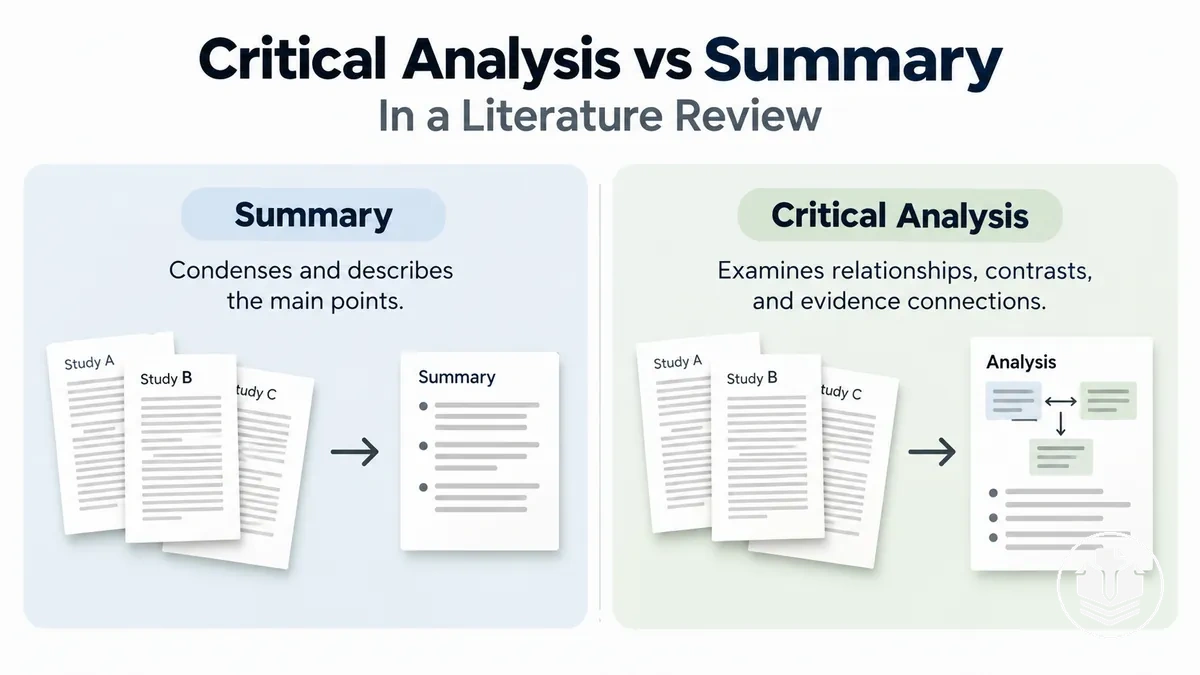
Evidence-processing map: summary, synthesis and critical analysis
Read the operations from left to right. Each stage adds a different analytical value; connecting sources through synthesis does not by itself evaluate what the relationship means.
-
Summary / reporting
- Guiding question
- What does the source say?
- Operation
- Condense the relevant finding, claim, method or context accurately.
- Output
- A traceable factual basis for the review.
-
Synthesis
- Guiding question
- How do the sources relate?
- Operation
- Align evidence around a shared claim and identify agreement, disagreement, extension or qualification.
- Output
- An explicit cross-source relationship or pattern.
-
Critical analysis
- Guiding question
- What does this evidence relationship mean for the claim?
- Operation
- Interpret and evaluate significance using relevant criteria, context and material limitations.
- Output
- A qualified judgment that supports, qualifies, challenges, narrows or redirects the review's proposition.
Decision boundary: if the writing stops after reporting what a source found, it remains summary. If it only connects sources, it is synthesis. Critical analysis requires an evidence-based interpretation or judgment linked to the review question or argument.
A literature review is too descriptive when reporting repeatedly remains the endpoint rather than a basis for analysis. Being critical does not mean fault-finding: concise summary remains necessary when it establishes the evidence or context required for the analytical step that follows.
Table of Contents
From Reporting Evidence to Evaluating Its Meaning
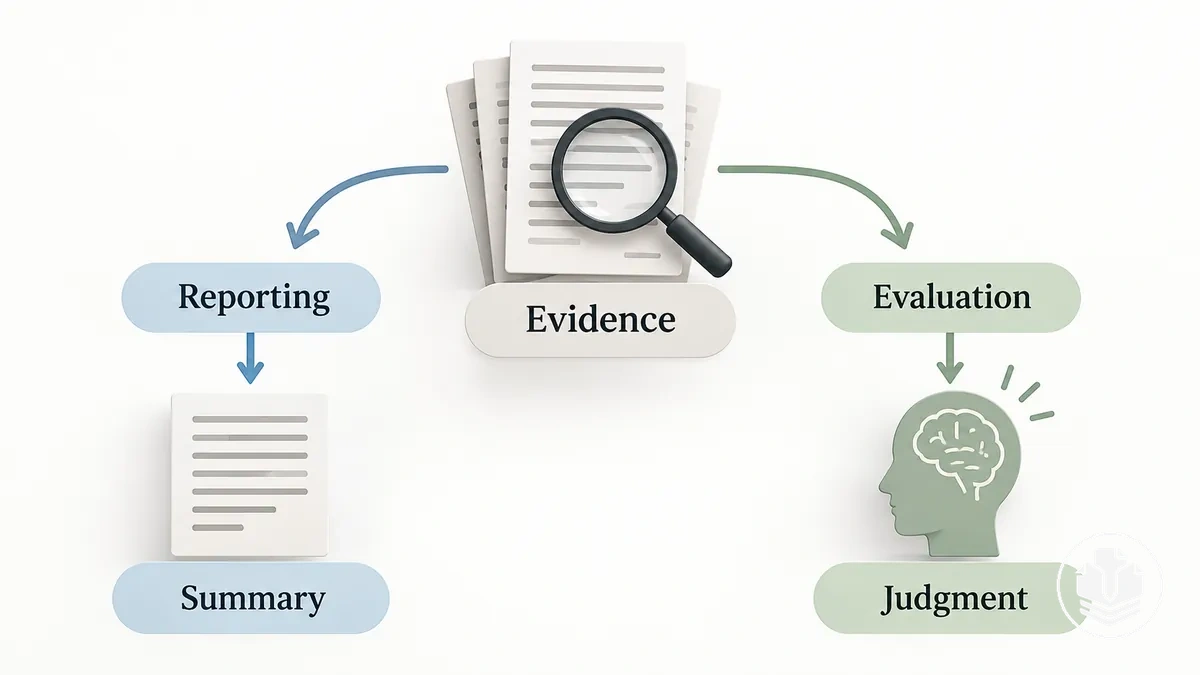
Reporting and evaluation can both appear in a literature review, but they perform different jobs on the same evidence.
Summary or reporting condenses a source finding, while critical analysis interprets that finding, evaluates its significance, and connects the resulting judgment to the review question.
The comparison therefore concerns how evidence is processed rather than whether description should be eliminated.
The comparison below separates purpose, typical operation, and analytical outcome for both writing modes.
The image uses one shared evidence item to distinguish the reporting path that condenses a finding from the evaluation path that interprets its significance.
| Dimension | Summary / Reporting | Critical Analysis / Evaluation |
|---|---|---|
| Purpose | Represent relevant source evidence concisely and accurately. | Establish what the evidence means for the review question or argument. |
| Typical operation | Reports and condenses a source's relevant finding or claim. | Interprets and evaluates the evidence, connects it with relevant considerations, and forms a qualified judgment. |
| Analytical outcome | A concise account of what the source reports. | A reasoned implication or conclusion bounded by what the evidence can support. |
For example, reporting might state that a study found an association between two variables; critical analysis would interpret what that same association supports in relation to the review question while accounting for relevant limitations and context.
The evidence remains the same, but the analytical outcome moves from describing the finding to evaluating its significance.
Summary Reports and Condenses What Sources Say
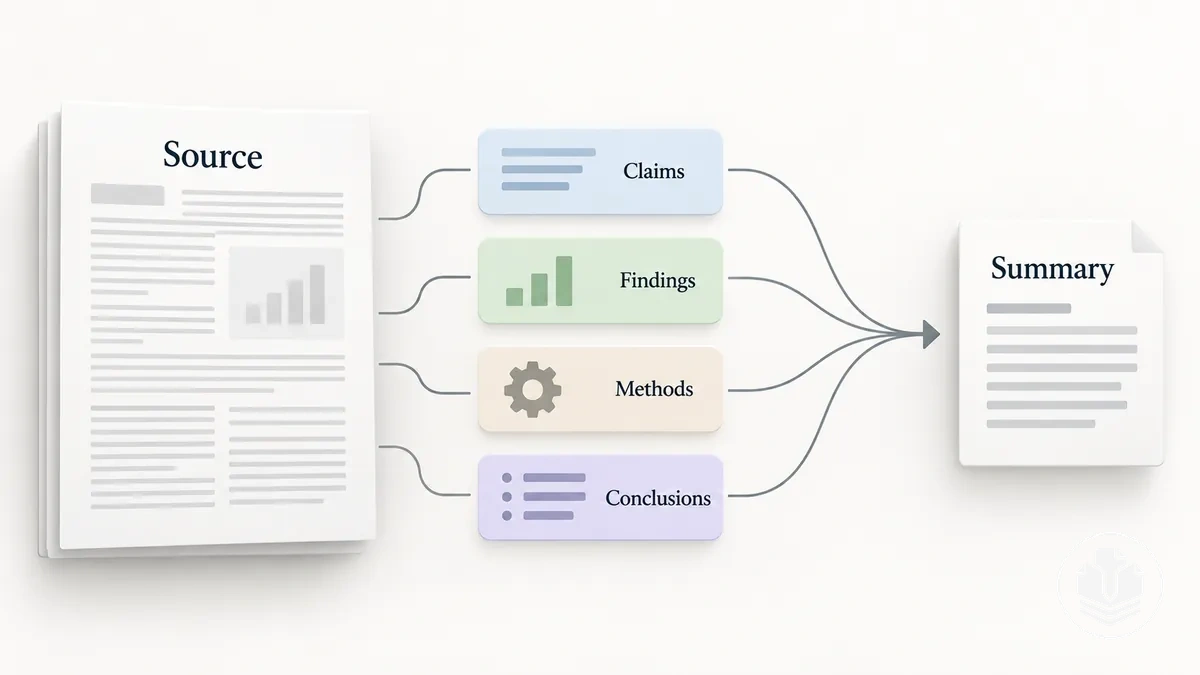
Summary is the selective condensation of relevant source content, including claims, findings, methods, or conclusions.
Summary reports the source's main point in a shorter form while preserving its meaning.
Which details are relevant depends on the literature review question and the context in which the source is being used.
Accurate reporting can establish what a study says, but summary does not by itself evaluate the significance or strength of the evidence or establish relationships with other studies.
The image illustrates this boundary by showing several source details being condensed into a shorter account without adding an evaluative judgment.
For example, a summary might report that a study found an association between two variables without interpreting what that finding implies for the review's argument.
Critical Analysis Interprets, Evaluates, and Relates Evidence
Critical analysis is the reasoned interpretation and evaluation of evidence to form a justified analytical judgment.
Critical analysis interprets what evidence means, evaluates its significance, and relates findings to relevant claims or other evidence.
It also considers strengths and limitations that affect what the evidence can support.
The resulting judgment is therefore qualified by the conditions and limitations of the evidence rather than treated as unsupported opinion.
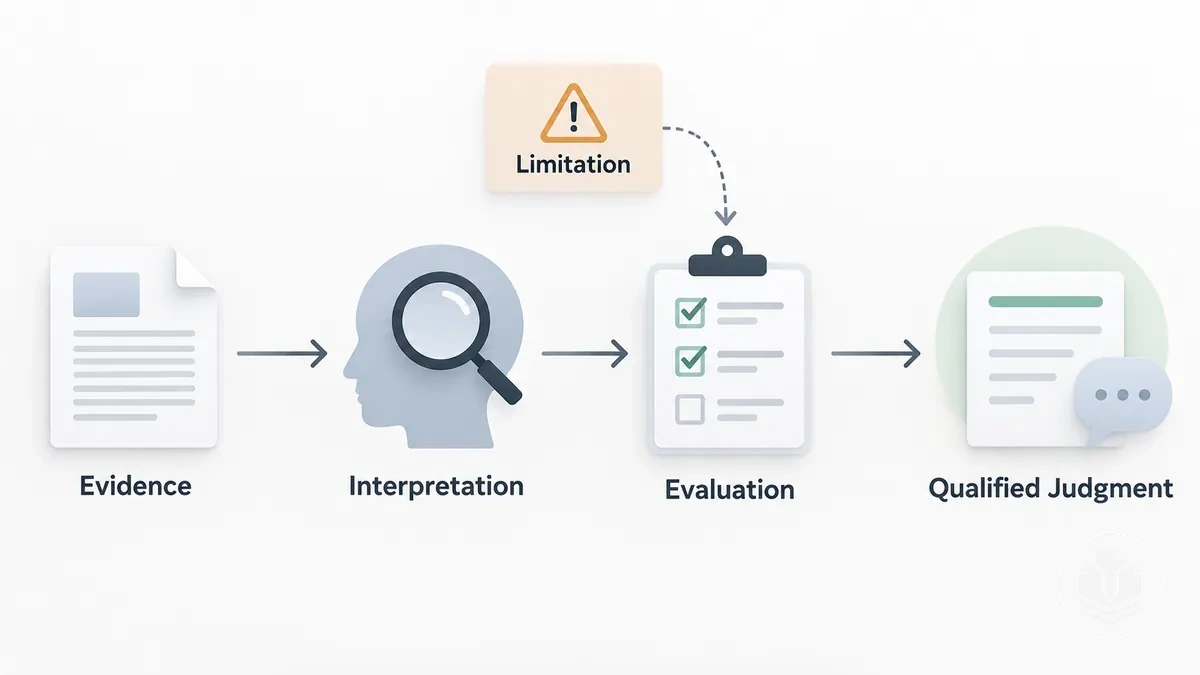
Critical analysis can explain how findings relate, whether a limitation changes their significance, and what implication is justified by those relationships.
For example, an analytical sentence can report an association and then infer that its significance is limited under a particular study condition; this is evaluation, not fault-finding for its own sake.
The judgment should remain traceable to the evidence and explicit reasoning that supports it.
Synthesis Connects Multiple Sources but Does Not Replace Critical Judgment
Synthesis connects evidence from multiple sources by identifying relationships among their findings or claims, while critical judgment evaluates what those relationships mean and what conclusion they can reasonably support.
Summary condenses material from a single source, synthesis integrates multiple sources, and critical judgment adds interpretation of the significance, consistency, or limitations of the connected evidence.
These operations are distinct, so connecting sources does not by itself establish an evaluative judgment.
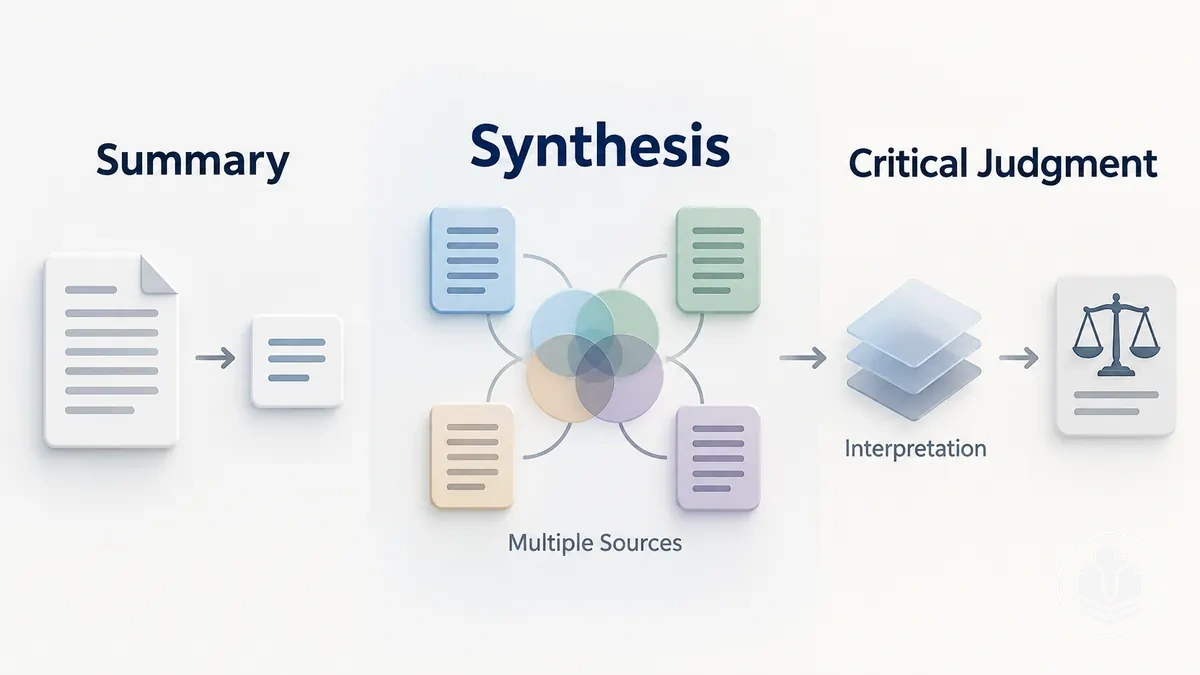
For example, several studies may report findings that point in a similar direction, and grouping those studies establishes a relationship through synthesis; critical judgment still requires interpretation of whether differences in context or limitations qualify the significance of that consistency.
Connecting multiple studies is therefore synthesis but not yet a full critical judgment; the separate process of how to synthesize studies belongs to the dedicated synthesis guidance.
The analytical boundary remains whether the relationships among the evidence have also been interpreted to support a qualified conclusion.
How to Diagnose a Literature Review That Is Too Descriptive
A literature review is too descriptive when reporting consistently outweighs interpretation, evaluation, and connection to the review question or argument.
The diagnostic issue is therefore a recurring pattern of summary-heavy writing, not the presence of description itself.
Descriptive sentences can appropriately establish evidence or context when they support later analytical processing.
Diagnostic signals help distinguish necessary reporting from a broader pattern in which sources are presented without sufficient evaluation or interpretation.
The annotated example highlights the same signal classes as the checklist so they can be recognised in writing, but no single diagnostic signal establishes the diagnosis on its own.
Each signal should instead prompt a check of what analytical operation is missing and whether that pattern recurs across the relevant paragraphs.
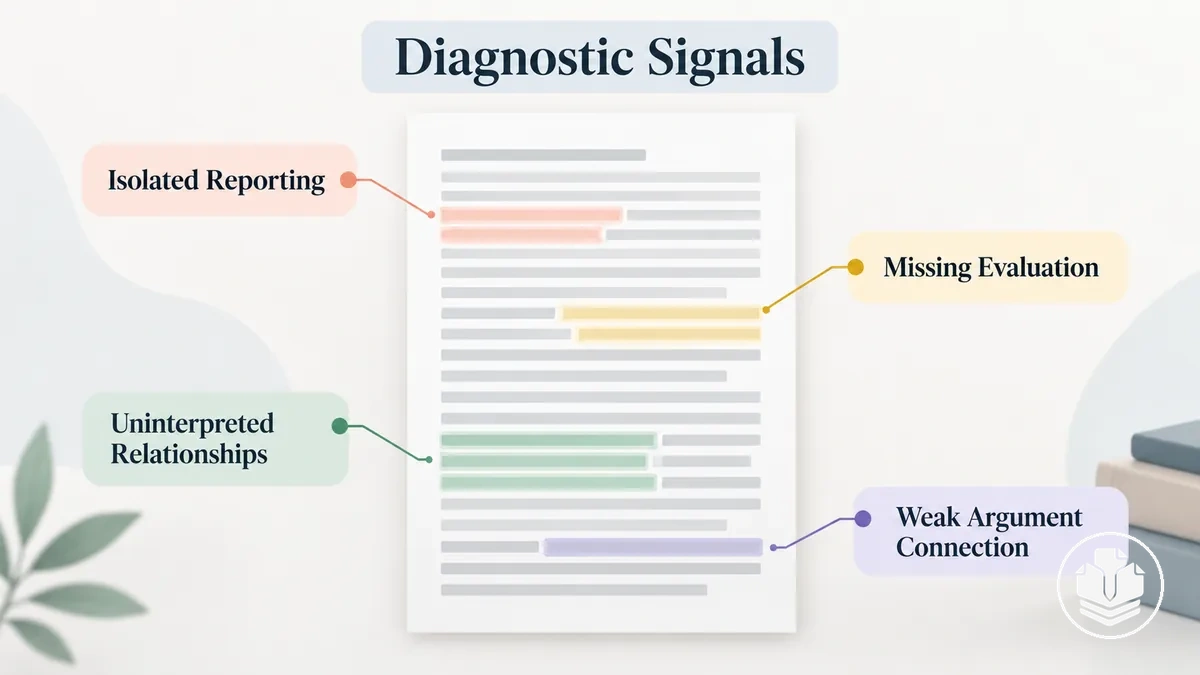
- Isolated source reporting: Sources are discussed mainly one by one. Check whether the writing connects their evidence to other sources or leaves each source as an isolated report.
- Missing evaluative judgment: Findings are reported without evaluation of what they support or how significant they are. Check whether the writer makes a reasoned judgment rather than stopping at description.
- Uninterpreted relationships: Similarities, differences, or other relationships among sources appear without interpretation. Check whether the writing explains what those relationships imply for the evidence.
- Weak connection to the review question: Evidence is presented without making its relevance to the review question or argument explicit. Check whether the discussion explains why the reported evidence matters to the argument being developed.
The combined pattern across several paragraphs is more informative than an isolated descriptive sentence or author-led paragraph, which may be appropriate for reporting necessary evidence.
When these signals recur and reporting repeatedly remains the endpoint rather than supporting evaluation, interpretation, and relevance to the argument, the writing is consistent with an overly descriptive literature review.
Studies Are Reported One by One Instead of Being Related
Source-by-source reporting may indicate descriptive organisation when studies are reported one by one and each source remains informationally isolated.
Repeated author-by-author reporting can produce a sequence of isolated summaries without stating a relationship around a shared claim.
The diagnostic signal is therefore the absence of analytical connection, not the presence of author names or individual study references.
Key distinction: organise the paragraph by source or by relationship?
Source-by-source reporting
“Study A reports one finding. Study B reports another finding.”
Effect: each study remains an isolated report, so the reader must infer the relationship.
Relation-led writing
“The studies agree on the shared claim, although Study B qualifies it under a different condition.”
Effect: agreement and qualification are made explicit around the same issue.
Findings Are Restated Without Evaluative Judgment
A finding remains a restatement when the writing reports what the evidence says but no evidence-based evaluative judgment follows.
The missing analytical step is a judgment about what the finding supports, how its relevance or limitation affects that support, or what implication follows in the review context.
Evaluation must therefore remain traceable to the evidence rather than becoming an unsupported assertion.
Before and after: add the analytical operation
Reporting only
“The study reports an association between the variables.”
Value: the finding is stated accurately, but its significance for the review is still open.
Evaluative judgment
“The study reports an association between the variables; however, the stated limitation qualifies how confidently this finding supports the review’s claim.”
Value: the same finding is interpreted through its support and limitation.
Agreements and Contradictions Are Not Interpreted
Relationships among studies remain descriptive when agreement or contradiction is identified without interpretation of its significance.
Noting that findings show consistency or divergence names an observed pattern, but it does not explain what that pattern implies for the review's developing judgment.
Interpretation requires the writer to distinguish the observed relationship from a possible explanation and from the implication that the evidence can support.
Pattern → interpretation → evidential boundary
Study A agrees with Study B, while Study C contradicts both.
Study A and Study B converge, while Study C diverges in a different population, suggesting that the apparent consistency may be context-dependent.
Differences in method, population, scope or context may help explain the pattern only when the evidence supports that connection.
Evidence Does Not Advance the Review Question or Argument
Evidence can be relevant to the topic yet remain analytically weak when its role in the review question or argument is unstated.
A correct study summary does not advance the line of reasoning if the reader cannot identify which claim the evidence affects or how it affects that claim.
For example, reporting that a study found a particular association is analytically weak if the summary stops there; the writer must state whether that finding supports or qualifies a claim connected to the review question.
The essential distinction is not whether every source creates a novel conclusion, but whether the evidence has an explicit implication for the review question or developing argument.
Why a Literature Review Becomes Too Descriptive
Overly descriptive literature-review writing usually reflects one or more contributing conditions in the writing process rather than a single cause.
These conditions can encourage a writer to transfer source information into prose without sufficiently processing relationships among evidence or forming an analytical judgment.
The resulting descriptive writing may be accurate at the source level while remaining dominated by reporting rather than interpretation.
The main contributing mechanisms differ in how they shift attention away from claims, relationships, and judgment.
The grouping below separates these mechanisms and the descriptive outcome each can encourage; the order does not indicate prevalence.
- Source-by-source notes transferred into prose: When source-by-source notes are carried directly into drafting, the prose can retain the structure of the notes and become a sequence of summaries. Reorganising the material around relationships or claims can create space for interpretation rather than simple transfer.
- Author-led organisation: Organising discussion around individual authors can encourage each source to be treated separately instead of showing how evidence relates to a shared claim. Shifting the organising focus toward claims and relationships can make the analytical purpose of each source more explicit.
- Unclear evaluative criteria: When the evaluative criteria for assessing evidence are unclear, a writer may report findings without knowing which features are relevant to an analytical judgment. Making the relevant criteria explicit helps distinguish evidence reporting from evaluation.
- Uncertainty about analytical judgment: A writer who is unsure how far the evidence supports a judgment may remain close to source wording and avoid stating an interpretation. Basing the judgment on what the evidence supports, qualifies, or limits can reduce this tendency without requiring unsupported certainty.
These mechanisms are contributing factors rather than guaranteed causes: source-by-source notes or author-led organisation do not necessarily produce descriptive writing if relationships and evidence-based judgments are added during drafting.
Broader problems involving searching, citation, plagiarism, time management, or revision fall outside this specific summary-versus-analysis mechanism and belong with other literature review mistakes.
The relevant causal boundary is whether a condition directly contributes to reporting sources without adequately processing their relationships and analytical significance.
How to Move from Summary to Critical Analysis
Moving from summary to critical analysis requires changing the operation performed on evidence, not simply adding evaluative vocabulary.
Instead of stopping after isolated reporting of source content, the writer must compare relevant evidence, evaluate what it supports, interpret relationships, and connect those relationships to the claim being developed.
Summary can remain where it establishes necessary evidence, but analytical judgment begins when the writing explains what that evidence means and what implication it can reasonably support.
- Align sources around the same claim. Use a shared issue, phenomenon or question as the comparison basis rather than treating each source as a separate endpoint.
- Compare the evidence relationship. Identify agreement, disagreement, extension, qualification, or a meaningful difference in context or method.
- Evaluate what the relationship can support. Apply criteria relevant to the claim and account for material limitations that change confidence, interpretation or scope.
- State the qualified implication. Connect the judgment to the review question or argument and keep its strength proportional to the evidence.
Worked transformation
“Study A reports an association between the variables, while Study B reports a similar association.”
Compare the findings, evaluate relevant limitations, interpret the consistency between them, and connect that interpretation to the claim.
“The similar associations reported by Studies A and B support the claim that the variables are related, although differences in study conditions may limit how broadly that consistency can be interpreted.”
Compare Sources Around the Same Claim or Issue
Sources become analytically comparable when they address the same shared claim, issue, phenomenon, or question.
The shared claim should organise the comparison so that relevant evidence can be aligned on a common basis rather than discussed as separate source summaries.
This makes it possible to classify the relationship among sources as agreement, disagreement, extension, or qualification.
Comparison basis: keep the claim constant, then interpret the relationship
- Shared point
- Align only evidence that bears directly on the same claim, issue, phenomenon or question.
- Relationship
- Identify agreement, disagreement, extension or qualification, and note context or method differences when they affect interpretation.
- Analytical implication
- If Studies A and B converge under comparable conditions while Study C differs in another population, the claim may be supported under some conditions but qualified under others.
Judge What the Evidence Supports Using Explicit Criteria
A defensible analytical judgment should use an explicit criterion that is relevant to the claim being evaluated.
The purpose is to decide what the evidence can reasonably support in the current review, not to assign a universal score to the entire source.
The weight of each criterion can vary with the review question, evidence type, and claim.
The criteria below connect an observed condition to its implication for confidence, interpretation, or scope.
- Relevance: If the evidence addresses the review question and bears directly on the claim, it contributes more clearly to that claim; if the connection is indirect, the interpretation should be more limited.
- Adequacy for the claim: Evidence is adequate only to the extent that it supports the specific claim being made. A broader claim requires evidence that can sustain that broader scope, while narrower evidence should lead to a correspondingly narrower judgment.
- Consistency or tension: Evidence that is consistent with other relevant findings can increase confidence in a shared interpretation, while meaningful tension should qualify that confidence and prompt closer interpretation of the difference.
- Material limitation: A limitation that directly affects the claim should reduce confidence, narrow the interpretation, or qualify the conclusion rather than being mentioned without consequence.
- Applicability: Evidence should be interpreted according to the context in which it applies. If the population, setting, method, or conditions differ materially from the current review context, the claim may need a narrower scope.
For example, the same finding may initially appear to support a broad claim, but a material limitation in population or context may reduce its applicability and justify a more qualified conclusion.
This claim-level judgment is distinct from a full appraisal of source quality; detailed guidance on how to evaluate the evidence belongs to the broader source-evaluation process.
Explain Why Patterns, Contradictions, and Limitations Matter
A pattern, contradiction, or limitation becomes analytically meaningful only when the writer explains how it changes the interpretation of the evidence.
Naming consistency, disagreement, or a constraint is an observation; the analytical task is to state what that observation implies for confidence, generalisability, a boundary condition, or the conclusion the review can reasonably support.
The observation, its possible explanation, and its warranted implication should remain distinct.
Observation → interpretation → implication
Several studies report similar findings, while one study reports a contradiction under different conditions.
The pattern suggests consistency within the shared conditions, while the divergent result may indicate that context or method affects how broadly the evidence applies.
Confidence may remain stronger within those shared conditions, but the contradiction qualifies generalisability and identifies a possible boundary condition rather than invalidating the evidence as a whole.
An unresolved contradiction or repeated limitation may point to an unanswered area when the evidence does not adequately explain the difference, but it does not automatically constitute a research gap.
A separate analysis is required to find research gaps and determine whether the unresolved issue is sufficiently supported as a gap rather than merely an observed inconsistency.
Connect Analytical Judgments to the Review Question or Argument
An analytical judgment should affect the review question, argument, or claim rather than remain an isolated evaluation of a source.
The writer should make explicit which proposition the evidence affects and what implication follows from the judgment.
The strength and direction of that implication should remain proportional to what the evidence supports.
Reasoning chain
For example, the isolated observation “The study's limitation reduces confidence in the finding” becomes argumentatively useful when revised to “The study's limitation reduces confidence in the finding, so the evidence qualifies rather than fully supports the review's current claim.” Once this judgment-to-argument connection is explicit, the separate task of how to build analytical paragraphs can organise that reasoning within paragraph structure.
When Summary Is Necessary Within Critical Analysis
Summary is necessary within critical analysis when readers need selective factual context before the evidence can be interpreted or evaluated.
Its function is to establish the relevant finding, concept, or context required for the analytical work that follows.
There is no fixed descriptive-to-critical percentage that suits every literature review. Use only as much summary as readers need to understand the evidence or context required for the interpretation or evaluation that follows.
The situations below distinguish functions of summary rather than prescribing fixed amounts of description.
In each case, concise reporting should provide only the information needed to support the subsequent analytical implication.
- Introducing a relevant finding: Summary can state the source finding that the critical analysis will interpret, compare, or evaluate.
- Defining necessary context: Summary can establish a concept or contextual condition when readers need it to understand why the evidence has a particular significance.
- Establishing a factual basis before judgment: Summary can present the evidence needed for an analytical judgment so that the judgment remains traceable to what the source actually reports.
The amount of summary is appropriate when it serves its defined function without displacing the interpretation or evaluation required by the review purpose.
For example, “The study reports an association between the variables” provides the factual basis; adding “This association supports the review's current claim under the study conditions, but does not establish that the relationship applies beyond them” makes the analytical implication explicit without requiring a fixed descriptive-to-critical ratio.