
Revising and Editing a Literature Review
Revise a literature review from macro to micro: first fix purpose alignment, claim–evidence support, section logic, synthesis, and redundancy; only then line-edit for clarity, transitions, terminology, and mechanics. Finish with a separate proofread against the applicable style and submission requirements, because sentence-level polishing cannot repair weak reasoning.
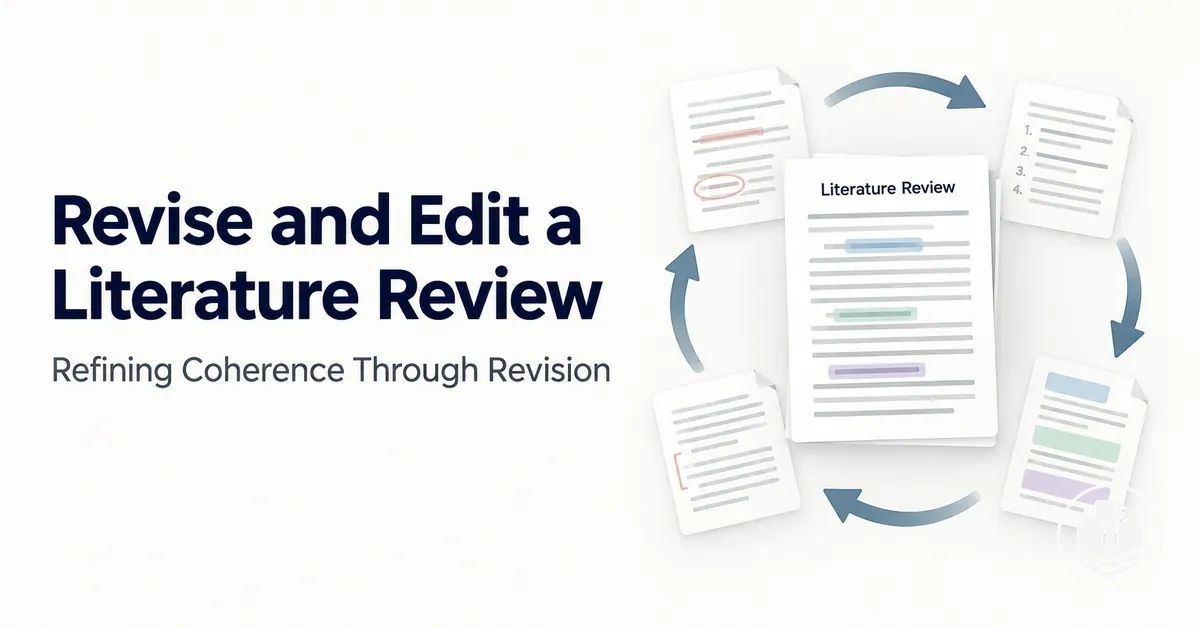
Revision order at a glance
Work from the quality of the argument to the quality of its expression. Each pass has a different decision target.
- Prepare the draftUse a complete draft, restate its purpose and scope, and confirm the assessment or submission requirements.
- Revise meaning and relationshipsCheck claim–evidence alignment, logical progression, cross-study synthesis, relevance, and redundancy.
- Edit expressionImprove paragraph connections, sentence clarity, terminology, consistency, and readability without changing evidential strength.
- Proofread and verifyCorrect grammar, punctuation, spelling, capitalisation, formatting, and citation mechanics under the governing convention.
Decision rule: if a problem changes reasoning or relationships, return to substantive revision; if the reasoning is sound and the problem is expression or mechanics, make a local edit.
The exact final form can vary by discipline, review type, and assignment requirements, so apply this sequence using the criteria that govern the specific literature review.
Table of Contents
Prepare the Literature Review for Revision
Prepare a literature review for revision once you have a complete draft, a clear purpose and scope, and the relevant assessment requirements.
These conditions make the draft complete enough to evaluate as a whole before individual sentences are changed.
Keep substantive revision separate from later copyediting so each pass has a distinct purpose.
Where practical, some distance from the draft or a separate fresh read can make inconsistencies easier to notice.
The visual below shows the readiness stages, while the ordered steps specify the action and purpose of each stage.
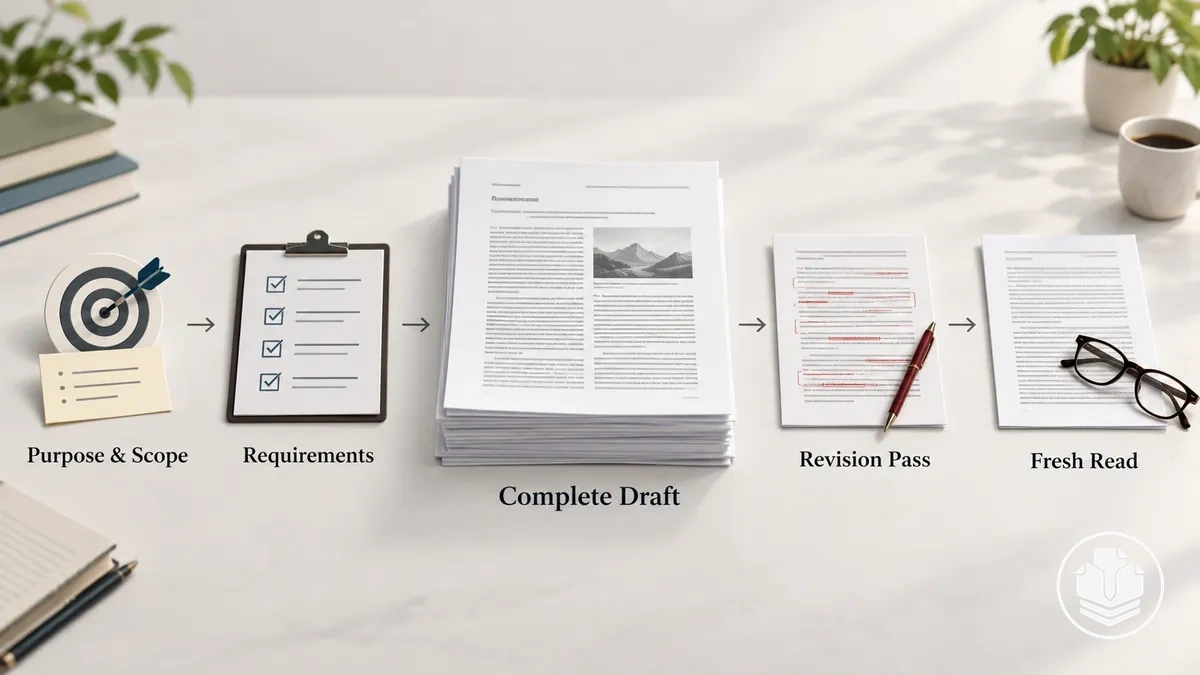
Revision readiness sequence
- Confirm the draft is complete enough to evaluate. Check that the planned sections and main discussion are present so the revision pass can assess the draft as a connected whole.
- Restate the purpose and scope. Use them as boundaries for deciding whether the draft addresses its intended question and remains within the intended coverage.
- Identify assessment or submission requirements. Confirm the criteria and constraints that apply to this literature review so revision decisions reflect the actual review requirements.
- Separate substantive revision from copyediting. Plan the revision pass for meaning and relationships before using a later editing pass for sentence-level correction.
- Create enough distance for a fresh read where practical. Use a separate reading pass when possible, then verify that the draft, purpose, scope, requirements, and planned passes are clear enough for substantive revision to begin.
Preparation for revision should not routinely restart the wider literature review process or reopen earlier research tasks.
Return to those tasks only when revision exposes a genuine evidence gap that cannot be resolved through editorial changes.
Revise the Literature Review for Coherence and Synthesis
Substantive revision checks whether the literature review draft works as a coherent analytical whole before line editing begins.
It evaluates relationships and analytical meaning across the draft rather than focusing on sentence-level polish.
The diagram below shows how claims, evidence, sections, and studies connect during this revision pass.
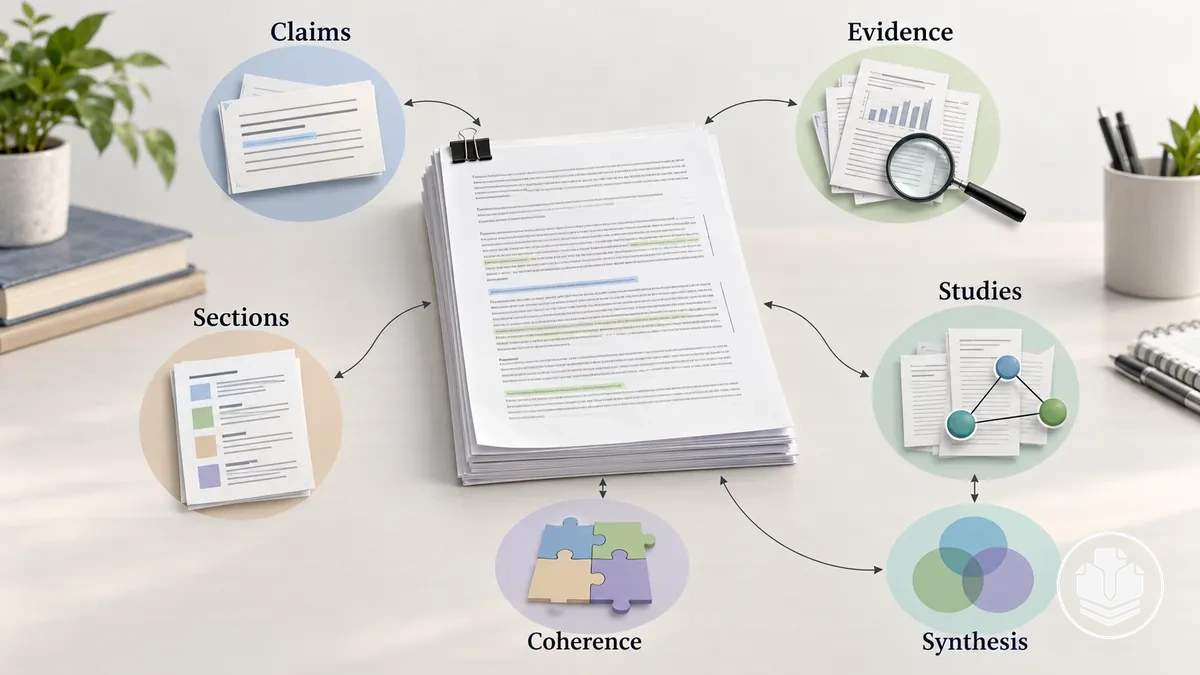
Claims must align with the relevance and strength of the evidence, while sections need a logical order that sustains coherence across the discussion.
Studies contribute to synthesis when their relationships and implications are connected rather than treated as isolated material.
Relevance determines whether material contributes to the review's purpose, while redundancy identifies content that repeats an analytical function without adding a necessary distinction.
These variables interact, so weakness in one relationship can affect how the surrounding draft is understood.
The required adjustment depends on the relationship that is weak: substantive revision may need to realign a claim with its evidence, change the progression of material, strengthen relationships among studies, or reconsider material whose relevance is unclear or redundant.
The appropriate structural revision can vary with the review type, discipline, and assignment, so the revision decision should respond to the specific weakness rather than assume one universal arrangement.
Check That Evidence Supports the Review's Argument
A claim is sufficiently supported when the cited literature is relevant to it and the wording matches the strength and consistency of the evidence.
The level of support should therefore determine how confidently the claim states its implication.
Evaluate relevance by asking whether the evidence directly addresses the claim and contributes to the review's purpose.
Then consider the degree of support, whether qualification is needed, and whether material disagreement changes the interpretation.
The annotated example below shows how claim wording can remain aligned with supporting evidence when the available literature is mixed or limited.

Evidence-to-claim checks
- Relevance: Does the cited literature address the specific claim and align with the review's purpose?
- Support strength: Does the evidence consistently support the claim, or is the support mixed, limited, or indirect?
- Qualification: Does the wording reflect the actual degree of support rather than express greater certainty?
- Material disagreement: Does conflicting evidence require the claim to acknowledge disagreement or narrow its implication?
Citation quantity alone does not establish evidential support; critical analysis also requires explaining how relevant evidence supports, qualifies, or challenges an interpretation.
For example, an unsupported generalisation such as “The literature agrees that the approach is effective” overstates mixed evidence, whereas “The literature suggests potential benefits, although findings are mixed” calibrates the claim to the stated evidence condition.
Check Logical Coherence Across Sections
Coherence exists when each section and paragraph has a clear logical relationship to adjacent ideas and the review's central purpose.
A coherent sequence makes the reason for moving from one content unit to the next explicit rather than presenting individually relevant summaries without a logical progression.
Evaluate each transition by tracing the preceding idea, its relationship to the following idea, and the effect of that connection on the overall reasoning.
The appropriate literature review structure can vary by purpose, discipline, or review type, so test the arrangement by its logic rather than against one universal order.
The diagram below illustrates how adjacent ideas can connect through explicit relationships while remaining aligned with the central purpose.
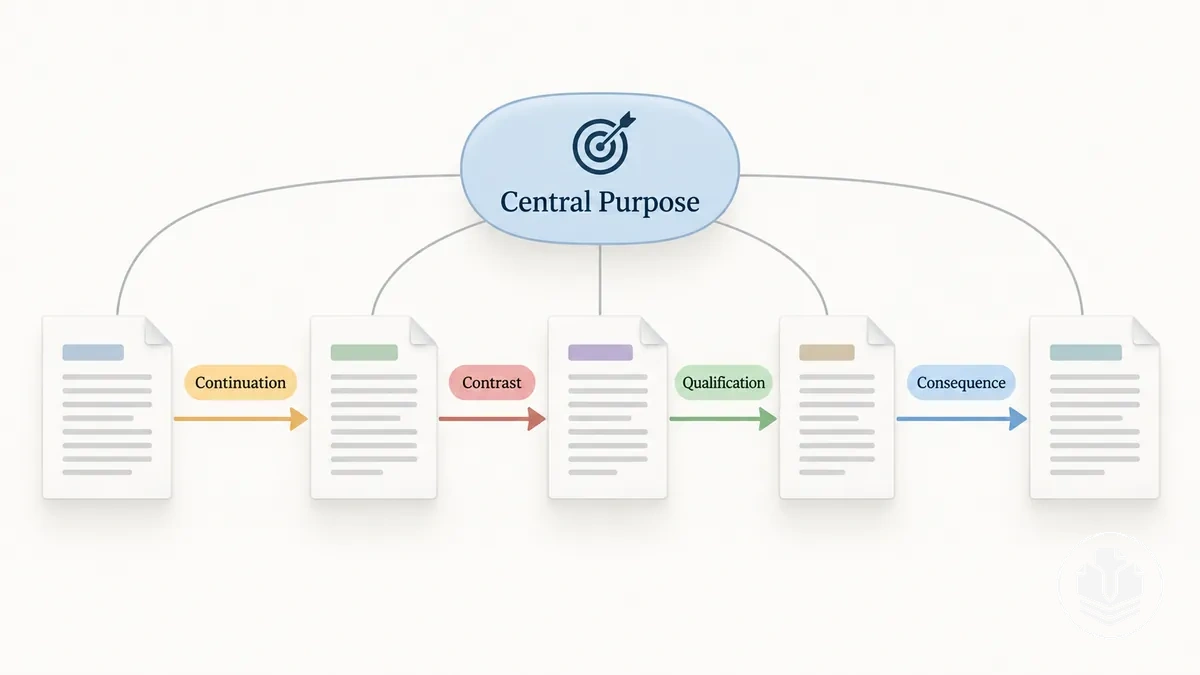
Coherence checks
- Logical order: Does each section follow from the preceding material through a meaningful analytical relationship?
- Topic-sentence continuity: Does each paragraph's topic sentence connect its main idea to the surrounding discussion?
- Explicit relationship: Is the connection between adjacent ideas identifiable as continuation, contrast, qualification, consequence, or another relevant relation?
- Central-purpose alignment: Does the sequence support the review's central purpose rather than create disconnected lines of discussion?
Coherence concerns the logic connecting ideas, while cohesion concerns surface devices that signal those connections.
Connective wording can make an existing relationship visible, but it cannot repair an illogical section or paragraph sequence where the underlying relationship is missing.
Check Synthesis Across Studies
Synthesis is present when studies are related around a shared theme or claim rather than reported one source at a time.
Multiple citations alone do not establish synthesis; the draft must make the relationship among studies explicit and connect that relationship to an analytical implication.
Check whether relevant studies show agreement, disagreement, or variation around the theme or claim, and state that relationship directly.
Methodological differences may qualify how findings can be interpreted together, while limitations may narrow the implication that the combined discussion can support.
The resulting synthesis should reflect whether the studies converge, conflict, differ in method, or support a more limited interpretation.
The comparison graphic below makes the difference between isolated reporting and relationship-based synthesis visible.
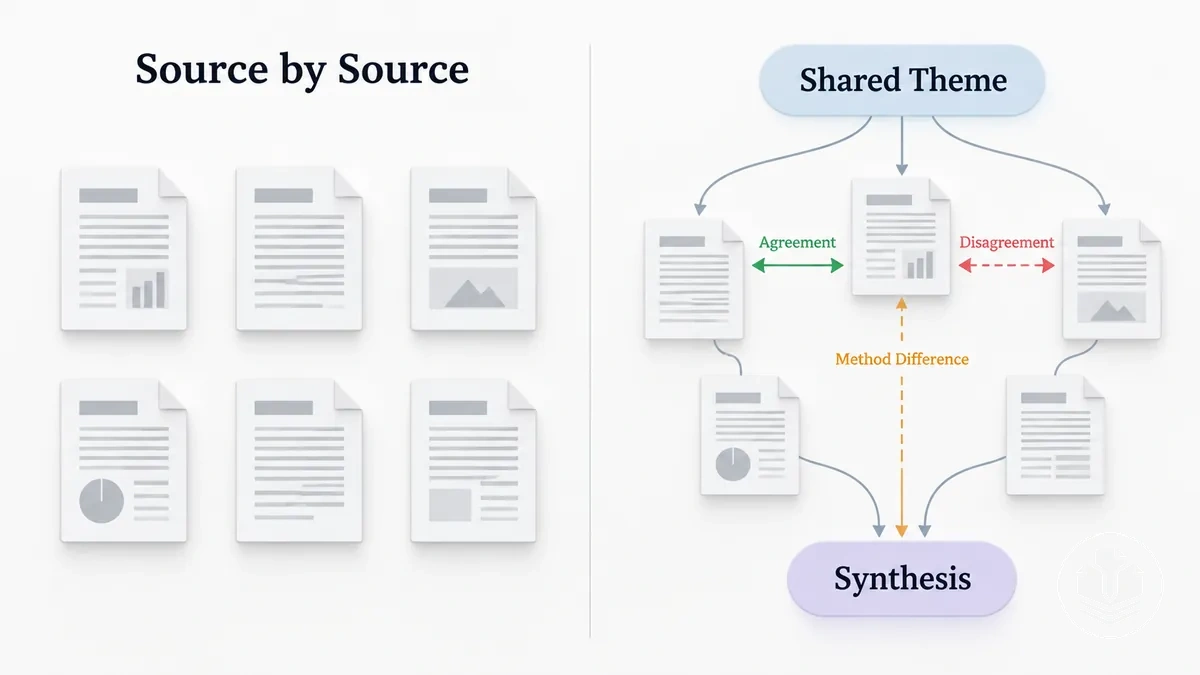
Source-by-source reporting: Study A addresses the theme, and Study B also addresses it, but their analytical relationship remains unstated.
Integrated synthesis: Study A and Study B address the same theme, but their findings differ; identifying that disagreement makes the variation part of the synthesized implication.
Use this distinction to diagnose weak synthesis before you improve paragraph-level synthesis; the relationship among studies, rather than source count alone, determines the analytical value of the synthesis.
Remove Redundancy and Repeated Claims
Repetition is redundant when repeated material adds no new analytical function or contribution to the literature review.
Repeated claims or wording may be deleted or consolidated, while purposeful repetition can remain when it provides a distinct contrast, qualification, or analytical role.
Diagnose redundancy by checking what each recurrence contributes in its context rather than treating repetition itself as the problem.
Duplicate wording and repeated background often add no new analytical value, while overlapping claims may need consolidation and repeated evidence may serve a distinct purpose.
The following criteria separate material that should be deleted or combined from repetition that performs a necessary analytical function.
Redundancy decision rules
- Duplicate wording: Delete or consolidate wording that restates the same idea without adding a distinction, qualification, or analytical contribution.
- Repeated background: Combine background information when later occurrences provide the same context without serving a new purpose.
- Overlapping claims: Consolidate claims that make substantially the same analytical point, while retaining distinctions that change the interpretation or implication.
- Repeated evidence: Retain evidence when its later occurrence supports a genuinely different analytical function; otherwise, consolidate unnecessary repetition.
Redundancy in drafted prose is not the same as redundancy among published studies or reviews; writers addressing broader revision problems can also fix common literature review mistakes.
After diagnosing the repeated material's function, delete content with no added contribution, consolidate overlapping material, or retain and distinguish material that performs a necessary analytical role.
Edit for Clarity, Flow, and Consistency
Line editing should begin after the literature review's substantive relationships are stable.
Its purpose is to improve clarity, flow, consistency, and readability while preserving each scholarly claim and its evidential strength.
Evaluate each sentence and paragraph by asking whether the wording communicates the intended meaning clearly and consistently.
Readability depends on focused expression, while paragraph flow depends on clear progression between connected ideas.
Terminology and academic tone should remain appropriate to the subject and consistent across the review.
Internal language choices, including abbreviations and recurring terms, should be standardised where variation would create unnecessary ambiguity.
Line-editing targets
- Readability: Clarify wording that obscures the sentence's main point without weakening or strengthening the underlying claim.
- Paragraph flow: Refine connections between adjacent sentences and paragraphs so the intended progression is clear.
- Terminology: Use the same technical term consistently when it refers to the same concept, unless a genuine distinction requires different wording.
- Academic tone: Refine phrasing to suit the relevant scholarly context without imposing one universal style.
- Internal consistency: Standardise recurring language choices when inconsistent usage could confuse the reader.
Choices about tense, voice, terminology, and academic tone may depend on disciplinary or institutional conventions, so line editing should follow the requirements that apply to the review.
Whatever convention is used, the revised wording should preserve the original evidential strength and meaning rather than introduce a stronger or weaker claim.
Strengthen Paragraph Connections and Transitions
A useful paragraph connection makes the logical relationship between adjacent paragraphs explicit or readily inferable.
The transition wording should express how the next claim contrasts with, continues, qualifies, or follows from the prior claim.
At each paragraph boundary, identify the prior claim, determine its logical relationship to the next claim, and let the next topic sentence carry that connection.
A contrast should show a meaningful difference, a continuation should extend the same line of reasoning, a qualification should narrow or condition the earlier point, and a consequence should state what follows from it.
The logical relationship matters more than the transition phrase because wording cannot create coherence between ideas that are not actually connected.
Generic connector
“However, the next studies used different methods.”
This signals contrast but does not explain why the difference matters.
Relationship-based transition
“However, the next studies used different methods, which limits direct comparison with the earlier findings.”
This states the qualification explicitly and shows how the next paragraph advances the prior claim.
Edit Sentences for Clarity and Consistency
Sentence clarity improves when editing removes ambiguity and unnecessary complexity while preserving precise academic meaning.
Each sentence should communicate its intended claim without changing the claim's evidential certainty or replacing necessary disciplinary terminology.
Evaluate sentence focus by checking whether the subject and predicate express the intended claim directly, then check whether each referent identifies an unambiguous noun.
Reduce wordiness when extra wording adds no necessary meaning, and keep terminology and abbreviations consistent when they refer to the same concepts.
Tense and voice should remain consistent where the relevant discipline, style guide, or context requires a particular convention.
Sentence-level checks
- Sentence focus: Check whether the sentence's subject and predicate make the intended claim clear without unnecessary complexity.
- Referent clarity: Replace an ambiguous pronoun with the relevant noun when the referent could reasonably indicate more than one entity.
- Wordiness: Shorten wording that repeats or delays the intended meaning, but retain detail needed for precision or qualification.
- Terminology and abbreviations: Use stable terminology for the same concept and apply abbreviations consistently according to the relevant convention.
- Tense and voice: Maintain consistent usage where required by disciplinary or institutional convention rather than imposing one universal preference.
For example, “This suggests the finding is limited” is ambiguous when “this” could refer to several preceding ideas; naming the relevant limitation clarifies the referent.
The revision should resolve that ambiguity while keeping the original qualification and evidential certainty intact.
Correct Grammar, Punctuation, and Mechanics
Perform the final copyedit after meaning-level and sentence-level revisions are stable.
This proofreading pass isolates mechanical errors and surface-level correctness without reopening settled analytical content.
Check grammar, punctuation, spelling, capitalisation, formatting consistency, and citation mechanics against the applicable style guide or institutional convention.
Acceptable variants may therefore differ where the governing convention differs.
Use the checklist to verify whether each text feature conforms to the relevant rule before making a correction.
Copyedit checks
- Grammar: Correct grammatical errors when the text violates the applicable language rule, while preserving the intended meaning.
- Punctuation: Verify punctuation against the required convention and correct marks that conflict with that convention or obscure the intended reading.
- Spelling and capitalisation: Correct genuine spelling or capitalisation errors while preserving accepted technical terminology and proper names.
- Formatting consistency: Check recurring formatting features for consistent treatment under the required style guide or institutional requirements.
- Citation and reference mechanics: Verify citation and reference formatting against the required style rather than imposing a different citation convention.
- Technical terms and proper names: Confirm unfamiliar forms before changing them; unusual terminology or spelling is not necessarily an error.
- Quotation integrity: Preserve quoted material accurately and make corrections only when the applicable quotation or citation convention permits them.
- Automated flags: Treat automated grammar or style flags as prompts for human review, not definitive proof that the flagged text is incorrect.
Run the Final Revision and Editing Checklist
The final quality check verifies that substantive revision and surface-level editing now work together across the completed literature review.
It confirms purpose alignment, evidence support, coherence, synthesis, clarity, consistency, and mechanics before the draft is treated as final.
Apply each check as a pass-or-correct decision rather than marking items complete automatically.
A failed condition requires a local edit when the problem is limited to expression or mechanics, or a return to substantive revision when the underlying reasoning or relationships remain weak.
Final pass criteria
- Purpose alignment: Pass when the review's claims and discussion remain relevant to its stated purpose; otherwise, revise or remove material that does not contribute to that purpose.
- Evidence support: Pass when each material claim is supported by relevant evidence at the level of certainty expressed; otherwise, qualify the claim or correct its relationship to the evidence.
- Logical progression: Pass when sections and paragraphs form a coherent line of reasoning; otherwise, return to substantive revision and correct the weak sequence or relationship.
- Cross-study synthesis: Pass when relevant studies are connected through agreement, disagreement, variation, or another meaningful relationship; otherwise, revise isolated source reporting into synthesis.
- Redundancy: Pass when repeated material serves a distinct analytical function; otherwise, delete or consolidate repetition that adds no analytical value.
- Paragraph transitions: Pass when adjacent paragraphs express or clearly imply their logical relationship; otherwise, correct the underlying connection before refining transition wording.
- Sentence clarity: Pass when each sentence communicates its intended claim without avoidable ambiguity or unnecessary complexity; otherwise, revise the wording while preserving evidential certainty.
- Terminology consistency: Pass when recurring terms and abbreviations identify the same concepts consistently; otherwise, standardise inconsistent usage without replacing necessary disciplinary terminology.
- Mechanics: Pass when grammar, punctuation, spelling, capitalisation, and formatting are consistent with the applicable requirements; otherwise, correct the surface-level error under the governing convention.
- Citation and reference consistency: Where the assignment specifies citation or formatting requirements, pass when citations and references conform consistently; otherwise, correct the relevant mechanics before final submission.
Finished literature review examples can calibrate judgments about how these qualities appear in completed writing, but they should not become templates that every review must copy.
Use examples to clarify borderline judgments while applying the requirements of the specific review type and assignment.