
Literature Review Examples in Practice
Literature review examples are most useful as models of how academic reasoning works, not as text to copy. A strong example shows how the introduction defines purpose and scope, how the body connects studies through synthesis, and how critical writing evaluates the strength and limits of the evidence; adapt those functions to your own question, evidence, and disciplinary requirements.
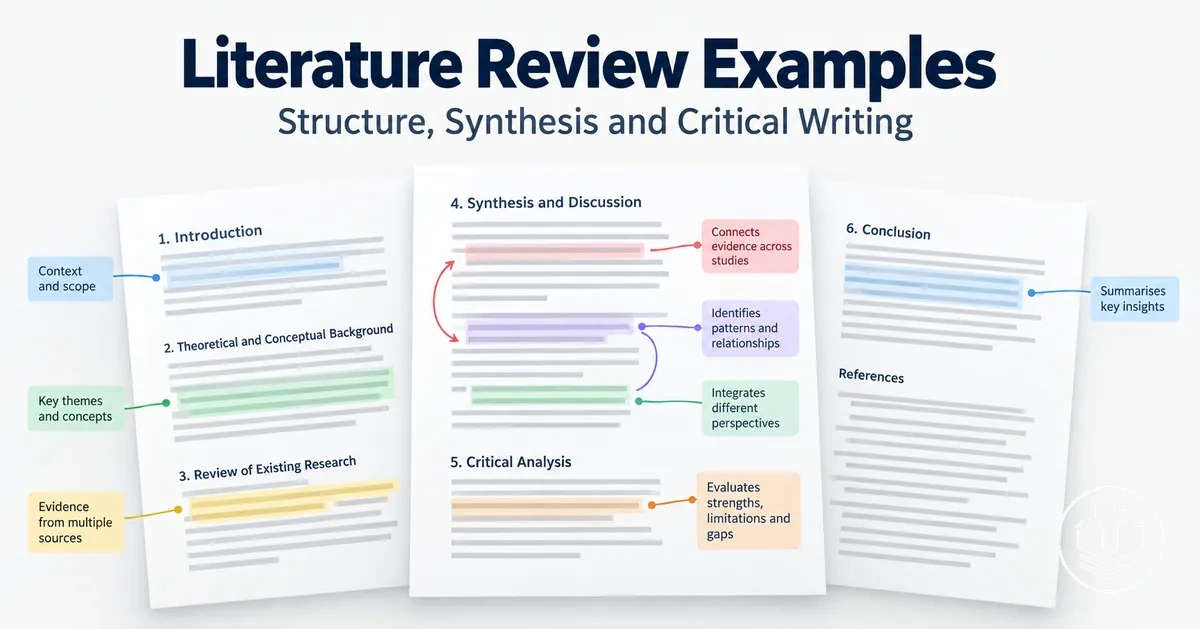
How to read a literature review example
Read the example at four connected levels. Each level answers a different question about how the review works.
1. Structure
Look for: purpose and scope → organising logic → final synthesis.
Meaning: the introduction, body, and conclusion perform different jobs while developing the same argument.
2. Synthesis
Look for: agreement, contrast, methodological difference, and context across studies.
Meaning: a higher-level claim should come from relationships among findings, not from a sequence of isolated summaries.
3. Critical writing
Look for: relevance, study design, limitations, consistency, and context.
Meaning: the interpretation should be qualified according to what the evidence can and cannot support.
4. Transfer
Look for: the function or evidence relationship beneath the example's wording.
Meaning: map that pattern to your own evidence, draft independently, and verify originality, support, coherence, and disciplinary fit.
Transfer rule: model the reasoning pattern, not the wording or argument of the example.
Because literature review conventions vary by discipline, assignment, scope, and review method, a sample does not provide one universal surface format. What remains transferable is the function of its introduction, body, and conclusion, the relationships created through synthesis, and the way critical evaluation qualifies claims.
Reading examples at that functional level shows how evidence is selected, connected, and used to develop a coherent review without reproducing another writer’s wording, layout, or argument.
Table of Contents
Example of a Coherent Literature Review Structure
A coherent literature review structure depends on how the introduction, body, and conclusion perform connected functions, not simply on whether those section labels are present.
The introduction establishes purpose and scope, the body develops evidence through an organising logic, and the conclusion draws that development into a final synthesis.
Coherence emerges when each part prepares the reader for the next and contributes to the same line of argument.
Consider an illustrative review examining the relationship between social media use and university student wellbeing.
Its introduction can delimit the topic and establish the review's purpose; its body can organise studies around relevant themes and relationships; and its conclusion can synthesise what that evidence development means at the level of the review as a whole.
The annotated example identifies these functions and the continuity between them rather than prescribing wording to reproduce.
Introduction, body, and conclusion are recurring functions within a literature review structure, but their length and surface form can vary with the assignment, scope, and review context.

Introduction
Defines the focus as social media use and university student wellbeing, establishes the scope of evidence to be considered, and forecasts the organising logic. This gives the body a defined question and boundary to develop.
Body
Groups and relates evidence around the defined focus rather than treating studies as isolated summaries. Its organising logic creates progression across the evidence and develops the argument that the conclusion will need to synthesise.
Conclusion
Brings the developed evidence together, identifies the overall interpretation supported by the preceding discussion, and closes the argument within the established scope. Its synthesis therefore follows from the body rather than introducing a disconnected claim.
At whole-review level, the example is coherent because purpose and scope establish what the review will examine, organising logic controls how evidence develops, and synthesis provides closure to that development.
The transferable structural pattern is continuity of function: each major part performs a distinct job while remaining connected to the same argument.
The exact execution of those functions belongs to the more detailed introduction, body, and conclusion examples that follow.
How the Introduction Establishes the Review Context
A literature review introduction establishes the topic, scope, purpose, and organising direction before the body develops the evidence.
The topic identifies the broader area of inquiry, while the scope narrows that area to the evidence the review will actually examine.
The purpose establishes the analytical focus, and the forecast signals the organising logic that will guide later coverage.
The following original example shows these functions in one opening; its annotations mark functional moves rather than mandatory wording.
“Social media use is widely discussed in relation to university student wellbeing.
This review examines research on how patterns of social media use relate to reported wellbeing among university students, with attention to both supportive and adverse associations.
It evaluates the evidence by grouping studies around patterns of use, social connection, and wellbeing outcomes.
” Topic: social media use and student wellbeing establishes the review context; Scope: research concerning university students narrows the evidence to be covered; Purpose: evaluating supportive and adverse associations establishes the analytical direction; and Forecast: patterns of use, social connection, and wellbeing outcomes signals the organising logic for the body.
These functions constrain later evidence development because the body must address the defined scope and develop the categories forecast by the introduction.

How the Body Develops a Connected Argument
A literature review body paragraph develops a connected argument by organising studies around one analytical point and making the relationships among their evidence explicit.
The topic sentence establishes the paragraph claim, while source integration places individual studies in relation to that claim rather than presenting each source as a separate summary.
Comparison and synthesis can then identify agreement, contrast, methodological difference, or contextual conditions that matter for interpretation.
The following illustrative paragraph shows how that logic can operate within one local argument; the annotations expose the relationship between the claim, evidence, and interpretation rather than prescribing wording to copy.
“Patterns of social media use may matter more to student wellbeing than use considered as a single undifferentiated activity.
Some studies associate socially connective forms of use with supportive experiences, whereas others report adverse associations in contexts involving comparison or disruptive patterns of engagement.
Read together, these differences suggest that the evidence is more informative when the context and form of use are considered rather than when studies are reported one by one.
” Claim: the topic sentence establishes the analytical point that controls the paragraph.
Evidence relationship: the studies are connected through comparison and contrast, while Interpretation: the synthesis explains why those differences change how the evidence should be understood.
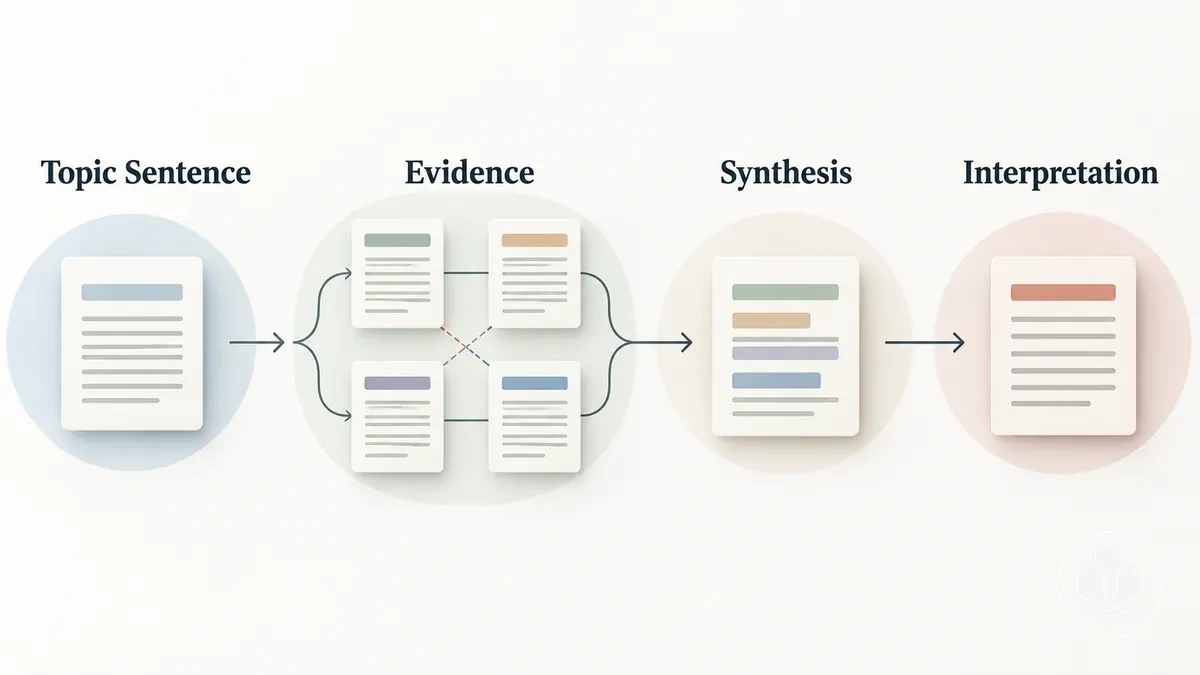
This example uses one relationship-led organising logic, but literature reviews can also use thematic and chronological organization when either pattern better fits the review question and evidence.
Whatever the organising logic, paragraph-level source integration sustains the broader argument when each comparison and interpretation develops the analytical point rather than becoming a source-by-source list.
How the Conclusion Brings the Review Together
A literature review conclusion consolidates the established evidence pattern into a synthesis of the main findings and explains their significance without introducing new evidence.
Its final interpretation should remain within the scope developed by the review, so each implication follows from evidence already examined.
Where the evidence supports a limitation or research gap, the conclusion can qualify what the review establishes rather than opening a new argument.
The following original example demonstrates synthesis, implication, and a justified limitation within the closing function; the image labels these moves and their connection back to the established evidence.
“Taken together, the reviewed studies suggest that the relationship between social media use and university student wellbeing differs according to patterns and contexts of use rather than following one consistent direction.
This synthesis indicates that interpretations of social media and wellbeing should account for how students engage with platforms, while differences in study methods and contexts limit how broadly the findings can be applied.
The evidence therefore supports a contextual interpretation while leaving a research gap around how particular patterns of use operate across different student populations.
” Synthesis: the conclusion integrates the main findings into an overall evidence pattern; Implication: it states the significance of that pattern within the review's scope; and Limitation and research gap: it qualifies the interpretation according to boundaries already established by the evidence.
This creates evidential closure because the concluding claims remain traceable to the argument developed in the review.

Example of Synthesizing Evidence Across Studies
Source-by-source reporting describes studies separately, whereas literature review synthesis makes the source relationships explicit and uses them to support a higher-level claim.
Synthesis therefore depends on how evidence shows agreement, contrast, or a methodological difference that changes the interpretation.
The important shift is from listing individual findings to explaining what the studies collectively support and where the evidence requires qualification.
Consider an original illustrative example in which three hypothetical studies examine the relationship between social media use and university student wellbeing.
Study A reports a positive association when use centres on social connection, while Study B reports a negative association when use involves frequent social comparison; Study C finds that the apparent relationship changes after distinguishing active interaction from passive consumption.
These findings are not simply contradictory: their contrast makes the context and form of use relevant to the combined interpretation.
The comparison below shows how the same illustrative evidence can remain a serial summary or become a synthesis claim based on relationships among findings.
Source-by-source reporting
Study A reports a positive association between socially connective use and wellbeing. Study B reports a negative association for social-comparison-oriented use, while Study C reports different findings after distinguishing active from passive use.
Synthesised reporting
Across the three hypothetical studies, social media use does not have a uniform relationship with student wellbeing; instead, the direction of the reported association differs according to the context and form of use. Together, the contrast between the findings and Study C's methodological distinction qualify a higher-level claim based only on overall social media use.
Takeaway: Synthesis transforms multiple study statements into an interpretation by identifying agreement, contrast, methodological difference, or context only where those source relationships affect what the evidence collectively supports.
The synthesized claim is stronger because its interpretation is supported by explicit relationships among the studies rather than by a sequence of isolated summaries.
The method for literature review synthesis develops these cross-source relationships systematically without treating transition words as synthesis.
At paragraph level, literature review paragraph examples show how a higher-level claim, supporting evidence, and interpretation can operate together in a synthesized paragraph.
The accompanying image illustrates the movement from separate findings through explicit source relationships to a qualified synthesis claim.

Example of Critical Writing Within a Literature Review
Descriptive reporting states what a study says, whereas critical writing evaluates what the evidence means and how strongly it supports a review claim.
The difference lies in the reasoning added through evaluation: relevance, methodological strength or limitation, consistency with other findings, and context all affect interpretation.
Critical writing therefore connects an evidential condition to a qualified judgement rather than treating every source as equally persuasive.
Descriptive
“Study A reports that frequent social comparison on social media is associated with lower reported wellbeing among university students.”
Function: states the study finding.
Critical
“Study A is relevant to the review because it examines social comparison among university students, but its cross-sectional design does not establish temporal order and therefore limits conclusions about direction of effect; its finding is most useful as evidence of an association rather than a causal conclusion.”
Function: links relevance and methodological limitation to a qualified interpretation.
Why the judgement is qualified: consistency with similar findings could strengthen the interpretation, while conflicting findings or materially different contexts would require the claim to be narrowed.
The critical judgement is justified by specific attributes of the evidence rather than by unsupported judgement.
For the review claim, confidence should be more qualified when the study design limits the inference, findings conflict, or the context differs materially; it can be stronger when the evidence is relevant to the question and converges across appropriately designed studies.
This distinction is central to critical analysis in a literature review: descriptive reporting identifies findings, while evaluation explains how evidential conditions affect their significance.
A well-supported interpretation therefore states not only what the evidence indicates, but also the methodological strength, limitation, or contextual condition that determines how far the claim can reasonably extend.
Features of a Strong Literature Review Example
A strong literature review example is useful because its structure, evidence relationships, critical evaluation, and coherence serve a defined review purpose rather than merely displaying polished academic prose.
Its relevance is visible in how consistently the discussion remains connected to the review question and scope.
Its quality is also evident when individual sources contribute to synthesis and interpretation instead of appearing as disconnected summaries.
The criteria below separate core quality signals from conventions whose form or weight can change with the assignment, discipline, and review type.
They focus on what can be observed in the example: how evidence is selected and related, how claims are supported, and how the argument progresses.
Disciplinary conventions can affect how these features are expressed, so the criteria support contextual evaluation rather than a universal score.
- Coherence and alignment: the introduction establishes a purpose and scope that the body develops and the conclusion resolves, showing alignment between the introduction, body, and conclusion rather than three disconnected parts.
- Relevance: included evidence and discussion remain connected to the review question and defined scope, so each substantial part has a clear role in the review's argument.
- Synthesis: the example makes source relationships visible through agreement, contrast, methodological difference, or context where those relationships affect interpretation, producing claims across evidence rather than a sequence of source summaries.
- Critical evaluation: judgements about evidence are tied to identifiable reasons such as methodological strength, limitation, relevance, or consistency with other findings, so evaluation is evidence-led rather than asserted.
- Evidence support: substantive interpretations remain traceable to the evidence discussed, with qualifications where the underlying evidence does not justify a broader claim.
- Paragraph progression: paragraphs develop connected analytical points through claims, related evidence, synthesis, and interpretation, allowing each paragraph to contribute to the larger argument.
These quality indicators work collectively: coherence and alignment establish continuity, while relevance, synthesis, critical evaluation, evidence support, and paragraph progression show how that continuity is developed through evidence.
Their precise expression depends partly on the assignment purpose, disciplinary conventions, review type, and quality of the underlying evidence, so a strong example should be evaluated in relation to those conditions rather than against one fixed surface pattern.
How to Adapt Example Patterns to Your Own Literature Review
Adapt literature review example patterns by transferring their function and underlying relationships to your own evidence rather than reproducing the example’s wording, argumentation, or source use.
The transferable pattern may connect purpose to structure, evidence to synthesis, or evaluation to a claim, while the specific content must come from your own review.
Independent drafting preserves originality because the example guides how information functions rather than supplying the information itself.
The sequence below moves from observing an example's function to applying and verifying that pattern in original writing.
Your review question, scope, own evidence, and disciplinary requirements determine whether and how the pattern fits.
- Identify the function: determine what the relevant part of the example accomplishes, such as establishing scope, synthesizing related studies, or qualifying a claim. Verify that the function addresses a need that also exists in your review.
- Abstract the pattern: describe the relationship beneath the example's surface wording, such as evidence comparison leading to synthesis or methodological limitation leading to a qualified interpretation. Keep the pattern general enough that it does not reproduce the example's argument.
- Map the pattern to your own evidence: identify which of your sources and findings can support the same functional relationship. Verify that the resulting claim follows from your evidence rather than being inherited from the example.
- Draft independently: write the passage from your own evidence, reasoning, and source use without following the example sentence by sentence. Check originality by confirming that the wording and argument development arise from your material rather than surface imitation.
- Verify fit: check that the adapted passage remains within your scope, has evidential support, contributes to coherence, and satisfies relevant disciplinary requirements. Revise or discard the pattern when it does not fit those conditions.
Final verification should confirm originality, evidential support, coherence with the surrounding review, and disciplinary fit rather than similarity to the example.
Example-based adaptation addresses only one part of literature review writing; the wider process also governs how the review is planned, researched, structured, drafted, and revised.
A transferred pattern is useful only when the reader's own evidence and review requirements support the resulting structure and interpretation.