
Evaluating Source Quality and Relevance for a Literature Review
Evaluate a literature-review source in four passes: relevance to the review question and scope, credibility, methodological quality, and its intended evidential role. Include it when it is sufficiently relevant and adequate for that role; use it with qualification when a manageable limitation matters; exclude it when a material scope or quality problem makes the intended use indefensible.

Source evaluation: a four-part decision framework
Use the stages in order. The aim is not to produce a universal score, but to decide whether a source is fit for a specific review question and evidential role.
- Relevance Compare the review question and predefined scope with the source’s concept, population or unit, context and time period. Result: direct fit, partial fit, or outside a required boundary.
- Credibility Assess authorship, publication controls, provenance, purpose and whether important claims have traceable, proportionate support. Result: converging confidence signals or concerns; no single marker is proof.
- Methodological quality Check design-to-question fit, sampling or data collection, analysis, bias, reporting transparency and limitations. Result: adequate support, a manageable limitation, or a material threat to the intended inference.
- Use decision Combine the earlier findings with the role the source is expected to play in the review, then record the reason for the decision. Result: include, use with qualification, or exclude for that role.
IncludeRelevant and sufficiently adequate for the intended evidential role.
Use with qualificationStill informative, but a limitation constrains interpretation or evidential weight.
ExcludeFails a material scope or quality condition required for the intended role.
A source is suitable only when it is relevant to the review and sufficiently trustworthy for its intended evidential role, with that judgment depending on the review question, scope, discipline, source type, and study design.
Source quality requires more than one signal.
Credibility indicators such as author expertise, publication standards, peer review, and evidence support can increase confidence, but no single indicator proves that the evidence is strong.
Methodological quality must also be considered because study design, potential bias, and acknowledged limitations can support or limit how confidently the source's findings should be interpreted.
Source evaluation is therefore a diagnostic judgment: identify relevant signals, interpret what they indicate, and distinguish stronger evidence from evidence that requires qualification.
The first decision is whether a literature review source has sufficient relevance and fit with the review question and scope.
Table of Contents
Evaluate Relevance to the Review Question and Scope
Source relevance is the fit between a source and the review question plus the review’s predefined scope, not merely broad topical overlap.
The exact inclusion boundaries depend on what the review has defined as eligible, so relevance must be judged against those boundaries rather than against topic similarity alone.
The main criteria test whether each source falls within the dimensions that define the review's scope.
These checks assess fit and eligibility, not source quality.
- Review-question alignment: the source addresses the question, relationship, or problem the review is intended to examine.
- Concept: the source examines the concepts or constructs required by the review rather than only mentioning the broader topic.
- Population or unit: the population, participants, cases, documents, or other unit of analysis fits the defined inclusion boundaries.
- Setting or context: the source falls within the geographical, institutional, social, clinical, or other context specified by the review when that boundary affects eligibility.
- Time period: the source covers the period defined by the review when publication date, study period, or historical setting is part of the scope.
- Explicit eligibility rule: the source satisfies any other predefined inclusion boundary that materially determines whether it belongs in the review.
The relationship between the review question, the defined scope, and a candidate source can be visualised as a scope-fit check across these dimensions.
An in-scope source aligns with the review question and the applicable inclusion boundaries; a partial-fit source matches some dimensions but differs on a condition that may limit its applicability.
An out-of-scope source falls outside a boundary that the review has defined as necessary for eligibility.
A partial match does not automatically require exclusion: its implication depends on which boundary differs and how that boundary relates to the review question.

For example, two sources may examine the same concept, but a source studying a different population or time period may be only a partial fit when those dimensions are explicit inclusion boundaries.
Finding candidate sources belongs to the literature search strategy; relevance evaluation determines whether those sources actually fit the review question and scope.
Topical and Conceptual Relevance
Conceptual relevance depends on whether a source’s concepts, constructs, outcomes, or arguments actually address the review question; broad topical overlap alone is insufficient.
Shared terminology may indicate that a source concerns the same topic, but it does not establish a substantive contribution to the question being reviewed.
A source has direct conceptual relevance when its central concept, construct, outcome, or argument aligns with what the review question examines.
Supporting relevance applies when a source contributes evidence or context that helps interpret the required concept without addressing it directly, while superficial topical overlap occurs when the source only mentions the broader topic without contributing to the required conceptual relationship.
These levels describe contribution to the review question rather than a universal scoring scale, and the contrast between conceptual fit and topical overlap can be visualised by comparing sources according to what they actually contribute.
Three levels of conceptual contribution
- Direct relevance: the source directly addresses the concept, construct, outcome, or argument required by the review question.
- Supporting relevance: the source contributes useful evidence or context to the required concept but does not address the review question directly.
- Superficial overlap: the source shares a topic or terminology but does not materially contribute to the concept being examined.
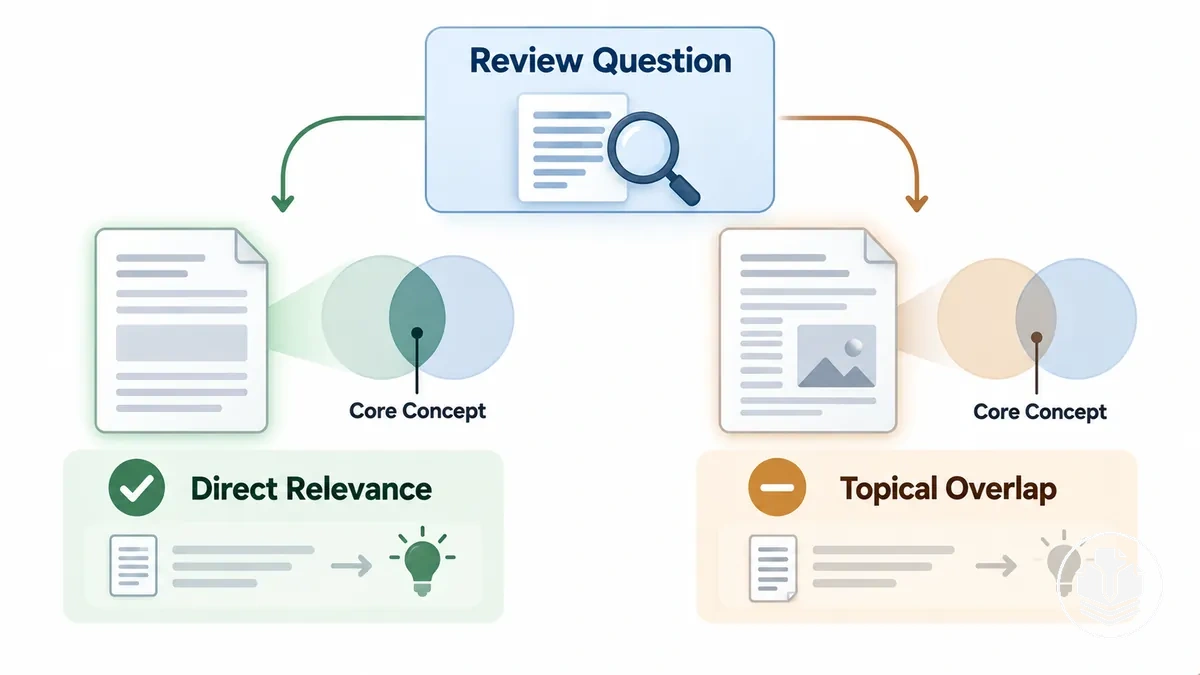
For example, if a review question examines how a particular factor relates to an outcome, a source that analyses that relationship has direct conceptual relevance; a source that merely mentions the factor and outcome within the same broad topic has superficial overlap.
The first can contribute directly to answering the review question, whereas the second should not be treated as substantively relevant on terminology alone.
Population, Context, and Time-Period Fit
Population, setting, context, and time-period differences matter when they change a source's applicability to the review question or its fit with the review scope.
A difference does not automatically make a source ineligible; its implication depends on whether that dimension is an explicit eligibility boundary or materially affects how the evidence can be applied.
Scope fit can be checked by comparing each review requirement with the corresponding source condition.
The diagram shows whether population, context, and time-period attributes align with the review boundary, while the table records the resulting match, partial match, or mismatch and its implication for eligibility or qualified use.
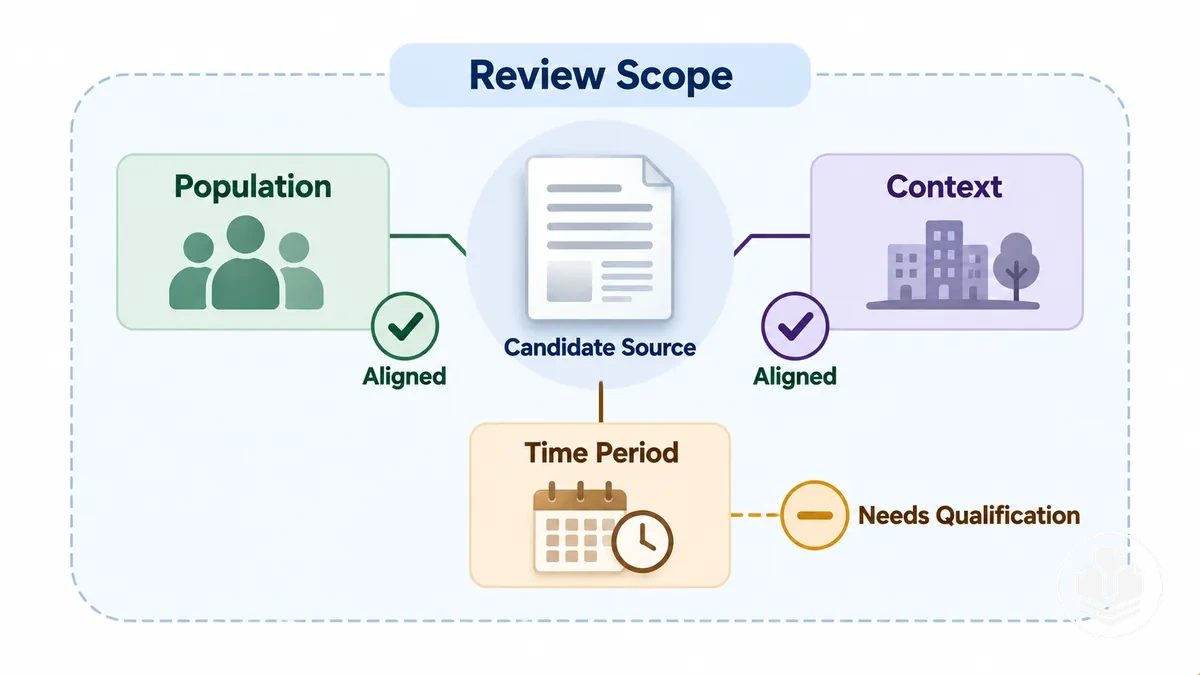
| Scope Dimension | Review Requirement | Source Condition | Evaluation Implication |
|---|---|---|---|
| Population/unit | The population or unit specified by the review scope | Matches the required population or unit, or differs on a characteristic relevant to the review question | A match supports direct applicability; a material difference may limit applicability or require qualification and may affect eligibility when that population boundary is explicit. |
| Setting/context | The setting, environment, or contextual conditions defined by the review | Matches the required context, or differs in conditions that are material to the review question | A contextual match supports applicability; a material difference may require qualified use rather than automatic exclusion unless the setting is an explicit eligibility requirement. |
| Time period | The publication or study period defined by the review scope | Falls within the required period, or differs in time where that difference affects applicability to the review question | A temporal match supports scope fit; a material time difference may limit applicability or affect eligibility when the review defines a time boundary. |
An older foundational study may remain relevant when the review needs the original formulation of an influential concept even though it falls outside the period used for evidence about current conditions.
In that case, the time-period difference requires qualification of the source's evidential role rather than an automatic conclusion that the source is unusable.
Evaluate the Source's Authority and Credibility
Source credibility should be evaluated through multiple converging signals rather than a single marker of prestige or publication status.
Authority, author expertise, publication standards, provenance, purpose, and evidence support can strengthen confidence when they are relevant to the source, but no single signal guarantees trustworthiness or correctness.
Author expertise indicates whether the person responsible for the source has relevant knowledge, while publication standards and peer review indicate the level of editorial or scholarly scrutiny applied before publication.
Provenance and transparency show whether the origin of information and supporting material can be traced, and purpose helps explain how the source may frame its claims.
Evidence support then determines whether substantive claims are backed by material that can be examined rather than accepted on authority alone.
These credibility signals should be interpreted together because each observed condition affects confidence differently.

Credibility signals to combine
- Author expertise: relevant qualifications, experience, or subject knowledge can support confidence in the author's authority; unclear or unrelated expertise calls for closer scrutiny.
- Publication standards: a documented editorial or review process can support confidence that the source received scrutiny; an unclear process provides less assurance.
- Peer review: peer review indicates that a scholarly work has undergone evaluation by other specialists, but it does not by itself establish that every claim or conclusion is correct.
- Provenance: clear authorship, publication origin, and traceable supporting material strengthen transparency; unclear provenance raises concern about how claims were produced.
- Purpose: an identifiable informational, educational, persuasive, or commercial purpose helps readers interpret how claims may be framed and what interests may influence presentation.
- Evidence support: claims linked to identifiable evidence support greater confidence; unsupported or difficult-to-trace claims require qualification or independent checking.
Strong credentials or publication processes can support confidence, but source credibility remains a judgment based on the combined signals and the evidence itself.
A source may therefore be credible yet still have limited relevance to a particular literature review if it does not address the review question or scope.
Authorship and Subject Expertise
Author expertise supports confidence only when the author's or responsible organisation's subject expertise is relevant to the specific claim being evaluated.
Qualifications, affiliation, publication record, or professional role can provide useful signals, but none establishes authority for claims outside the field to which that expertise applies.
Assess authorship by connecting each expertise signal to the subject of the claim and considering what that signal can and cannot establish.
The annotated example highlights common authorship cues that help identify relevant expertise without substituting those cues for appraisal of the evidence itself.

- Author identity: clear authorship establishes who is responsible for the claim and allows their expertise to be assessed; identity alone does not demonstrate relevant expertise.
- Qualifications and disciplinary expertise: qualifications in a field related to the claim can support confidence in subject expertise; credentials in an unrelated field do not establish authority for that claim.
- Affiliation: an affiliation can provide context about an author's professional or academic setting; institutional association alone does not establish relevant expertise or the accuracy of the claim.
- Publication record: a publication record related to the subject can indicate sustained work in the relevant field; publication history outside that subject does not establish expertise for the claim being evaluated.
- Role: a professional or research role can support confidence when its responsibilities are relevant to the subject; a title alone does not demonstrate expertise beyond that role.
- Disclosed interests: disclosed interests provide transparency about relationships or competing interests relevant to interpreting the source; disclosure alone does not establish either unreliability or accuracy.
For example, an author with substantial credentials in one discipline may demonstrate relevant expertise for claims within that discipline but not for specialised claims in an unrelated field.
Confidence should therefore reflect the match between the author's expertise and the particular claim, not the apparent prestige of the credentials alone.
Peer Review, Source Type, and Publication Standards
Peer review is one publication-control signal that provides scholarly scrutiny, but it does not guarantee that a source is correct or methodologically strong.
Publication standards should therefore be evaluated alongside the source type, editorial process, transparency, purpose, and the evidence the source presents.
Different source types undergo different forms of review or editorial scrutiny, so their publication processes provide different credibility signals.
A scholarly article may be reviewed by disciplinary peers, a scholarly book may undergo editorial assessment and specialist review, and an institutional report may undergo internal, technical, or editorial review according to the responsible organisation's process.
For evidence use, the relevant question is what scrutiny occurred, how transparent that process is, and what its limitations are rather than where the source type sits in a universal hierarchy.
| Source Type | Review or Editorial Process | What It Signals | Evaluation Limitation |
|---|---|---|---|
| Peer-reviewed scholarly article | Reviewed by disciplinary peers and handled through a journal editorial process before publication. | Peer review provides disciplinary scrutiny and signals that the scholarly article has undergone a formal review process. | Peer review does not establish methodological quality by itself; weaknesses, bias, or limitations may remain. |
| Scholarly book | May undergo editorial assessment and specialist review through a scholarly publisher, depending on the publication process. | A documented review and editorial process can signal scholarly vetting and publication control appropriate to the work. | The scholarly book format does not establish the quality of every claim; the actual review process and supporting evidence still require evaluation. |
| Institutional or government report | May undergo internal, technical, editorial, or approval review according to the responsible organisation's publication standards. | Clear provenance, transparency, and a documented review process can provide credibility signals relevant to the report's evidence use. | Institutional publication does not automatically establish reliability; purpose, provenance, transparency, evidence support, and the applicable review process remain relevant. |
Publication controls provide scrutiny but do not replace critical appraisal of the evidence itself.
A peer-reviewed scholarly article can still contain methodological weaknesses, bias, or limitations, while non-peer-reviewed material may remain suitable for a particular evidential use when its purpose, provenance, transparency, and supporting evidence justify that use.
Currency, Purpose, and Evidence Support
Currency, purpose, and evidence support are separate source credibility attributes, and they can point in different directions.
A recent publication date does not by itself establish strong evidence, while an older source may remain current for a foundational concept when later field change has not displaced its relevance.
Each attribute should be evaluated from its observed condition to its credibility implication rather than collapsed into a single score.
Purpose can shape how a claim is framed and may introduce potential bias without making the information automatically false.
Evidence support depends on whether cited evidence supports the claim, is traceable to identifiable sources, and is proportionate to the claim's strength.
Three attributes to judge separately
- Currency: compare the publication date with the rate and type of field change relevant to the review. A source remains current for the intended evidence use when its information still represents the concept or conditions being examined; where subsequent change could alter the claim, confidence in direct use is limited unless its continuing relevance can be established.
- Purpose: identify the source's communicative purpose and consider how its audience or interests may affect the selection, framing, or interpretation of information. Potential bias calls for appropriate scrutiny and may justify cautious or contextual use, but purpose alone does not determine whether a claim is accurate.
- Evidence Support: check whether cited evidence actually supports the claim and whether that support is traceable to identifiable sources. Relevant, traceable support proportionate to the claim strengthens confidence, whereas unsupported, weakly connected, or untraceable support limits confidence regardless of the number of citations provided.
An older but foundational and well-supported source can remain relevant when it is used for the concept or contribution it originally established.
By contrast, a recent source making an unsupported claim can remain weak evidence despite its recency, so confidence and evidence use should reflect the specific credibility attributes being assessed.
Critically Appraise Methodological Quality
Critical appraisal judges whether a study's design, conduct, analysis, and reporting make its findings trustworthy enough for the role they will play in the review.
It examines methodological quality directly rather than assuming that publication reputation or source type establishes the strength of the evidence.
Appraisal criteria should match the study design because different research questions and methods create different risks of bias and limitations.
A methodological signal that matters for one design may have a different implication in another, so appraisal should interpret each check in relation to the research question, design, and intended evidence use.
Appraisal tools can support this process, but they should not be treated as universal scoring systems that establish study quality mechanically.
The diagnostic sequence organises appraisal questions rather than supplying fixed thresholds for acceptable evidence:
Appraisal sequence
- Study question and design fit: identify the research question and assess whether the study design is appropriate for answering it; poor alignment limits what the findings can establish.
- Conduct and data quality: examine how participants, observations, measurements, or other data were obtained and handled; weaknesses in execution may introduce bias or reduce confidence.
- Analysis: assess whether the analytical approach fits the study design and data and whether the reported interpretation is supported by that analysis.
- Bias, reporting, and limitations: identify signals that suggest risks of bias, incomplete reporting, or other limitations, while distinguishing a possible risk from confirmation that the findings are invalid.
- Confidence in use: combine the design, conduct, analysis, reporting, bias, and limitation judgments to decide how much confidence the study warrants for its intended evidential role; one weakness may require qualification without automatically invalidating the study.
Critical appraisal operates at the level of an individual study and determines how its methodological strengths and limitations affect confidence in its findings.
It is distinct from critical analysis of the literature, which addresses broader analytical relationships across sources after individual evidence has been appraised.
Research Design and Methodological Fit
Methodological fit depends on whether the study design and methodological approach are suited to the research question and can support the type of claim being made.
A rigorous design can still be poorly suited to a particular question, so methodological quality and design appropriateness are separate judgments.
Assess design-to-question fit by tracing the research question to the design choice, the evidence that design can produce, and the inference the study intends to make.
The methodological approach should generate the type of data needed to answer the question, while the study design should support the claim only within its legitimate inferential limits.
A mismatch between the required evidence and the chosen design limits interpretation even when the study is otherwise carefully conducted.
- Research-question alignment: determine whether the study design is suited to the question being asked; a design that does not address the required relationship or phenomenon limits what the study can answer.
- Evidence suitability: check whether the methodological approach can produce the type of evidence needed for the research question; unsuitable data restrict the relevance of the findings to that question.
- Claim support: assess whether the design can support the claim made from the findings; conclusions that extend beyond the design's capabilities require qualification.
- Inferential limitation: identify what the design does not establish and how that limitation affects interpretation, confidence, or applicability.
Sampling, Data Collection, and Analysis
Methodological execution supports a study's conclusions when sampling, data collection, measurement, and analysis are appropriate for the study design and internally coherent.
The relevant quality conditions vary by methodology, so validity, reliability, and other execution criteria should be interpreted according to the methods used rather than applied as identical rules across qualitative, quantitative, and mixed-methods studies.
Sampling should provide a sample adequate for the study's purpose, with sample selection assessed for conditions that may introduce bias or affect precision. Adequacy is method- and design-dependent, so a single sample-size cutoff should not be applied across qualitative, quantitative, and mixed-methods studies.
Data collection should be consistent with the methodological approach, while measurement validity and reliability should be evaluated where those concepts are relevant to the method.
Analysis should be appropriate for the data and research purpose because a mismatch can reduce precision or limit interpretability.
The conclusions should align with the results and remain within what the sampling, measurement, and analysis can support.
These execution checks connect each methodological procedure to its quality condition, possible effect, and implication for confidence:
- Sampling and sample selection: assess how the sample was selected and whether it is adequate for the study's purpose; an unrepresentative sample may introduce selection bias or limit how broadly the evidence can be interpreted when representativeness is required for the intended inference.
- Data collection: examine whether data were collected consistently with the stated methodological approach; unexplained inconsistencies or departures from the procedure may reduce confidence in the comparability or interpretability of the resulting data.
- Measurement: evaluate measurement validity and reliability where relevant to the study design; measurements that do not adequately represent the intended construct or produce sufficiently dependable observations may limit confidence in the resulting evidence.
- Analysis: determine whether the analytic method is appropriate for the type of data and the question being examined; an analysis that does not match the data may limit precision, interpretability, or the inference supported by the results.
- Conclusion alignment: compare the conclusions with the reported results and methodological limitations; conclusions that extend beyond what the evidence supports require qualification rather than automatic rejection of the study.
An unrepresentative sample is therefore a warning signal when representativeness is necessary for the intended inference, not proof that every finding is unusable.
Likewise, an analytic mismatch may reduce confidence in a particular conclusion, with its implication depending on how the mismatch affects the evidence supporting that conclusion.
Bias, Limitations, and Reporting Transparency
Bias, limitations, and reporting transparency are signals that modify confidence in a study rather than simple pass-or-fail labels.
A manageable limitation can be acknowledged and appropriately reflected in interpretation, whereas a material concern is one that meaningfully weakens the evidence supporting a relevant finding or leaves an important source of uncertainty unresolved.
Reporting transparency allows observable features of the source to be separated from inferences about their possible effects.
Selective reporting may increase the risk that the reported findings provide an incomplete account of the evidence, while missing methodological detail can limit confidence in how the study was conducted or interpreted.
Disclosed competing interests identify a potential influence that requires judgment in context rather than proving bias, and acknowledged limitations can improve transparency when their implications are addressed.
A qualified conclusion that reflects uncertainty and relevant study limitations supports a more proportionate interpretation of the findings.
The following signals require interpretation in context because their implications depend on how they affect the findings and the intended use of the evidence:
Signals that change confidence
- Selective reporting: evidence that outcomes, analyses, or relevant findings are reported incompletely suggests a risk of selective reporting; if the omissions could materially change interpretation, confidence in the affected conclusions should be reduced or qualified.
- Competing interests: a disclosed financial, professional, or other relevant competing interest identifies a potential source of influence; its presence requires consideration of how it could affect the research or reporting, but disclosure alone does not establish that the findings are biased.
- Unaddressed limitations: an important limitation that is evident but not considered in the interpretation can increase the risk of conclusions extending beyond what the evidence supports; a disclosed and appropriately addressed limitation may remain manageable when its effect is bounded.
- Missing methodological detail: absent information needed to understand how important procedures were performed suggests incomplete reporting and can limit confidence when the missing detail prevents meaningful appraisal of the findings.
- Qualified conclusion: a conclusion that reflects the study's stated uncertainty and relevant limitations supports proportionate interpretation; a conclusion that exceeds what the reported evidence can support represents a more material threat to confidence.
A limitation is manageable when its scope and plausible effect can be identified and the relevant claim can be interpreted with appropriate qualification.
It becomes a material threat when it substantially weakens support for the claim or prevents a necessary appraisal, in which case the evidence may warrant reduced confidence or exclusion from that particular evidential role.
Make a Defensible Source-Selection Decision
A defensible source-selection decision combines relevance, credibility, and methodological quality using explicit criteria that are applied consistently.
The decision should then consider whether any material weakness affects the source's intended evidential role rather than reducing the evaluation to a single score or arbitrary cutoff.
A source may meet some criteria and only partially meet others, so weaknesses should be judged by their practical effect on the review.
A weakness is material when it meaningfully changes whether the source can support the claim, context, or evidential role for which it is being considered.
Formal inclusion and exclusion rules depend on the review method and predefined scope, so criteria should be established before source selection rather than changed afterward to admit evidence based on preference.
The decision flow organises the earlier evaluation results into a consistent selection judgment without creating universal cutoffs:
Selection flow
- Confirm relevance: determine whether the source meets the review question and predefined scope closely enough to be considered for use.
- Assess credibility and methodological quality: identify whether the source meets, partially meets, or fails the applicable credibility and methodological criteria for its source type and study design.
- Identify material weaknesses: determine whether any weakness is material to the source's intended role or whether it can be managed through qualification.
- Choose the decision: include the source when it meets the necessary criteria for its intended use; exclude it when a material weakness prevents that use; choose qualified use when it remains informative but its limitations constrain interpretation or evidential weight.
- Record the rationale: document which criteria were applied, the important strengths or weaknesses identified, the intended evidential role, and why the final decision was made.
A borderline source may therefore be treated differently depending on how it will be used.
For example, a source with a methodological limitation may be unsuitable as primary evidence for a central claim but still support qualified contextual background if the limitation does not undermine that narrower role; the rationale should record that distinction so similar sources are judged consistently.
Once the selection rationale is complete, the remaining sources can be taken forward to organise literature review sources as a separate task.
Balance Relevance Against Evidence Quality
Relevance and evidence quality are separate dimensions of source usefulness, and strength on one does not automatically cancel weakness on the other.
A source can be highly relevant but methodologically limited, or methodologically strong but peripheral to the review question, so its evidential role should reflect both dimensions.
The comparison below keeps the same basis across four combinations: relevance to the review question, evidence quality, likely contribution, and the qualification needed for use.
| Relevance | Evidence Quality | Likely Role in the Review | Qualification Needed |
|---|---|---|---|
| High relevance | Strong evidence | May contribute directly to addressing the review question and can support central claims when it fits the intended evidential role. | Normal critical qualification remains necessary, but confidence can be comparatively high when no material limitation affects the relevant claim. |
| High relevance | Weak evidence | May still contribute because it closely addresses the review question, especially where few sources cover the same issue. | Requires clear qualification about methodological limitations, reduced confidence, and the narrower role the evidence can reasonably support. |
| Lower relevance | Strong evidence | May provide peripheral evidence, background, comparison, or contextual support rather than direct evidence for the central review question. | Its contribution should be limited to the aspect for which the source fits the review scope rather than treated as directly relevant evidence. |
| Low relevance | Weak evidence | Usually has little evidential usefulness for answering the review question because both source fit and evidential strength are limited. | Use generally requires substantial justification, and exclusion may be appropriate when the source fails the review's predefined criteria or cannot support a necessary evidential role. |
A borderline source may be uniquely relevant to a narrow aspect of the review while also having a methodological limitation that weakens confidence.
Such a source can be discussed with explicit qualification when its relevance adds information unavailable elsewhere, but it should not be treated as equivalent to stronger evidence supporting the same claim.
Include, Exclude, or Use With Qualification
The final source-use outcome is to include, exclude, or use with qualification according to predefined relevance and quality criteria and the source's intended evidential role.
Inclusion means the source has sufficient relevance and evidential adequacy for that role, exclusion means it fails a material boundary or quality requirement, and qualified use means a limitation matters but does not remove all informational value.
The three outcomes should be applied consistently and supported by a recorded rationale rather than treated as universal pass-or-fail rules:
Three defensible source-use outcomes
- Include: include when the source meets the material relevance requirements and has sufficient evidential adequacy for its intended role. The source can contribute at the level justified by its strengths and limitations, with the rationale recording why it meets the applicable criteria.
- Exclude: exclude when the source fails a material boundary, relevance condition, or quality requirement that prevents it from supporting the intended evidential role. The rationale should identify the specific failed criterion so comparable sources can be judged consistently.
- Use with qualification: retain with qualification when the source partially meets the relevant criteria and still contributes useful information despite a material limitation. Its limitation should be stated explicitly, and it should carry less inferential weight than stronger evidence addressing the same claim.
For example, a study that is uniquely relevant to a narrow question but methodologically limited may remain useful as qualified evidence while receiving less inferential weight than stronger studies.
After the final rationale is recorded, the retained evidence can move to the separate task of learning how to synthesize studies.