
Writing the Introduction and Conclusion of a Literature Review
A literature review introduction should establish the topic and its significance, define the review focus and scope, and preview the organising logic so the reader knows what literature will be examined and how the discussion will proceed. The conclusion should return to that same focus and scope, synthesise the major patterns already developed in the body, explain what they mean, and close without introducing new evidence or arguments.

From opening frame to final synthesis
Use the same review focus and scope across all three stages, while changing the function of each stage.
Introduction
- Context
- Introduce the topic and establish why it warrants review.
- Focus
- State what the review will examine.
- Scope
- Set the boundaries that determine what literature is included.
- Preview
- Signal the organising logic or main analytical themes.
Body
- Evidence
- Compare and connect findings across the reviewed literature.
- Analysis
- Develop patterns, agreements, disagreements, and meaningful variation.
- Boundary
- Keep claims inside the focus and scope established at the beginning.
Conclusion
- Patterns
- Carry forward only the findings that materially answer the review focus.
- Synthesis
- Combine related findings into an overall interpretation.
- Implications
- State gaps or implications only when the synthesis supports them.
- Closure
- Reinforce the established interpretation without adding a new evidentiary path.
Continuity rule: the wording may change, but the conclusion should resolve the same analytical focus and remain within the same scope established by the introduction.
The amount of introductory and concluding material can vary with the assignment and with whether the literature review is standalone or embedded in a larger paper. The functional distinction remains stable: the introduction opens and directs the review; the conclusion closes the synthesis developed from the reviewed literature.
Table of Contents
What the Introduction and Conclusion Must Accomplish
The introduction establishes the literature review's focus and expectations, while the conclusion consolidates the reviewed evidence into synthesis and closure.
The introduction signals the topic's significance, defines the relevant scope, and prepares the reader for the analytical direction of the review.
The conclusion interprets the patterns already developed from the evidence, draws out their implications, and closes the discussion within that established direction.
The opening and closing functions are distinct, but they should preserve the same review focus rather than operate as disconnected summaries.
Their relationship can be understood through a few paired responsibilities:

- Focus and synthesis: the introduction establishes what the review will examine; the conclusion synthesises what the reviewed evidence shows about that focus.
- Scope and closure: the introduction sets the boundaries relevant to the review; the conclusion closes the analysis within those boundaries rather than opening a separate line of discussion.
- Expectations and implications: the introduction signals the analytical direction the reader can expect; the conclusion interprets the implications that emerge from the evidence already discussed.
These complementary roles belong within the broader literature review structure, where each section has a different function while contributing to one consistent analytical direction.
The introduction opens that direction and the conclusion closes the resulting synthesis; neither functions as an independent summary detached from the review as a whole.
Purpose of the Introduction: Establish the Review Focus and Direction
The literature review introduction establishes what literature is being reviewed, why the topic has significance, and the direction the review will take.
It identifies the review focus and frames the scope within which the literature will be discussed.
It also signals the expectations for the body by giving readers a clear sense of the review context and analytical direction.

The topic and its significance provide context, while the review focus and scope clarify which part of that context the body will address.
These framing elements keep the introduction focused on preparing readers for the literature and organising logic that follow rather than becoming an overloaded background section.
This local framing role is narrower than the broader purpose of the literature review, which concerns why the review itself is being undertaken.
The introduction therefore gives the body a defined direction without taking over the work of the review itself.
Purpose of the Conclusion: Bring the Review's Synthesis to a Clear Close
The literature review conclusion brings the review's synthesis to a clear close by consolidating what the discussed evidence shows.
It draws the main findings and patterns together so the reader can see the overall interpretation developed through the review.
Rather than functioning as a separate argument, the conclusion gives final emphasis to the analysis already established in the body.
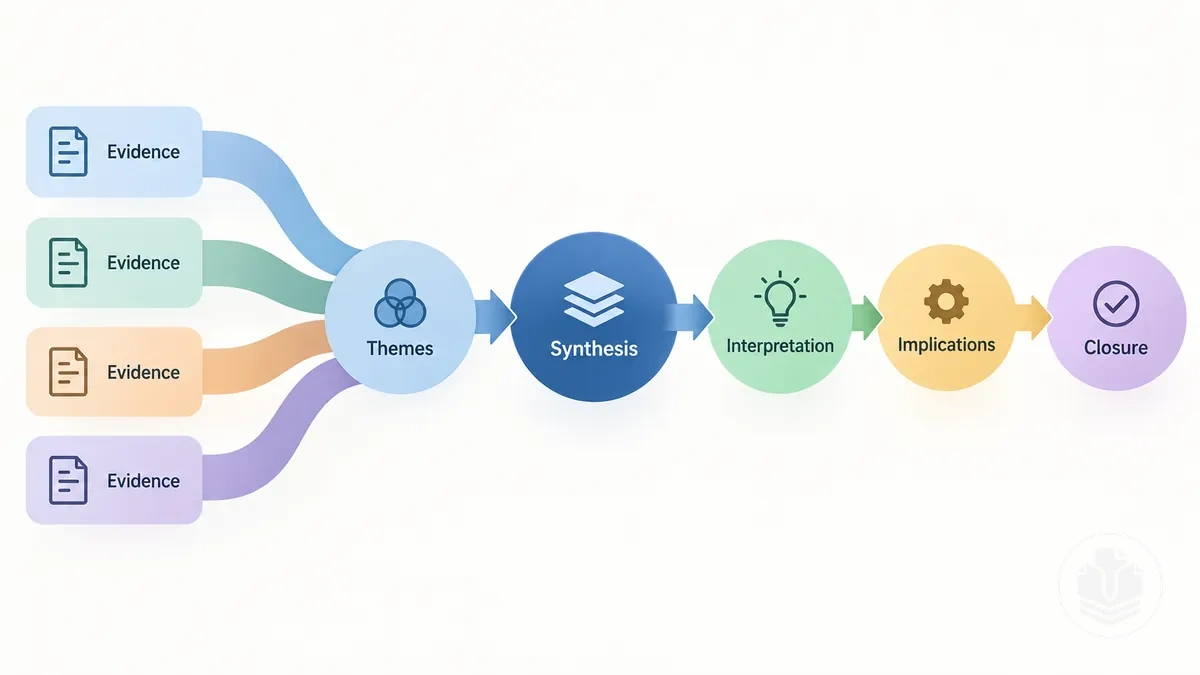
The conclusion works from existing evidence, bringing related patterns into a final synthesis rather than merely repeating earlier sentences.
It can identify implications or remaining gaps when those points are supported by the reviewed evidence, while keeping them connected to the review's findings and interpretation.
This consolidation provides closure by showing what the literature collectively indicates within the review focus.
The conclusion therefore closes the developed evidentiary path rather than opening a new one.
How to Write a Literature Review Introduction
Write a literature review introduction by moving from broad context toward a specific review focus, scope, and organising logic.
Establish the topic and its significance first, then narrow the discussion so the reader understands what literature the review will examine and where its boundaries lie.
The introduction should also signal the main themes or organising logic that will guide the body.
The exact emphasis and amount of each element can vary with the assignment and review design, so this progression is a practical model rather than a fixed formula.
The progression connects context with increasingly specific decisions about the review.
It separates material that establishes the topic and its significance from material that defines the review focus and scope, while showing how those elements prepare the reader for what follows.
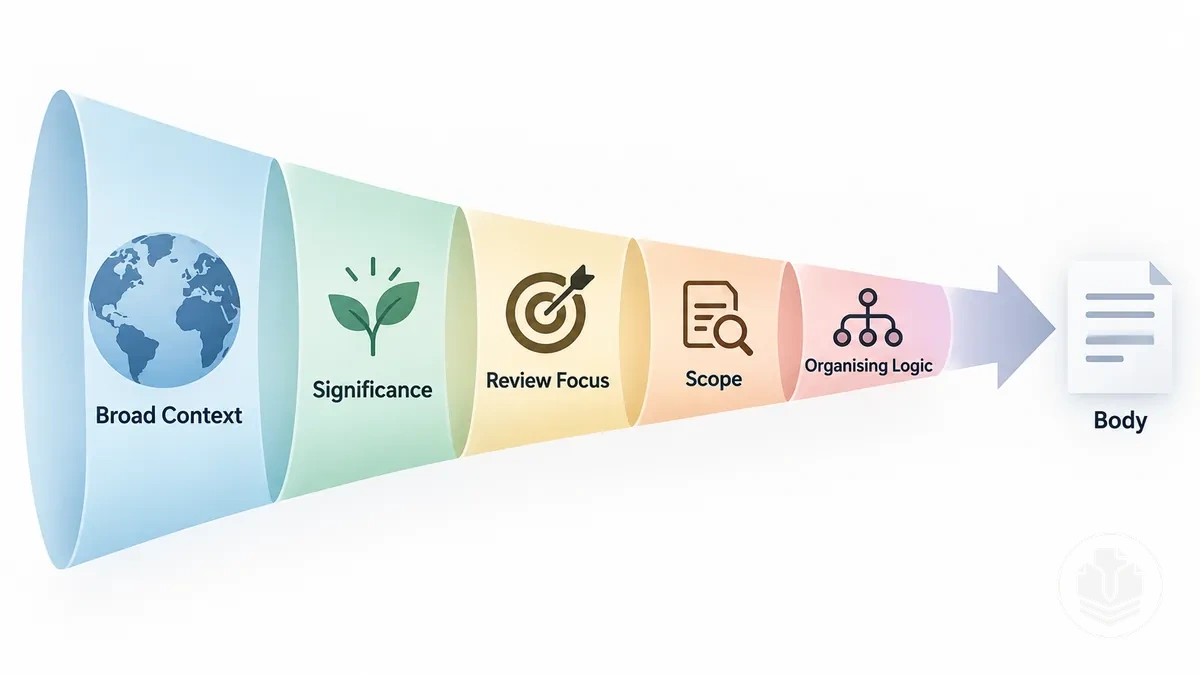
- Establish the broad context: introduce the topic in enough context for the reader to understand the area of literature being reviewed.
- Explain the significance: identify why the topic is relevant to the review so the discussion has a clear reason for narrowing further.
- Define the review focus and scope: specify the aspect of the topic the review examines and frame the boundary that keeps the discussion focused.
- Signal the organising logic: preview the main themes or other organising principle so the reader can anticipate how the body will develop the review.
- Check readiness for the body: confirm that the introduction has moved from broad context to a sufficiently specific focus, scope, and preview for the body to begin.
The organising logic should connect the introduction directly to the body rather than add another layer of background.
A thematic review, for example, can preview its main themes without summarising the literature that belongs under each theme.
By the end of the introduction, the reader should know the review focus, its relevant scope, and the logic that will organise the discussion that follows.
Open With the Topic and Its Significance
Open the literature review introduction by identifying the topic and establishing a credible reason it warrants review.
Give enough context for the reader to understand the subject area, then connect its significance to academic or practical relevance within the field.
Support that significance with the available evidence or established field context rather than relying on a vague claim that the topic is simply important.
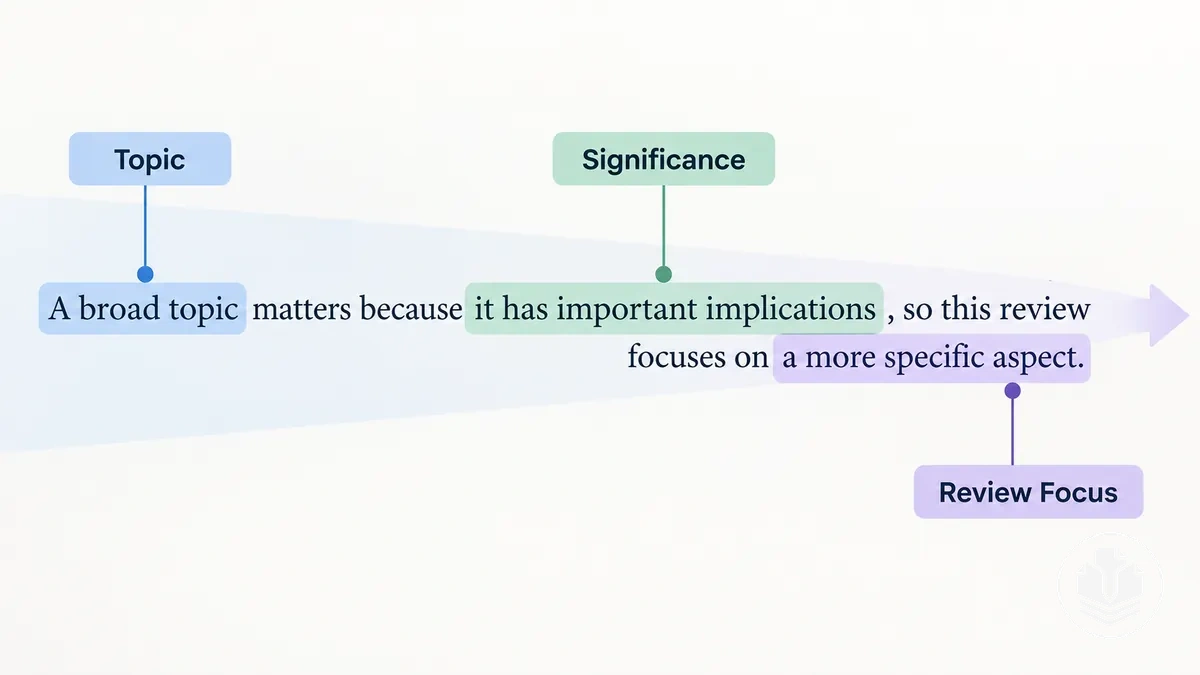
The significance of a review topic should remain proportionate to what the evidence and field context can support.
For example, an opening might identify a topic, state the specific academic or practical relevance that creates a reason to examine the literature, and then narrow toward what the review will investigate.
This approach connects topic, context, and relevance without inflated claims or unnecessary background.
The opening can then move toward the review focus without beginning the separate task of defining its scope.
Narrow to the Review Focus and Scope
Narrow the review focus and scope by defining which literature falls inside the review and which literature falls outside it.
Scope turns a broad topic into the specific body of literature the review will cover by setting explicit inclusion and exclusion boundaries.
The relevant boundaries depend on the review and may concern a population, concept, period, geography, evidence type, or a combination of these dimensions.
Apply only the dimensions that materially affect the review's coverage.
Each scope dimension should make its effect on inclusion or exclusion clear.
The dimensions below illustrate common ways to control review coverage without treating every criterion as mandatory:
- Population: include literature about the population relevant to the review focus and exclude populations outside that boundary.
- Concept: include literature addressing the concept being reviewed and exclude adjacent concepts that would broaden the discussion beyond its intended focus.
- Period: limit coverage to a defined period when time materially affects which literature belongs in the review.
- Geography: include or exclude literature by location when geographic context is relevant to the review focus.
- Evidence type: delimit the kinds of evidence covered when particular forms of literature are relevant to the review's purpose.
A broad topic becomes workable when these boundaries specify what the review will and will not cover, rather than attempting to include every related source.
For example, a review of a broad educational topic could narrow to one population and one concept within a relevant period, leaving other populations or adjacent concepts outside its coverage.
When more detailed boundary decisions are needed, the next task is to define the review scope without turning the introduction itself into a search-strategy or inclusion-method section.
Preview the Organising Logic and Main Themes
The introduction should preview the organising logic used to structure the body without reproducing the body as a list.
It should signal the main themes or analytical categories that will group the reviewed literature and orient the reader to how the discussion will develop.
This signposting creates clear expectations about the review's organisation while keeping the focus on synthesis rather than individual sources.
Preview the logic, not the contents list
Use analytical signposting
If the body follows a genuine sequence, preview that order. If it is thematic or categorical, name the grouping and the relationship that connects the discussion.
Avoid mechanical listing
Do not simply enumerate authors, section titles, or themes without explaining the organising relationship among them.
How to Write a Literature Review Conclusion
Write a literature review conclusion by moving from the main patterns in the existing evidence toward synthesis, interpretation, and closure.
The conclusion should work only with findings already developed in the review, drawing agreements, disagreements, and recurring patterns into a higher-level overall finding.
Its purpose is to interpret what those synthesised findings mean within the review rather than introduce a new argument or evidentiary direction.
A synthesis differs from a source-by-source recap because it combines related findings across the reviewed literature instead of repeating what each individual source said.
The sequence below models a synthesis-to-closure progression rather than a rigid paragraph formula.
Each action should remain tied to evidence already discussed in the body.
- Identify the main patterns: bring together the findings, agreements, disagreements, or recurring relationships that emerged across the reviewed evidence.
- Synthesise the findings: combine those patterns into an overall finding that represents what the literature collectively shows rather than restating individual sources.
- Interpret the synthesis: explain the significance of the overall finding within the review focus, while keeping the interpretation consistent with the evidence already analysed.
- Connect supported gaps or implications: identify gaps, implications, limitations, or future research directions only when they follow from the reviewed evidence.
- Verify closure: check that the conclusion closes the review without introducing evidence, claims, or arguments that were not previously established.
Gaps and implications should remain conditional on what the synthesis supports rather than appearing because every conclusion is expected to contain them.
Where the findings justify them, they can clarify what remains unresolved or what the overall interpretation implies for the field.
The conclusion should end by bringing the established findings and interpretation into a final synthesis that closes the review without creating a new evidentiary path.
Summarise the Main Patterns and Findings
The conclusion should carry forward only the major patterns and findings that materially answer the review focus.
Prioritise agreements, disagreements, trends, and recurring relationships that emerge across the evidence rather than repeating individual studies.
The aim is concise synthesis: group related findings according to their relevance to the review focus and give the most important patterns the greatest emphasis.
What belongs in the final pattern summary
- Pattern status
- Describe a pattern as convergent when the evidence broadly aligns, or as mixed when important disagreements or contextual differences remain.
- Meaningful variation
- Preserve differences by context, method, population, or evidence quality when they change the strength or scope of the synthesis.
- Detail boundary
- Leave out minor or source-specific details unless they materially change the overall synthesis.
Explain What the Synthesis Shows and Why It Matters
The synthesis should explain what the combined patterns mean in relation to the review focus, not simply restate what the literature reported.
Move from evidence to meaning
- Identify the pattern. Note where the literature converges and where findings diverge.
- Interpret it. Explain what that pattern suggests in relation to the review focus rather than merely restating what individual studies reported.
- Preserve the boundary. Keep differences in context, method, population, and other relevant limitations visible when they affect the interpretation.
- State only supported implications. Keep the implication traceable to evidence already discussed rather than extending into unsupported claims or recommendations.
State Remaining Gaps or Implications When They Follow From the Review
A gap or implication belongs in the conclusion only when it follows from the reviewed evidence and remains relevant to the review focus.
The observed state of the literature should come first, followed by the unresolved element or limitation and then the bounded inference that the evidence supports.
A gap should not be manufactured simply to make the conclusion appear more novel.
Match the inference to the evidence state
Mixed evidence
The issue may remain unresolved under particular contexts or methods. Mixed findings do not by themselves show that no research exists.
Sparse evidence
The question may be underexamined. Avoid turning limited coverage into a stronger claim of complete absence.
Methodological limits
Reduce the confidence or scope of the implication when study design or evidence quality limits what can be concluded.
These conclusion-level observations can point toward research gaps, but the inference should remain limited to what the synthesised evidence actually supports.
Close Without Introducing New Evidence or Arguments
The final conclusion sentence should reinforce the final synthesis and provide closure without adding a new evidentiary path.
Final-sentence boundary
Appropriate closure
Restate the established interpretation at a higher level, emphasise significance already demonstrated, and reinforce what the reviewed evidence collectively indicates within the review focus.
New material to avoid
Do not add new evidence, a new argument, an unsupported recommendation, or a theoretical explanation that the body did not examine.
How to Connect the Introduction and Conclusion
The introduction and conclusion should preserve the same review focus while performing opposite framing jobs.
The introduction frames the topic, scope, organising logic, and analytical focus that the review will develop, while the conclusion resolves that frame through synthesis of the reviewed evidence.
Their connection depends on functional correspondence and continuity rather than repeated wording.
A useful directional pattern is for the introduction to narrow from broader context toward the review focus, while the conclusion moves from synthesised findings toward their broader significance, although individual reviews may organize this movement differently.
The opening frame should therefore correspond to what the closing resolution actually delivers.
A focus established in the introduction should remain the focus of the conclusion; the scope should continue to bound the claims; and the organising logic should support the analytical focus from which the final synthesis is drawn.
If the conclusion changes the topic, extends beyond the established scope, or resolves a different analytical question, that correspondence is lost.
Alignment means that the conclusion answers the expectations created by the introduction without copying its wording.
For example, if an introduction frames a review around how a defined body of literature explains a particular issue, the conclusion should synthesise what that reviewed evidence collectively shows about the same issue and its significance.
The wording can change because the opening previews the analytical task and the closing states its evidence-based resolution.
The connection comes from corresponding functions across the review, not repeated phrasing.
Keep the Review Focus and Scope Consistent
The conclusion must answer the same review focus and remain within the same scope boundaries established in the introduction.
The topic and analytical emphasis should remain stable, while relevant boundaries such as population, concept, period, or evidence coverage should continue to limit what the conclusion claims.
A change in wording is acceptable; a substantive shift in focus or boundary is scope drift.
Continuity check before you finish
- Review focus: does the conclusion answer the same analytical focus introduced at the start?
- Population or concept: has either broadened or narrowed beyond the stated scope?
- Period and evidence boundary: do the same limits still constrain the closing claims?
- Analytical emphasis: does the final synthesis resolve the question the body actually developed?
Scope drift occurs when the conclusion makes a substantively broader or different claim than the introduction allowed. Correct it by limiting the closing claim to the population, concept, period, and evidence actually covered.